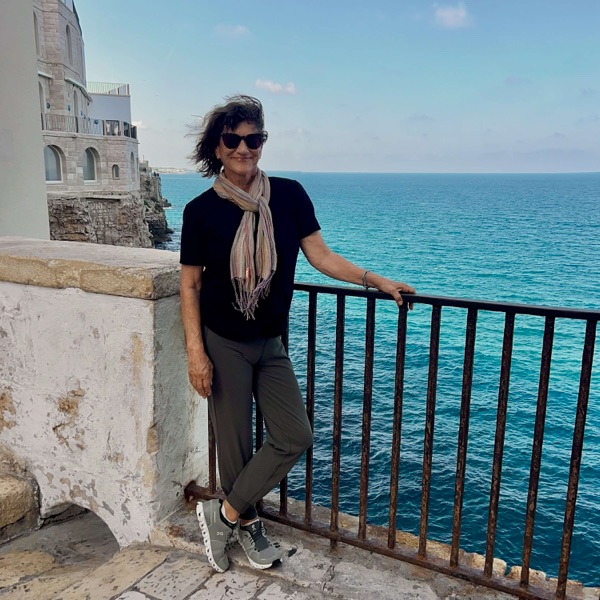
Most of us have been to Paris, Peter Murphy Lewis tells Marilyn Ball, and most of us cannot say when the Eiffel Tower was built. What he remembers is the waiter who flirted with his wife, the waitress who poured an extra glass of wine, and the cafe they sat in. That one observation is the whole operating theory behind the travel company he built in South America, and it is why he now spends his time making documentaries.
Marilyn Ball hosts Speaking of Travel, and she comes at this as a travel interviewer rather than a business one, which is what makes the episode useful. She keeps pulling the conversation back to people: how a boy from a Kansas town of 2,000 ended up living in Chile, how he made a company out of walking tours, and what he did after it went away.
So the episode turns into a career told through one idea. Lewis explains how he trained guides to introduce themselves rather than introduce monuments, how that company reached four cities before civil unrest ended it, and how the same instinct now shows up in films about certified nursing assistants, a pygmy hippo and a bank. It is a travel interview that ends up being about what makes a story worth keeping. For how we put this into practice, see our page on attractions and tourism marketing.
Key Takeaways
1. Travelers Remember the Waiter, Not the Monument
Lewis describes what he built as an immersion travel agency, and he built it against the standard model on purpose: anti-bus, pro walking, biking and markets. He trained guides to talk about themselves as people instead of presenting cities as monuments. Paris is his test case. “I don’t remember when the Eiffel Tower was built, but I can tell you about the beautiful waiter that flirted with my wife,” he says. He remembers the extra glass of wine, the chocolates, the cafe. The history left. The people stayed, and so did the reason to recommend the trip.
2. Retention Was the Growth Plan, Not Outside Money
About two years in he realized he liked going to work more than anything else, and wanted a team he would choose as friends. Growth then meant a specific thing: no outside investor, no selling a piece of the company, and staff he could keep year round through the seasonality. He says on the episode that the business reached roughly 35 full-time and 15 part-time people across four cities and hit seven figures fairly quickly. The part he values now is not the revenue. It is the colleagues who “felt like first cousins to me.”
3. One Industry in One Country Was the Real Risk
The company survived an earthquake that erased six months of bookings and a bird-flu-style scare that kept visitors home. What finished it was civil unrest in Chile. Thirty subway stations burned in a single night, he says, and within ten days he told his business partner they should lay everyone off and close. The postcard he would send his younger self is a business note first: “don’t put all of your eggs in one basket.” Travel rises and falls with what a country is doing economically and politically, and none of that was his to control.
4. Reinvention Started by Deleting a Belief, Not by Making a Plan
He flew back to Kansas at 40 with a three-year-old and moved into his parents’ basement, 26 years after leaving home at 14. He lost the labels of founder and CEO, and describes deep depression and some PTSD. The turn came roughly six months into a job as chief strategy officer at a zoo, sitting with a coach who was walking him through what was blocking him. He had been carrying a quiet assumption. “I think people who make money are unhappy,” he told the coach. Seeing that it was not a fact was the moment things moved.
5. The Best Documentary Subjects Are the Ones Nobody Would Pick
Documentaries are now one of his three jobs, alongside consulting and board work. He mentions five in the healthcare space in the past year, plus a film about a pygmy hippo and one about a bank, and the common thread is deliberately unglamorous subject matter. His first series followed certified nursing assistants, three seasons and 22 episodes, with two more seasons due. “Most people probably don’t think that they’d ever want to learn anything about CNAs,” he says, before noting that it was accepted by Apple TV, Hulu and Amazon. Curiosity, in his definition, is finding the extraordinary in the ordinary.
6. Follow Your Passion Is the Advice He Would Rewrite
Asked for bad advice he actually took, he names the most repeated line in entrepreneurship. Following your passion, he argues, can be a poor financial decision for you and your family. He loved travel and built a travel business; he also ran marathons and sensibly built nothing around those. The travel company ran 365 days a year, and more money meant more people, which meant more stress. His revision is small and load-bearing: “follow your passion that makes money,” and specifically a passion that buys back time with the people you started it for.
Rapid Fire Q&A
Q: How would you define an outside the box thinker?
A: Someone drawn to problems, puzzles and logic, who looks for an unusual route to the answer. That might mean learning from another industry, asking an uncommon expert, or asking a stranger in a park, rather than going back to the same book every time.
Q: How did you adjust to living in Chile?
A: Badly at first. He thought his Spanish was strong after social work with a Latino population in Boston, but the Chilean accent beat him, so he recorded his three-hour university lectures and listened again afterwards. He also boarded a bus going the wrong way and lost the return hour to the driver’s lunch.
Q: What would you write on a postcard to your younger self?
A: Two things. Do not concentrate everything in one industry in one country. And remember that the success came from resilience and being agile, so tomorrow is survivable: you have run this marathon before, and you have placed on the podium.
Q: What does curiosity actually mean to you?
A: He declines the definition and offers the feeling instead: finding the extraordinary in the ordinary. He wants the sky and the clouds to look new every morning, and says he feels like a two-year-old every time he gets on a plane, or mows the yard.
Q: How do you switch back to a better attitude when life is hard?
A: His mother’s line, which he has tattooed, is that the only thing you can control is your attitude. His method is stranger: an app called We Croak sends him a random quote about death, and being reminded he is small makes a hug from his son count for more.
What This Means for Travel and Hospitality Brands
The transferable idea here is casting. Most travel marketing sells the asset: the monument, the pool, the itinerary, the drone shot. Lewis built a company on the opposite bet, that the guide is the product and the itinerary is only the excuse. If the thing a guest will still be describing in five years is a person, then the marketing should introduce people, and the photography and the copy should be built around faces rather than facades.
That is a content decision with an operations tail. Guides who can talk about themselves have to be recruited, trained and kept, which is exactly why his growth plan was retention rather than investment. For an operator, that collapses two budgets into one. The footage you shoot to attract guests is the same footage that attracts and keeps staff, and the only version of it you cannot buy back later is the one you shoot while your best people are still with you.
His argument that unglamorous subjects make the strongest films is the part worth borrowing wholesale. Nobody expected a series about certified nursing assistants to be watchable, and the People Worth Caring About docuseries is the evidence he keeps returning to. The equivalent in travel is not the sunset. It is the driver, the kitchen at 6am, the guide who has walked the same street for eleven years and still notices things.
You do not need a series to begin. One filmed conversation with a long-serving guide or a founder telling the story straight gives you something a competitor cannot generate, which is what brand story video production exists to produce. And take the concentration warning with it: he lost a seven-figure business because it depended on one industry in one country, so spread your demand across markets and channels before you have to.
Listen to the Full Episode
The full conversation is “Where Storytelling Meets The Journey With Peter Murphy Lewis” on Speaking of Travel with Marilyn Ball, published on 16 November 2025. Marilyn Ball asks the questions Peter says he has never been asked before, and the second half, on collapse, the basement, the zoo and the coach, is the part worth hearing whole. Listen to the full episode on Speaking of Travel.