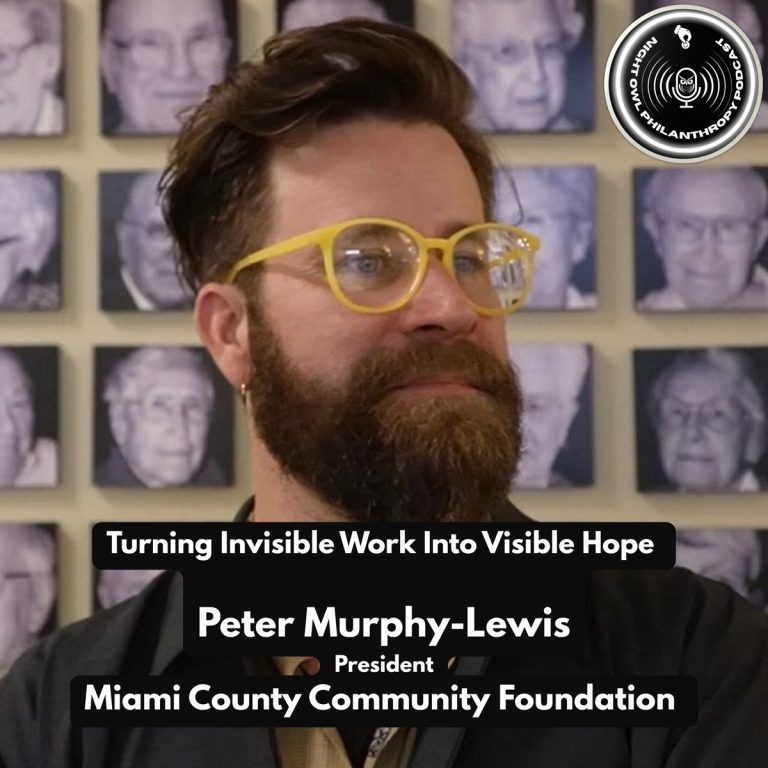
Peter Murphy Lewis describes his why in one sentence: making people care about missions they otherwise would not, through storytelling. On episode 21 of Night Owl Philanthropy Podcast: What Is Your Why?, host Dean Jones spends an hour testing what that means when the mission is a small community foundation in rural Kansas rather than a brand with a marketing budget.
Peter is president of the board of the Miami County Community Foundation, which has served the towns about an hour south of Kansas City since 2007. He came back to the county after years running a travel company and hosting television in South America, and the episode traces how that path shaped the way he thinks about storytelling for social impact: who a story is really for, why authentic beats polished, and how a foundation becomes visible without making itself the hero.
The conversation runs from a documentary he filmed about his own father to a pen bought at Walmart, and it ends with a framework anyone can use to tell their own story in a few minutes.
Key Takeaways
1. The first audience for a story is the community telling it
Most people think about story as outbound: who you are talking to and how they see you. Peter argues there is a second side to the coin, the story a person or a place tells itself. He learned it personally when three marathons were cancelled on him in a row and he started believing he had lost his value. Watching The Last Dance changed that internal story, and he signed up again before his fortieth birthday. Communities work the same way. When he hosted television in South America, audiences loved hearing an outsider tell them their work mattered. In Miami County, he says, people often assume the grass is greener elsewhere, and sometimes the story needs to be told to the people who already live there.
2. Story adds value people can feel, and value they can price
Peter’s favorite illustration from his keynotes is a cheap pen. Ask an audience what it is worth and they offer about half its store price. Tell them it was their grandfather’s pen from World War II, found at a flea market, and the bids jump to hundreds of dollars. Same object, different story. His point is that story is not marketing fluff. It explains who you are to outsiders and insiders alike, and it changes what people are willing to give. He makes the same case about American team mascots, which his wife, who is from South America, once asked him to explain: they are about identity and belonging, superficial or not.
3. A local foundation’s edge is speed and proximity
Asked what a community foundation can do that larger philanthropy cannot, Peter names two things. It can spot problems before they become serious, and it can move quickly on new needs, from mental health and suicide prevention to veterans’ housing, shelters and food banks. He describes a board call where a larger funder asked questions it could not answer from a distance, and local board members immediately named the pressures: inflation, housing, transportation, heating, water. A small board can also reach the entrepreneur who will never volunteer for a committee but wants to see their community thrive.
4. Hope has to be louder than the scroll
Peter sits on the board of a community bank his family has long been involved with, where every employee is expected to volunteer. His warning to institutions like that is blunt: if they are too humble to share the good they do, they risk disappearing. In a feed built on negativity and clickbait, he says, you have to be loud, understand the algorithms and be a cheerleader for the good people around you. That is how a foundation builds hope in places that feel overlooked.
5. Human, not Hollywood
The first season of Peter’s docuseries People Worth Caring About, made to help with the workforce shortage in long-term care, was shot on a phone. A leader who backed the project summed it up as human, not Hollywood, and Peter credits that rawness for opening minds. His test for dignity when filming vulnerable people is a gut check: by the end, do you understand the person, feel more connected, and leave with something you can act on? A story about trauma should not stop at the dark part. It should hand the viewer a way to make things better.
6. Radical visibility means people can feel the work before anyone explains it
Peter’s idea of radical visibility is that people should sense a mission is working without being told who is behind it. He points to a viewer named Rosalie who binge-watched all seven episodes of People Worth Caring About and wrote that it changed her view of long-term care completely, and to a participating organization that now has a line of volunteers after using its episode in recruiting. Neither episode asked for either outcome. The story did the work.
Rapid Fire Q&A
Q: Why did Peter move back to Kansas?
A: Civil unrest in the country where he lived with his wife and three-year-old son forced him to close his company and leave in a hurry. His first job back was as a marketing consultant at a wildlife park, which came with housing, so he moved into a zoo, and still lives there.
Q: What does he actually do as president of the foundation?
A: He describes himself as a marketing facilitator. Executive director Tammy runs execution with teammate Carrie, and Peter plugs in interns from his consultancy to help with newsletters, LinkedIn, video and the foundation’s Google Ad Grant.
Q: Why does he put himself on camera in his documentaries?
A: Because he is comfortable being the least informed person in the room. Viewers get defensive if a film tells them they are ignorant, he says, but they will follow someone on a journey from ignorant to informed. He credits his father, who taught him to hire people smarter than himself.
Q: What does success look like for the foundation?
A: That it would keep thriving if every board member disappeared tomorrow. He compares it to parenting his ten-year-old son: the job is to make sure the child can be happy and contribute without you.
Q: Early bird or night owl, tea or coffee?
A: Early bird, at his computer by 5 a.m. Coffee, definitely. The book he has gifted most is The Five Love Languages.
What This Means for Community Foundations and Nonprofit Leaders
The most practical part of the episode is the framework Peter closes with, the same one he teaches healthcare workers who are uncomfortable talking about themselves. Think of someone who changed how you see the world. Pick one specific moment with them. Describe who you were before it and who you were after. That before and after usually explains your why, and you have told it by talking about someone else. It is storytelling for social impact at its simplest.
He models it on the show. As a boy, he rode with his father to deliver holiday plates to Alonzo, an older friend from his father’s summer job who lived alone in a small trailer. He remembers the cigarette smoke, the turkey and the look in his father’s eyes. That moment, he says, is why he serves the foundation: to keep the small-town values his father showed him. It takes under a minute to tell and it is impossible to forget, which is the point.
For foundation boards, the lesson is to stop leading with global, altruistic impact. Not everyone is wired to be altruistic, Peter says, so start with what is in it for the person hearing the story, and give them an individual to care about rather than an issue to agree with. On polarizing topics, he argues, people change their minds when there is a neighbor’s story next to the issue. If you are weighing whether your organization is ready to put those stories on camera, our guide to nonprofit storytelling and being ready to be filmed walks through the questions to answer first.
Finally, give credit away. Peter filmed a documentary about his own father, a community banker, that will not be shown until his funeral, because his father, a humble man, would only agree if nobody saw it while he was alive. The film exists for the next generation. Stories like that are why Strategic Pete builds nonprofit video production around the people doing the work rather than the executives describing it.
Listen to the Full Episode
This conversation is episode 21 of Night Owl Philanthropy Podcast: What Is Your Why?, hosted by Dean Jones and published on 16 October 2026 under the title “Turning Invisible Work Into Visible Hope.” Peter also talks about living in a zoo, coming home from Chile, and why rural Kansas families want the same mentors and neighbors he grew up with. Listen on Apple Podcasts or watch the full episode on YouTube.