
At a glance
The problem
A training company relied on paid ads, ran overlapping CRMs and had no nurture sequence, so leads went cold.
The approach
An audit of materials, sales calls and workflows, then prioritised fixes: unified tracking, clearer messaging and automated nurture.
The plan
A three-month roadmap: lay the foundation, build nurture and reach, then refine and scale.
Introduction
Every business has its unique challenges, but for one professional training company (let’s call them “the Client”), a marketing audit quickly revealed some all-too-familiar hurdles: a heavy reliance on paid ads without proper attribution, inconsistent product messaging that left prospective buyers confused, and a lack of structured follow-up content to keep new leads engaged.
Furthermore, their CRM wasn’t fully structured and presented opportunities for improvement, further complicating their efforts to nurture leads effectively. Despite having invested in multiple marketing tools and previously hired external agencies, the Client still saw gaps in their lead funnel and growth trajectory.
Marketing Audit Explained
A marketing audit is a systematic, objective review of an organization’s marketing efforts, designed to assess the accuracy, relevance, and effectiveness of its marketing systems. Unlike a planning process, which focuses on strategizing future actions, a marketing audit evaluates whether existing strategies, tactics, and systems align with established processes and best practices.
It’s easy to confuse a marketing audit with a marketing analysis or assessment, but each serves a distinct purpose. A marketing audit focuses on verifying facts, processes, and outcomes to ensure that best practices are followed and documented strategies are properly executed. It is objective and methodical, centered on evaluating conformity and performance.
On the other hand, a marketing analysis dives deeper into specific components of marketing efforts to understand how they work together, such as through environmental or gap analysis.
Meanwhile, a marketing assessment takes a broader approach, combining analysis, evaluation, and actionable recommendations to measure where marketing efforts fall short of benchmarks and objectives.
Enter Strategic Pete. Drawing on deep expertise in auditing and optimizing B2B funnels, our team collaborated with the Client to conduct a holistic review of their processes, from website content to sales-call transcripts.
So, how would the client benefit from a marketing audit from Strategic Pete?
- Bird’s-eye view of their current marketing efforts: This would allow them to step back from day-to-day tasks and evaluate the bigger picture, enabling the client to gain clarity on where they stand and where adjustments are needed to stay competitive.
- Pinpoint what’s working and what’s not: A Strategic Pete marketing audit highlights high-performing strategies and uncovers areas where campaigns are underperforming, enabling the client to allocate budgets more effectively
- Alignment and clarity to in-house teams: This is especially important, as by reducing miscommunication and setting clear expectations, businesses can unite their teams around common goals and prevent duplicated efforts.
- Understanding how different campaigns work together: A marketing audit reveals synergies between efforts, such as repurposing content across multiple platforms, and identifies opportunities to integrate strategies for stronger results.

We discovered overlapping CRM systems causing messy workflows, inconsistent reporting dashboards, and minimal nurturing efforts to guide prospects from initial interest to purchase.
By refocusing on foundational elements—clearer messaging, robust tracking and reporting, and a multi-stage nurture sequence—we helped the Client transform their scattershot marketing approach into a cohesive, high-performing growth engine.
Client Background: Why They Needed a Marketing Audit
For many businesses, improving communication skills amongst teams (internally and externally) can be a daunting path—one often overlooked in favor of more tangible business objectives like sales or operations.
Our client recognized this market gap and built a thriving training company to address it. Specializing in corporate workshops and coaching programs, they’ve long been passionate about helping teams and leaders communicate effectively to achieve sustainable growth.
Despite a forward-thinking mindset, they faced significant roadblocks. Their long-standing reliance on paid ads drove some initial success, but they quickly hit a plateau. Prospective customers struggled to understand exactly what services were on offer, and confusion often stemmed from inconsistent branding and scattered marketing efforts.
The client relied on multiple CRMs with overlapping functions, which led to duplicate data entries and misaligned messaging. While they had some automation in place, the system wasn’t very efficient—leaving room for improvement with automated lead nurturing, cleaned workflows, and better integration across tools. Meanwhile, the absence of a robust email nurture or follow-up process meant potentially interested leads still slipped through the cracks.
When they came to Strategic Pete, they were looking for a cohesive strategy—one that would unify their brand messaging, build an efficient lead funnel, and streamline all the various marketing elements and tools they’d been juggling. Our mandate was clear: help them move beyond quick fixes and establish a stable, scalable foundation for long-term success.
The Audit & Analysis Process
The first step in our engagement was a thorough investigation of the client’s existing marketing ecosystem. While they had numerous tools and processes in place—from Google Ads and landing pages to social media profiles and a patchwork of CRMs—they lacked a cohesive framework that tied it all together. Our goal was to uncover pain points at each stage of their funnel and prescribe clear, data-backed solutions.
A. Data Collection
- Review of Existing Materials
We compiled and examined all available assets, including past ad campaigns, web pages, social media posts, and sales collateral. By understanding where their messaging was being deployed, we could pinpoint gaps in consistency and clarity. - Sales Call Transcripts & Recordings
To capture the real voice of the customer, we listened to call recordings and read through transcripts. Recurring questions, misunderstandings about the company’s core offering, and hesitations surfaced repeatedly—revealing pivotal opportunities to adjust both messaging and lead nurture tactics. - CRM & Workflow Review
The client’s use of multiple platforms—HubSpot, GoHighLevel, and an older in-house tool—created data overlap and redundancies. We audited each system to identify missing fields, duplicated contacts, and fragmented workflows that led to inconsistent follow-up.
B. Key Findings
- Gaps in PPC Campaign Funnels
A review of their paid campaigns showed minimal retargeting and no tailored landing pages or video content to re-engage visitors. This one-size-fits-all approach contributed to high CPC (cost per click) and missed opportunities for recapturing leads. - Product Messaging Gaps
Prospects visiting the client’s website or social media profiles were often unclear about the company’s core offerings. “Communication training” remained a broad, catch-all term. We discovered a pressing need for more specific, benefit-focused language, especially for higher-level decision-makers in corporate environments. - Lack of Nurture & Follow-Up
The absence of automated email workflows and middle-of-funnel content meant potential leads were left hanging after a single touchpoint. Our research showed that many visitors needed multiple, targeted interactions before they felt confident scheduling a call or making a purchase decision. - Misaligned Tracking & Reporting
Because the client did not have a unified dashboard, it was nearly impossible for them to see which channels were driving conversions. Some leads were documented in one CRM but not another, and nobody had a clear picture of conversion ratios at each stage of the funnel.
From this comprehensive audit, it became clear that an aligned, data-driven approach—grounded in consistent messaging and supported by robust follow-up sequences—would be critical to accelerating both the volume and quality of the client’s leads.
Strategic Recommendations
Our audit revealed key gaps in messaging, lead nurturing, and CRM functionality, so Strategic Pete compiled a set of prioritized recommendations. Our approach aimed to balance immediate fixes (essential for quick wins and establishing a solid foundation) and long-term growth strategies (to generate ongoing results and scalability).
1. Immediate Priorities
Establish Unified Tracking & Reporting
- Centralized Dashboards: We proposed integrating data from all CRMs into a single reporting platform, ensuring that every lead and its journey through the funnel could be tracked in real-time.
- Workflow Consolidation: Cleaning up overlapping systems (HubSpot, GoHighLevel, etc.) would reduce confusion, eliminate redundant efforts, and provide a clear picture of which marketing activities were driving results.
Strengthen Product Messaging
- Benefit-Focused Content: Since many potential clients didn’t fully understand the training services, our first move was to clarify the offerings. We drafted clear, succinct copy that articulated the specific benefits—such as improved team alignment, more efficient communication, and stronger leadership competencies.
- Consistent Brand Voice: We recommended standardizing language across the website, social media channels, and sales scripts. This helps prospects quickly connect the dots from initial ad impressions to final sales conversations.
Implement a Multi-Step Nurture Sequence
- Email Automation: To prevent leads from slipping away, we built an email series that introduced the client’s services, offered social proof (case studies, testimonials), and addressed common FAQs.
- Content for Different Funnel Stages: We suggested creating short videos, blog articles, or infographics targeting top-of-funnel (awareness), mid-funnel (education), and bottom-of-funnel (decision) prospects. Each piece would speak directly to their level of understanding and pain points.
2. Growth Roadmap
Expand Top-of-Funnel Initiatives
- Webinars & Lead Magnets: We encouraged hosting monthly or quarterly webinars tackling communication challenges, enabling the client to capture fresh leads interested in training solutions.
- Diversified Ad Channels: Beyond Google Ads, we proposed experimenting with LinkedIn and Facebook retargeting. Leveraging more channels could mitigate risk if one paid channel underperforms.
Bold, Persona-Aligned Content
- Controversial/Polarizing Ads: Since the client’s founders were comfortable with strong opinions and bold communication, we advised creating attention-grabbing ad campaigns that deliberately challenge the status quo and appeal to equally bold decision-makers in their audience.
- Distinctive Brand Personality: We outlined steps for reinforcing the brand’s unique voice, particularly on social media, to help it stand out in a crowded market.
Value Ladder Offerings
- Introductory “DIY” Product: We suggested a lower-priced workshop or online course for budget-conscious clients to complement their high-ticket packages. This ladder approach serves as an on-ramp, helping potential customers sample the training before committing to more expensive, in-depth programs.
- Upsell & Cross-Sell Strategy: Once a new client has engaged with the lower-tier offering, the client can upsell a more comprehensive solution—maximizing customer lifetime value.
By focusing on foundational alignment first—unified dashboards, consistent messaging, and automated follow-ups—our client could swiftly address glaring inefficiencies. In parallel, a deliberate growth roadmap gave them the structure and confidence to explore new channels, experiment with creative content, and ultimately scale sustainably for the long term.
Implementation & Collaboration
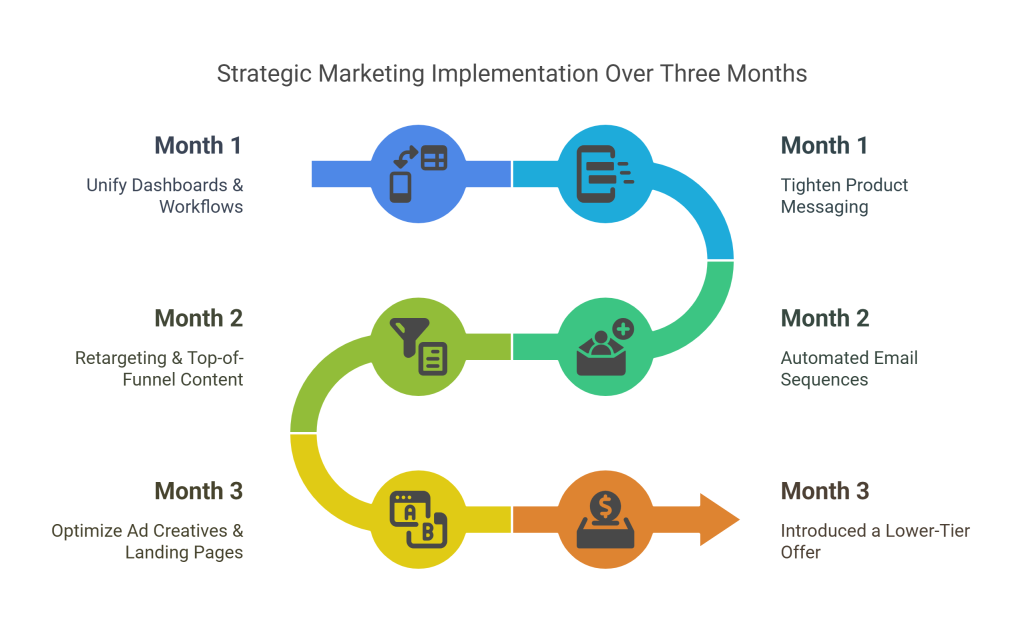
Month 1: Lay the Foundation
- Unify Dashboards & Workflows: We merged data from the client’s multiple CRMs (HubSpot, GoHighLevel, etc.) into a single reporting platform. This eliminated duplicated contact records and gave stakeholders a clear, real-time view of leads, conversions, and marketing performance.
- Tighten Product Messaging: Working with the branding team and key decision-makers, we refined the company’s unique value propositions and benefits into clear, compelling copy. We then rolled out these updates to the client’s website, landing pages, and sales call scripts.
Month 2: Build Nurture & Expand Reach
- Automated Email Sequences: We implemented an email nurture series designed to guide prospects from initial awareness to deeper engagement. Each sequence included carefully timed follow-ups, FAQs, and relevant case studies to build trust and address common hesitations.
- Retargeting & Top-of-Funnel Content: Collaborating with the client’s PPC agency, we set up segmented retargeting campaigns on LinkedIn and Facebook. At the same time, we began promoting thought leadership webinars that attracted fresh leads at the top of the funnel.
Month 3: Refine & Scale
- Optimize Ad Creatives & Landing Pages: Based on performance data, we ran A/B tests to tweak ad copy, visuals, and landing page layouts—maximizing click-through rates and conversions.
- Introduced a Lower-Tier Offer: We piloted an introductory workshop to capture budget-conscious prospects. Attendees who showed further interest were then given opportunities to upgrade to the client’s flagship training programs.
Strategic Pete also worked closely with the client’s external vendors to implement each recommendation. This hands-on, cross-functional approach ensured that no part of the marketing ecosystem was left behind in the transition.
- PPC Agency Collaboration: We communicated openly with the client’s existing PPC agency to ensure that new landing pages, creatives, and target audiences were properly integrated with ongoing campaigns. This collaborative dynamic allowed us to refine bids, keywords, and ad placements in real time.
- CRM & Data Cleanup: We consulted with CRM consultants who had previously worked on their systems, significantly reducing setup friction. Together, we designed a streamlined contact flow, ensuring leads were properly tagged, categorized, and funneled to the right nurture sequence without duplications or errors.
- Branding & Design Alignment: The client’s design partner played a key role in polishing visuals for webinars, email headers, and social media content. We provided creative direction on how to reflect the newly clarified messaging while the branding team ensured all materials stayed on-brand.
- Internal Team Empowerment: Strategic Pete held weekly check-ins with the client’s leadership and marketing teams throughout each phase. We provided training on using new dashboards, interpreting conversion metrics, and personalizing email sequences—equipping them with the confidence and know-how to manage their evolving marketing infrastructure.
FAQs
A. What are the components of a successful marketing audit?
A comprehensive marketing audit consists of six main components, each offering unique insights into the effectiveness of a business’s marketing efforts. The marketing environment audit examines external factors such as industry trends, competitive landscape, and customer behavior to assess how they impact the business. The marketing organization audit evaluates the structure, roles, and efficiency of the marketing team or external agencies. Next, the marketing strategy audit focuses on whether the overall strategy aligns with the company’s objectives, target audience, and competitive positioning. The marketing system audit reviews the tools, processes, and systems in place, ensuring they support smooth operations and accurate data tracking. The marketing productivity audit measures the ROI of campaigns, analyzing how resources like budget and time are being utilized. Finally, the marketing functionality audit assesses specific tactics, such as content creation, social media, or paid advertising, to determine their performance and alignment with the broader strategy. Together, these six components provide a holistic view of a business’s marketing health and offer actionable insights for improvement.
B. What Tools Can Help with a Marketing Audit?
Several tools are designed to make the marketing audit process efficient and insightful. Here are some recommendations:
- Google Analytics: Provides detailed website performance data, including traffic, user behavior, and conversions.
- SEMrush or Ahrefs: Useful for auditing your SEO performance, keyword rankings, backlinks, and competitive analysis.
- HubSpot: Offers tools to assess lead generation, email marketing, and CRM performance.
- Social Media Insights: Platforms like Facebook Insights, Instagram Analytics, and LinkedIn Analytics help measure social media engagement.
- Email Marketing Platforms: Use tools like Mailchimp or ActiveCampaign to analyze open rates, click-through rates, and campaign success.
- Canva Brand Kit: To ensure brand consistency, this tool helps you maintain visual uniformity across marketing materials.
- Audit Checklists: Platforms like Asana, Monday.com, Jotform Boards or Trello can help manage and track the audit process.
C. How Do Marketing Audits Differ from Marketing Assessments?
While both processes analyze marketing efforts, there are distinct differences between audits and assessments:
- Scope:
- Marketing Audits are comprehensive and cover all aspects of your marketing strategy, channels, and performance.
- Marketing Assessments are narrower, focusing on specific areas like branding, content, or a particular campaign.
- Purpose:
- Audits aim to provide a holistic view of your marketing performance and identify gaps or inefficiencies.
- Assessments are typically used to evaluate the potential or effectiveness of specific initiatives.
- Depth:
- Audits involve a deep dive into data, processes, and strategies to uncover strengths and weaknesses.
- Assessments are often more surface-level and quicker to conduct, serving as a checkpoint rather than a full evaluation.
- Frequency:
- Audits are usually conducted annually or biannually for strategic planning.
- Assessments can be done more frequently, often as part of campaign reviews or quarterly checks.
Both audits and assessments are valuable, but audits provide the foundation for long-term improvements, while assessments help with ongoing optimization.