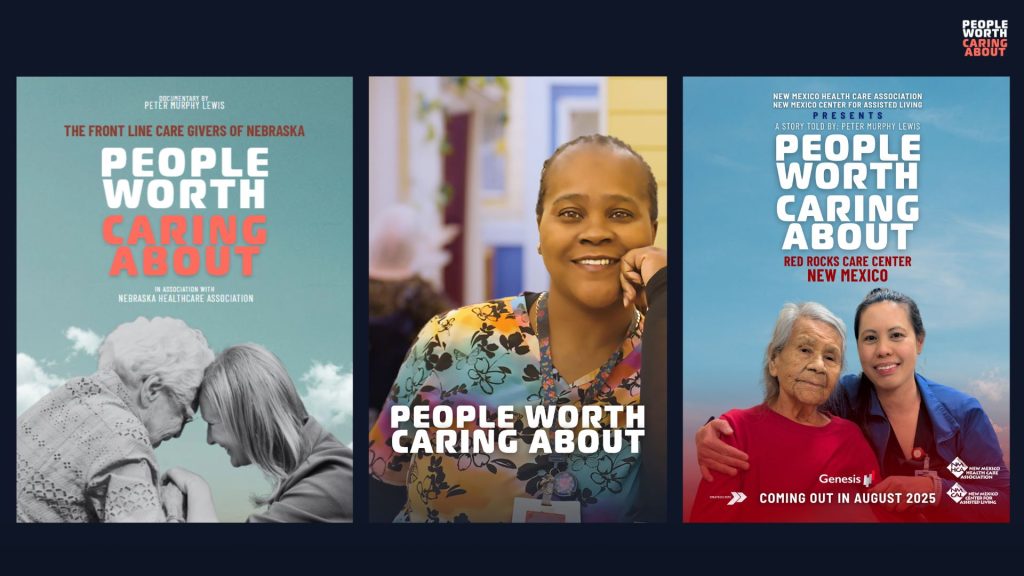
Every day across Nebraska, long-term care professionals show up for moments most people never see. They care for aging neighbors, listen to stories repeated with love, and carry responsibility that doesn’t end when the shift does.
Their work rarely makes headlines—but it shapes lives.
The Nebraska Healthcare Association chose to honor members who live this commitment every day.
-
- 1st state in the U.S. to premiere a long-form Long Term Care workforce documentary in a theater.
-
- Filmed over 2 weeks in April 2024.
-
- 7 Nebraska communities captured: Wakefield, Gothenburg, Auburn, Fremont, Lincoln, Omaha, and Broken Bow.
-
- 21 unscripted human stories, told without scripts or prompts.
-
- Representing 7 different ownership groups across facilities.
-
- Created by a 3-person crew: 1 Executive Director, 1 camera operator, and the Nebraska partner.
-
- Premiered October 24, 2024, at Nebraska’s largest historic theater.
-
- 3 seasons of People Worth Caring About are now streaming, with 3 more filming in April, May, and July 2026 (Florida, North Dakota, Texas).
-
- Honored with multiple state and national awards, including Bright Ideas and Prism Awards.
-
- Streaming nationwide on Apple TV, Amazon TV, Roku, and all major Smart TV platforms.
-
- Funded by the non-profit arm of the Nebraska Health Care Association.
-
- Built as evergreen content, repurposed across PR, social media, conventions, keynotes, education, legislation, and member engagement.
Introduction
It didn’t start with a script, a crew, or even a title. It started with a conversation between Jalene Carpenter and Peter about a world the public rarely sees. The original vision was almost daringly simple: strap a GoPro to Peter and just hit ‘record.’ No filters, no staging—just an honest look at the heartbeat of Long-Term Care. What began as a raw, unstructured experiment in truth-telling eventually blossomed into the documentary People Worth Caring About, a love letter to the Nebraska care community.
The assumption was simple: film a few stories, show young adults what caregiving involves, with the hope of inspiring some to pursue a career in long-term care.
But Nebraska realized this project could be something even bigger. When Jalene Carpenter and the Nebraska Health Care Association team said they were planning a full red-carpet theatrical premiere at the Rococo Theater and not a web upload, everything changed.
Caregivers weren’t just subjects anymore. They were the stars.
For documentarian Peter Murphy Lewis, who has spent nearly a decade telling stories in the healthcare space, the moment wasn’t about Hollywood glamour. It was about getting to watch caregivers watch themselves on screen for the first time.
“This was one of the most important days of my life, because caregivers weren’t in the background. They were the main characters.”
Those faces. That room. Those reactions.
It wasn’t marketing or PR. It was real life, finally being seen.
The Vision Shift
Nebraska didn’t just support the idea of a documentary; they elevated it.
They refused to treat People Worth Caring About as a media asset or a recruitment brochure. They treated it like art. Like cinema. Like something worthy of a theater, a red carpet, and formal attire.
The premiere at the Rococo Theater became a defining moment. It marked the point where long‑term care shifted from being seen as “just work” to a profession recognized and celebrated publicly. They aren’t just CNAs.
This wasn’t a conference hall with lanyards and coffee cups. This was a premiere night.
No badges. No hotel carpet.
Just caregivers and other healthcare industry stakeholders walking into a theater as the stars of their own story.
By choosing to go big, Nebraska reframed what a workforce film could be.
They didn’t just share stories.
They legitimized them.
The Framework Comes Alive in Nebraska
I. Discovery
Nebraska started with a simple truth no whitepaper had ever addressed: long-term care faces a visibility problem. Nursing homes are seen as sterile, quiet places rather than communities full of humor, tenderness, pride, and connection.
The goal wasn’t to rebrand LTC. The goal was to reveal it. As Jalene called it,
“Human, not Hollywood.”
II. Storyboarding
Seven communities were chosen:
-
- Wakefield,
-
- Gothenburg,
-
- Auburn,
-
- Fremont,
-
- Lincoln,
-
- Omaha, and
-
- Broken Bow.
Each contributed a thread: a sense of belonging in small towns, pride in the immigrant workforce, dignity in hospice care, and high schoolers planting flowers alongside residents.
III. Immersive Filming
No scripts. No staged lighting. No retakes. Just real life unfolding slowly, patiently, and unscripted. Cake shared in Wakefield. Succulents planted in Auburn. A former dance teacher in Lincoln moves her arms to a video of her younger self performing on stage. Small moments captured honestly reveal the soul of the work.
IV. Delivery
Nebraska hosted a premiere instead of just posting a video. They gave caregivers a well-deserved night usually reserved for actors and let the public see caregiving the way caregivers experience it.
“This was one of the most important days of my life, because caregivers weren’t in the background. They were the main characters.”
— Peter Murphy Lewis
V. Activation
Then came the ripple. The film streamed on Amazon TV, and awards followed.

Coverage spread across digital media, TV segments, streaming platforms, podcasts, and social media. Healthcare leaders reposted it, interviews amplified it, and new audiences kept discovering it. Other states expressed interest. Suddenly, the caregivers felt witnessed; all the love they poured out in silence came back to them glowing with honor and worth.
Nebraska proved the model worked not just in theory, on slides or in strategy decks, but in real rooms with real people watching real stories—across every channel that mattered.
Behind the Scenes Human Proof
Chris has been on this hill for 33 years, starting mornings before most of us wake up.
By 7 a.m., he’s helped seven or eight residents out of bed, cleaned up, shaved, dressed, and ready for coffee.
With Mark — a former wrestler — Chris swaps wrestling stories and talks a little smack like old teammates.
He knows their histories, their quirks, and exactly how to make them smile.
You can see it in their eyes: that’s not routine care — that’s trust.
At Stone Hearth Estates in Gothenburg, they created “Grandma on a Stick” — cutouts so families could take loved ones along to life’s moments.
Those paper grandmas showed up at coffee shops, backyard grills, and even water skiing.
Photos and stories came back through the doors.
When a resident had no family to participate, staff stepped in — a connection disguised as construction paper.
In Fremont at Nye Legacy, Joy — a culinary associate from Thailand — knew every breakfast order by heart.
Grape juice for Sandy, three drinks for Donna, one creamer for Nancy.
Residents called her “Mrs. Perfect” and hated when she had a day off.
“Everybody happy, I’m happy,” she said — and she meant it.
At The Grace Space, hospice CNA Bailey gently curled a resident’s hair in their in-house beauty space.
Later, the resident shared,
“I never really had much of a family. So it’s nice to have one here.”
These weren’t staged storylines. These were ordinary shifts revealing extraordinary humanity.
Measurable Impact
Nebraska launched the People Worth Caring About movement, establishing the foundation for what has since expanded into Ohio, New Mexico, Kentucky, Florida, and North Dakota. With three seasons recorded to date across these states, the following figures reflect cumulative lifetime performance metrics across all published content:
1. Digital Reach & Social Proof
-
- 7.9M+ total TikTok views across People Worth Caring About content.
-
- 558K+ likes, 40K shares, 2.2K comments.
-
- Top TikTok clip: 535K likes, 38.8K shares, 9.16% engagement rate.
-
- Additional clips achieved engagement rates between 5.54%–21.62%.
-
- YouTube highlights: 475K total views and 2600K hours watch time.
-
- Audience demographics: ~60% male, majority 25–44.

2. Staff Pride
CNAs and frontline caregivers reported feeling seen. For the first time, they felt real pride in what they did. One caregiver told Jalene after the premiere: “This made me feel proud to be in this field.” That mattered — in a workforce that often feels invisible.
This docuseries has been a game-changer for our association, providing a high-impact asset that moved our board members and physicians to tears while simultaneously serving as a recruitment tool for the next generation of caregivers. From university educators immediately adopting the series into their classrooms to donors being inspired at our fundraisers, it has fundamentally elevated our facility’s and the industry’s image and given our staff a profound sense of pride; it is a lasting strategic tool that I plan to leverage in every way possible to strengthen our message. When we showed the docuseries at our annual fundraiser, we raised our highest amount of money ever!
– Tracy Lichti, President & CEO of New Cassel Retirement Center
3. Public Image Shift
Families shared the film across their Facebook feeds. Jalene’s own extended relatives — who never quite understood her work — finally “got it.” Local and national media picked up the story, and suddenly nursing homes weren’t being interpreted as places of decline — but places of community.
The docuseries has helped our families and communities see what we do each day and has brought that level of understanding and appreciation. We are now showing this series to new team members, setting them up with a passion and realization that what they do and HOW they do it, matters! The series is able to show the vast opportunities and growth potential that Long Term Care has to offer.
– Madison Guthrie, Director of Safety and Environmental Services at Brookestone View
4. Policy Influence
State senators started quoting scenes from the film during discussions about funding and workforce shortages. People Worth Caring About influenced lawmakers more effectively than whitepapers, memos, or traditional advocacy decks ever could.
5. National Benchmark
Other state association leaders started texting Jalene the same message: “I’m jealous we didn’t get there first.” Nebraska set the bar — and changed expectations for what a workforce story could be.
6. Education + Integration
Nebraska integrated the docuseries into:
-
- New State Senator presentations
-
- Geofenced reels + ads around Capitol debates
-
- Distributed QR code handouts to all State Senators at the session opening.
-
- Nebraska Health Careers Pipeline (Grades 3–12)
-
- Nebraska HOSA Spring Conference
-
- UNO Department of Gerontology curriculum
-
- Girls State Basketball geofenced placements (Gothenburg episode)
-
- National FFA Week social features (FFA episode)
7. Award Recognition
-
- Bright Idea Award: Nebraska Healthcare Marketers
-
- Prism Awards: AMA Lincoln Chapter (Non-Profit Video + Non-Profit Integrated Communications)
-
- Nebraska Admiral: the highest honor in the state. These were ordinary shifts—revealing extraordinary humanity.
Lessons Learned
Nebraska demonstrated that storytelling is more than just ornamentation. Caregivers didn’t just feel appreciated; they felt truly seen. Families didn’t just observe care; they recognized it as love in action. Legislators didn’t just hear a policy argument; they witnessed dignity worth defending.
What began in Nebraska is now a movement—one that has grown season after season. The documentary is now in its sixth season, expanding its reach, deepening its impact, and inviting new states and communities to join.
Nebraska confirmed that the best way to change public understanding is not through messaging but through lived experiences on-screen. They proved that when you give unseen workers the stage, they don’t hesitate. They demonstrate the power of authentic stories to shift perceptions.
“The only real way you can change someone’s opinion is through a story.”
— Ken Burns
Closing
Nebraska didn’t just produce a documentary; they made history.
They became the first state in the country to give long-term care workers a national platform. They turned the invisible into the undeniable. They showed the nation what it looks like when everyday people, not celebrities, become the main characters in the story of care.
Nebraska set the precedent. And because of their courage to go first, four seasons later, People Worth Caring About is now streaming nationally.
Their decision didn’t just influence awareness.
It changed the trajectory of an industry.
And it proved something simple, unforgettable, and lasting:
When you give real people dignity on screen, you give the entire field a future worth fighting for.
This is what our healthcare video production work looks like when an association commits to it.