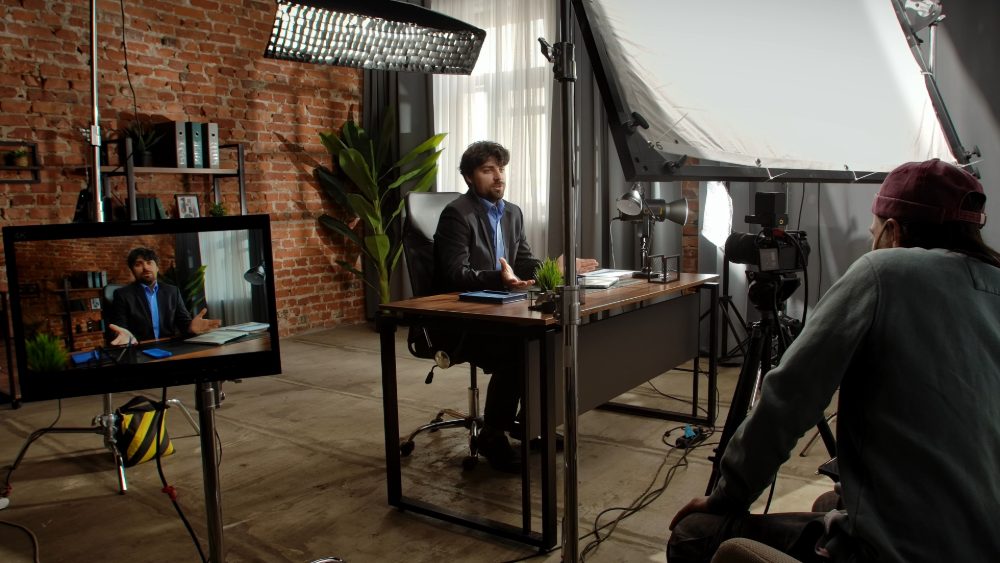
A video content strategy is a plan for which stories you film, who each finished video is for, where it runs and how you’ll know it worked. For a small marketing team, the plan that works best is usually one filming block a year, cut into everything the calendar needs. That is cheaper than a string of one-off shoots, and it keeps every video telling the same story.
Most teams run it the other way round. A product launch needs a video, then an event, then a recruiting push, and each gets its own shoot, crew day and approval cycle. By spring the budget is gone and the channels are quiet again.
This guide walks through the alternative in the order you would actually do it. Start with the business problem, then build the year around one shoot and cut it for every channel. After that, set a calendar you can defend to finance and measure what the video moves.
Why Most Video Content Strategy Fails in Month Three
The failure is rarely the camera work. It is the plan. Video gets commissioned one request at a time, so nobody decides in advance what the year of video is for.
You can spot the pattern in three symptoms:
- Every video starts from zero. New brief, new crew, new locations, new approvals. The fixed costs of a shoot get paid again and again.
- Nothing is built to be reused. A two-minute explainer is edited for the homepage and nowhere else, so the social team asks for “something short” and a second shoot gets booked.
- Distribution is an afterthought. The video goes live, gets shared once from the company page and stops. As Strategic Pete’s nonprofit video page puts it, “A film nobody sees is an expensive keepsake.”
A sound video strategy fixes all three at once, because it makes the decisions before anyone books a crew. It says what the footage has to do and who it has to reach. It also plans how one day of filming becomes months of material.
Start With the Business Problem, Not the Format
Before you pick a format, name the problem the video has to solve. “We need more video” is not a problem. “Candidates don’t believe our culture is different” is. So is “buyers stall because they can’t picture us inside their operation.”
Strategic Pete’s documentary process opens with exactly this step, which it calls “Discover the stakes”: map the perception gap between what your organization does and what people believe it does. The gap tells you what the video has to prove, and to whom.
Three questions sharpen it:
- Who has to change their mind? Candidates, buyers, donors, legislators and your own staff each need different proof.
- What do they believe now? Write it down in their words, not yours.
- What would they have to see to believe otherwise? That answer is your story, and it usually lives in a person, not a product.
This is also where your video marketing budget should be set. If you know the one belief you need to shift, you can fund one serious piece of work against it rather than spreading the money across a dozen assets that each shift nothing.
Decide Who Owns the Plan
A plan with no owner reverts to one-off requests within a quarter. Name one person who approves every cut, holds the footage log and says no to shoots that don’t serve the belief you chose.
In a small team that is usually the marketing lead. The job is less about production than about protecting the plan when a department asks for “just a quick video” that the existing footage could already cover.
Build Your Video Marketing Strategy Around One Filming Block

Here is the structural choice that changes the economics. Instead of shooting a little every month, plan one concentrated filming block and design the whole year of output from it. A video marketing strategy built this way pays the fixed costs of production once.
Crew travel, setup and access to your people all happen once. Every asset downstream is an edit, not a new shoot. That is why a documentary-led approach suits small teams better than it first appears.
Strategic Pete builds a video content strategy on documentary storytelling for exactly this reason. Its process runs Discover the stakes → Find the humans → Film with care → Deploy the asset, and the last step is where the year of video actually comes from.
The Master Story and Its Cut-Downs
Think of the filming block as producing one master story and many cut-downs. The master is the long piece: a documentary short, an episode or a brand film. The cut-downs are everything else.
The Glass Peaks Senior Living mini-documentary case study shows the shape. The community in Toledo, Ohio, could not recruit memory-care specialists through conventional channels. The production delivered one 17-minute episode plus 30–60 second cut-downs for social, distributed through the community’s own social channels, paid Facebook and LinkedIn campaigns aimed at caregivers, and press outreach.
One shoot, one story, several formats and three distribution routes. The case study does not publish outcome figures, so treat it as a model of structure rather than proof of results.
What One Shoot Can Produce
At larger scale, the numbers are public. Read how Nebraska put long-term care on screen: a three-person crew filmed 21 unscripted stories across 7 communities in 2 weeks in April 2024.
That single block fed a theatrical premiere, streaming episodes and a stream of social clips. The case study reports 7.9 million-plus TikTok views and 475,000 YouTube highlight views. The team ran geofenced reels around Capitol debates and handed QR-code cards to every state senator at the session’s opening.
Most marketing teams do not need 21 stories. The principle scales down: film enough real material in one block that the edit suite, not the calendar, becomes the constraint. If you want to see what a video marketing strategy anchored in documentary video production looks like as a fixed engagement, the service page lays out the formats, from 5–15 minute documentary shorts to full docuseries.
If your year of video starts with one story worth filming properly, start a documentary project with Strategic Pete.
Turning It Into a Video Content Marketing Strategy

Footage is not a campaign. A video content marketing strategy decides what each cut is for and where it runs. It also sets the order people meet the pieces in.
Map every cut against the belief you set out to shift. The master story does the persuading for people who give it their attention: boards, finalists, donors, key accounts. The short cuts do the reaching, and their job is to earn that attention in the first place.
Short-Form Video Strategy Without a Second Shoot
A short-form video strategy often gets treated as a separate production line with separate creators. It does not need to be. The best short clips are usually single moments pulled from a longer, well-filmed conversation: a line a nurse says without thinking, a founder’s pause before answering.
Plan for this on the shoot. Ask for answers that stand on their own, film vertical-safe framing where you can, and log the strongest 20–60 second moments in the edit. Nebraska’s clip performance came from this kind of material rather than from anything scripted for social.
Caption every cut. Captions are, in the W3C’s words, “a text version of the speech and non-speech audio information needed to understand the content,” and the W3C Web Accessibility Initiative’s guidance on captions notes they also help “people who process written information better than audio.” If you sell to federal buyers, Section 508’s synchronized media requirements make captions for prerecorded video a baseline, not a courtesy.
Owned, Paid and Earned Distribution
Split distribution into three lanes and plan all three before the shoot:
- Owned. Your website, email, sales decks, onboarding, events. The master story belongs on the page where the belief matters most, such as your careers page or a key service page.
- Paid. Targeted placements that push the short cuts to a defined audience, as Glass Peaks did with caregivers on Facebook and LinkedIn.
- Earned. Press and partner coverage. A real story about real people gives journalists something to write about that a product video cannot.
Choose platforms by where your audience already is, not by habit. Pew Research Center’s 2025 social media fact sheet found that 84% of U.S. adults use YouTube, 71% use Facebook, 50% use Instagram and 37% use TikTok. Those are adults in general, not your buyers, so use them as a starting assumption to check against your own analytics.
One more rule if employees share the cuts. The FTC’s guidance on endorsements says staff promoting their employer’s products should disclose the relationship, and that listing your employer on a profile page is not enough. A one-line employee advocacy note avoids the problem.
A 12-Month Video Content Plan You Can Take to Your CFO
Here is how the pieces become a calendar. The quarters below assume one filming block early in the year. Adjust the timing to your own sales cycle or recruiting season, but keep the order.
Quarter One: Find the Story and Film It
Define the belief you need to shift and choose the people who can show it. Then run the filming block. Strategic Pete’s process calls this “Find the humans” and “Film with care”: no actors, and in the service page’s words, “No scripts that sand down the truth.”
Log every usable moment as you go. That log becomes your video content calendar for the rest of the year.
Quarter Two: Launch the Master Story
Release the long piece where it will be watched in full: a premiere, a board meeting, a customer event, the page your buyers or candidates already visit. Open the first wave of short cuts in paid and owned channels the same week, so the launch has reach as well as depth.
Quarter Three: Run the Cut-Down Program
This is where the video content marketing plan earns its keep. Release the short cuts on a steady rhythm, each one built around a single moment. Feed the strongest ones to sales for follow-up emails and to recruiting for job posts.
Quarter Four: Reuse, Measure and Brief the Next Block
Recut the best-performing moments for year-end reviews, investor updates or award entries. Then write next year’s brief from what you learned: which moments carried, which audiences responded, what belief still hasn’t moved.
Put on one page, that is your video content plan: one shoot, one master story, a year of cuts and a clear reason for each. It is also the version of a video content strategy that a finance lead can follow, because every cost sits in one line and every asset traces back to it.
How to Measure a Video Content Strategy

Measure against the belief you set out to shift, not against views alone. Views tell you the video was seen. They don’t tell you whether anyone changed their mind.
The Glass Peaks case study names the kinds of measures that fit a recruiting-led program: video view counts, application submissions and increased website traffic. Swap in the equivalents for your own problem:
- Recruiting. Applications from the pages and ads carrying the video, and quality of applicants.
- Sales. Meetings booked or deals advanced after a prospect watched the master story. Your CRM can usually record this if sales logs it.
- Advocacy and reputation. Whether the people you needed to reach actually saw it. In Nebraska, state senators started quoting scenes from the film during workforce debates.
Report reach figures honestly and keep them separate. Strategic Pete’s People Worth Caring About series, for example, reports 32.1 million in social media reach and separately carries national smart TV distribution. Those are different measures, and a good report never adds them together.
Set the Baseline Before You Launch
Record where each measure stands before the master story goes live: current applications per month, current meeting rate, current traffic to the page that will carry the film. Without a baseline, every result afterward is an anecdote.
Keep the window long enough to be fair. A documentary-style piece often does its work slowly, through repeated viewings in sales conversations and interviews, so judge the video content marketing strategy on the full twelve months rather than the launch week.
Frequently Asked Questions
What Is a Video Content Strategy?
A video content strategy is a plan that decides which stories you film, who each video is for, where it runs and how you’ll judge it. It differs from a production schedule because it starts with the business problem, not the list of videos.
How Is a Video Marketing Strategy Different From a Video Content Strategy?
The terms overlap. A video marketing strategy usually focuses on campaigns and channels. A video content strategy covers the whole year of material, including recruiting, internal and sales uses that never appear in a campaign.
How Much Should a Content Strategy Video Cost?
There is no honest single number, because scope drives cost. Strategic Pete’s documentary page says each project “is scoped as a fixed engagement before filming begins” and promises “a number, not a range.” The practical point is to fund one strong filming block rather than many small shoots.
How Many Videos Should a Small Team Plan for a Year?
Plan one master story and as many cut-downs as the footage honestly supports. The count matters less than whether each cut has a single job and a place to run.
Is There a Standard Rule, Like the 5-5-5 Rule, for Posting Video?
Several posting “rules” circulate online, and none of them comes from an authoritative source. A better guide is your own calendar: release at a pace your footage and your team can sustain for twelve months.
Conclusion
The teams that run out of video by spring usually didn’t spend too little. They spent it in too many small pieces. A video content strategy that starts from one belief to shift and one filming block to shift it changes that. It turns the budget into a year of material instead of a handful of disconnected clips.
That is the real test of any video content strategy: whether the footage is still working in month ten.
The less obvious gain is consistency. When every cut comes from the same real people, your careers page, your sales follow-up and your social feed all tell the same true story.
Buyers and candidates notice that before they notice the production values. “Not Hollywood. Not PR fluff.” Just the work, filmed well and used all year.
If you are weighing whether a documentary-style brand story video production or a longer film fits your year, the next step is a conversation about the story you already have.
Have a story that could carry a year of video? Talk about a project like this with Strategic Pete.