
A fractional CMO for SaaS startups gives you senior marketing leadership without hiring a full-time executive. They help define your ICP, sharpen positioning, build your go-to-market strategy, improve pipeline quality, and connect marketing activity to SaaS metrics such as ARR, MRR, CAC, LTV, churn, and payback period.
Here’s why it works:
- Cost Savings: A full-time CMO costs $300K–$575K annually. Fractional CMOs deliver expertise for $60K–$180K per year.
- Faster Start: While hiring a full-time CMO can take 3–6 months, fractional CMOs can begin in 1–2 weeks.
- SaaS Expertise: They specialize in metrics such as MRR, CAC, LTV, and churn, tailoring strategies to SaaS growth challenges.
- Flexibility: Work 10–25 hours weekly, scaling involvement as needed.
Fractional CMOs focus on aligning marketing with revenue goals, optimizing channels, and setting up data-driven systems. They provide immediate impact while building a foundation for sustained growth.
If your SaaS startup is between $1M and $10M in ARR, a fractional CMO can be especially useful when you need marketing strategy, pipeline accountability, and leadership across channels — not just outsourced campaign execution.
What Does a Fractional CMO Do for a SaaS Startup?
A fractional CMO leads marketing strategy on a part-time or contract basis. For SaaS startups, that usually means turning scattered marketing activity into a focused growth system.
They typically help with:
- defining the ideal customer profile and positioning
- building the go-to-market strategy
- improving demand generation and conversion paths
- aligning sales and marketing around pipeline goals
- choosing the right mix of SEO, paid search, content, lifecycle marketing, and partner channels
- setting up reporting for CAC, LTV, churn, MRR, ARR, and pipeline velocity
The goal is not simply to run campaigns. It is to build a repeatable marketing engine that supports revenue growth.
sbb-itb-8f8c601
Benefits of Hiring a Fractional CMO for Early-Stage SaaS
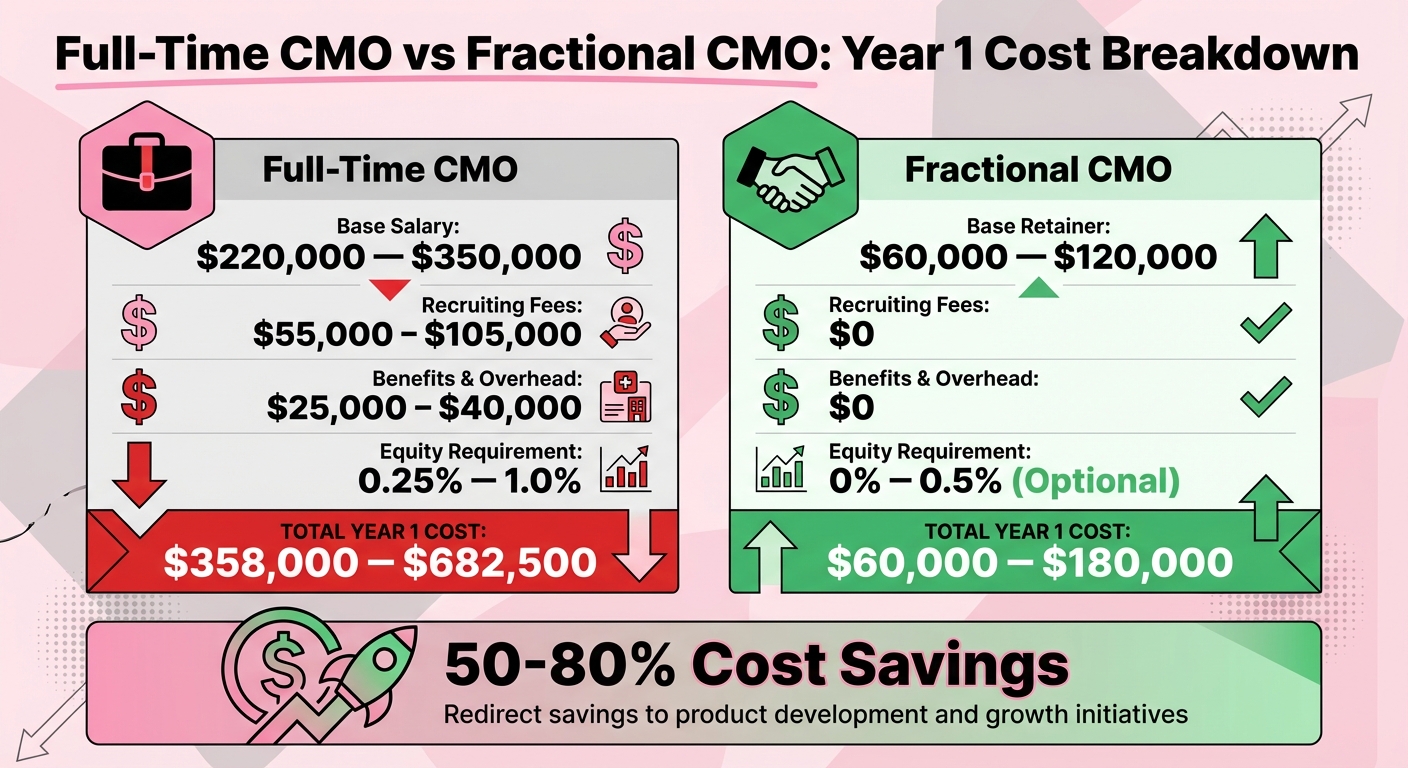
Full-Time CMO vs Fractional CMO Cost Comparison for SaaS Startups
For SaaS startups looking to establish a strong foundation for growth, bringing in a fractional CMO offers clear advantages, including cost savings, adaptability, and specialized expertise tailored to the industry.
Cost-Effective Leadership Without Full-Time Overhead
Hiring a full-time CMO can be a major financial commitment. With a base salary often around $250,000, additional costs like bonuses, benefits, taxes, and recruiting fees can quickly double that figure. Following the “2x Rule of Thumb”, the first-year expense for a full-time CMO can exceed $450,000.
By contrast, a fractional CMO provides the same level of expertise at a fraction of the cost – typically between $60,000 and $180,000 annually, with little or no equity required.
“A fractional CMO can give you senior-level leadership for 50-80% less. That’s strategic capital you can pour back into your product.” – BriskFab
This cost-efficient model is especially critical in today’s SaaS landscape, where the focus has shifted to achieving growth through efficiency rather than unchecked spending.
| Cost Component | Full-Time CMO | Fractional CMO |
|---|---|---|
| Base Salary / Retainer | $220,000 – $350,000 | $60,000 – $120,000 |
| Recruiting Fees | $55,000 – $105,000 | $0 |
| Benefits & Overhead | $25,000 – $40,000 | $0 |
| Equity Requirement | 0.25% – 1.0% | 0% – 0.5% (Optional) |
| Total Year 1 Cost | $358,000 – $682,500 | $60,000 – $180,000 |
These savings free up resources that can be redirected toward essential growth initiatives. Beyond cost, fractional CMOs also provide the flexibility that startups need to adapt as they scale.
Flexibility and Scalability for Startup Needs
Fractional CMOs offer a tailored approach, adjusting their involvement based on your company’s stage and priorities. For early-stage startups, they might focus heavily on strategy – defining your market positioning, identifying your ideal customer profile (ICP), and creating a go-to-market (GTM) plan. As your company grows, their role often shifts toward team management and scaling marketing operations.
Their contracts are typically short-term, running month-to-month or quarterly. This avoids the long-term financial risks and severance costs associated with hiring a full-time executive (which can range from $3,000 to $35,000 per month in severance). If your needs change or you’re ready to hire a full-time CMO, transitioning is straightforward and avoids the complications of terminating a permanent hire.
Fractional CMOs usually provide 10–20 hours of high-level strategic input per week, giving you access to top-tier talent without the expense of a full-time role. Many startups start with a 90-day trial period, allowing time to identify quick wins and assess the value of the collaboration before committing to a longer-term plan.
SaaS-Specific Expertise and Proven Playbooks
Beyond cost and flexibility, fractional CMOs bring deep SaaS industry knowledge and proven strategies. For example, they know that a CAC (Customer Acquisition Cost) payback period exceeding 18 months is a problem for Series A investors, who generally expect a 12–18 month benchmark. With this insight, they can fine-tune your GTM strategy by analyzing early customer data and refining your ICP.
“A consultant delivers advice. A fractional CMO owns outcomes. They sit in the leadership team, attend board meetings, manage the marketing budget, and are accountable for GTM results.” – ThinkCap Advisors
These experts follow structured playbooks to deliver results quickly. For instance:
- Week 1: Conduct a GTM audit.
- Day 30: Present a documented strategy.
- Day 90: Establish a working pipeline dashboard and demand generation system.
They also tailor growth strategies to fit your product, whether it’s Product-Led Growth (PLG), sales-assisted models, or enterprise-focused Account-Based Marketing (ABM).
In 2026, many fractional CMOs are leveraging AI tools to handle up to 40% of mid-level marketing tasks, including content creation and campaign optimization. This enables them to focus on strategic initiatives while maximizing the output of your marketing resources without requiring a large team.
Core Responsibilities of a Fractional CMO in Building a SaaS Growth Engine
A fractional CMO plays a key role in building a growth engine for SaaS companies by aligning marketing with revenue goals, fine-tuning channels for measurable outcomes, and establishing data-driven systems.
Aligning Marketing Strategy with Business Goals
The primary responsibility of a fractional CMO is to ensure that every dollar spent on marketing ties directly to your revenue objectives. Using frameworks like Objectives and Key Results (OKRs), they link marketing efforts to metrics like Monthly Recurring Revenue (MRR) and Annual Recurring Revenue (ARR) growth.
To focus resources effectively, they define your Ideal Customer Profile (ICP) and Serviceable Obtainable Market (SOM). Collaboration with the sales team is critical – weekly meetings help review pipeline health, track MQL-to-SQL conversion rates, and gather feedback on lead quality. This alignment prevents the common issue of marketing generating leads that sales can’t convert.
“The fractional CMO’s job is to build an experimentation framework where every campaign teaches you something, and every insight feeds the next decision.” – Matthew Deal, Fractional CMO
Typically, within the first two weeks, they create a 90-day plan with 3–5 measurable goals to demonstrate quick results. This plan includes board-level reporting to show clear progress toward investor expectations.
Once a revenue-focused strategy is in place, the next challenge is balancing immediate results with sustainable growth.
Optimizing Inbound and Performance Marketing Channels
Fractional CMOs manage a mix of “quick-win” channels, such as Paid Search (Google Ads), for immediate results, and “compounding” channels, such as SEO and Content Marketing, for long-term growth. They analyze early customer acquisition patterns to build repeatable frameworks. For inbound marketing, the focus is on closing keyword gaps, planning editorial calendars, and leveraging platforms like G2 and Capterra, which are essential for SaaS visibility. For performance marketing, paid search captures demand quickly, while remarketing nurtures potential customers who aren’t yet ready to commit.
A great example of this in action: In February 2026, fractional CMO Matthew Deal revamped VenturEd Solutions‘ broken HubSpot and Salesforce integration. By standardizing data across more than 60 fields and documenting the architecture, the EdTech SaaS company saw its MQL-to-SQL conversion rates jump from 8–11% to 17% within three months. This overhaul also saved about 30 hours per week in manual data reconciliation.
Before scaling any channel, a fractional CMO ensures data-driven attribution is in place. This step connects marketing activities directly to sales outcomes, so you’re never operating without clear insights.
Implementing Data-Driven Attribution and Reporting
Once marketing channels are optimized, the focus shifts to analytics that make every campaign measurable.
Fractional CMOs transition your decision-making from guesswork to analytics-based strategies. They integrate tools like Salesforce or HubSpot with marketing platforms to track pipeline results. Reporting is typically split into two tiers: weekly dashboards for metrics like MQLs, SQLs, and conversion rates, and monthly reviews to assess ROI. Even campaigns that don’t succeed outright provide valuable data for future adjustments.
Predictive analytics is another tool they implement to flag churn risks early, helping you retain customers before they leave. This data-driven approach becomes crucial as your company scales. With industry benchmarks showing that the B2B SaaS customer acquisition cost (CAC) payback period is typically 12–18 months, a fractional CMO uses attribution data to ensure your channels meet this target.
These responsibilities form the foundation of a scalable growth engine, positioning SaaS startups to generate revenue from the start.
Day-One Implementation Strategies
A fractional CMO kicks off by diagnosing problem areas, launching campaigns aimed at quick wins, and setting up retention systems. The goal? Build momentum immediately while laying the groundwork for steady growth.
With the diagnosis complete, the focus shifts from analysis to action.
Conducting a Marketing Audit
The first step is figuring out where your marketing efforts are paying off – and where they’re not. A fractional CMO dives into your Ideal Customer Profile (ICP), key funnel metrics (like MQL-to-SQL conversion rates), and the performance of all active channels. They also compare your positioning against at least three direct competitors. This process spans over 70 platforms, including search engines, SaaS directories (like G2 and Capterra), and buyer communities like Reddit.
Here’s a surprising stat: many SaaS companies lose between $25,000 and $50,000 due to inefficient spending or unclear messaging. By delivering a detailed audit in just five days – costing around $1,800, which is less than 1% of a full-time CMO’s $240,000+ annual salary – companies often recover 5–10× the audit’s value within 60–90 days. They achieve this by addressing funnel friction and improving messaging.
The audit typically includes:
- An executive diagnostic report
- A refined ICP
- A “Non-ICP” list to avoid unproductive segments
- A 90-day roadmap with clear, measurable goals
“The first 90 days are not about launching campaigns. They are about understanding why the current GTM is not producing what it should. Diagnosis before execution is the only sequence that works.”
– Maansi Sanghi, Founder, Envizon
Launching Quick-Win Campaigns for Early Traction
After the audit reveals what’s holding you back, the fractional CMO focuses on fast-win campaigns to drive quick results. They refine messaging for high-value markets and cut low-performing ad spend to improve lead quality. Additionally, they roll out 3–5 automated email sequences to engage prospects at critical points.
The idea is to tackle bottlenecks, such as an inefficient sales funnel or a weak nurturing process, and fix them quickly. Internal interviews with sales and customer service teams often uncover issues that haven’t been addressed because of a lack of authority or oversight. Reporting these early wins and linking them to measurable results, such as increased revenue or faster pipeline velocity, builds trust and support for bigger changes. This is key, especially since 70% of transformation projects fail without early momentum.
Establishing a Scalable Customer Retention Framework
Growth doesn’t mean much if customers don’t stick around. That’s why a fractional CMO starts by analyzing past churn data to understand why customers leave and where the biggest issues are. Along with refining the ICP, they create a “Non-ICP” list to avoid targeting segments that look good on paper but don’t support long-term retention.
By aligning insights from Customer Success, Sales, and Product teams, they ensure a consistent go-to-market strategy. They also improve interdepartmental handoffs to create a seamless customer experience from first contact through long-term engagement. Mapping content to the customer journey further ensures customers receive relevant value at every stage, helping reduce churn. Given that 90% of startups fail and 20% don’t make it past their first year, retention strategies are critical for survival.
“Marketing has to be the shepherd that brings everything together into cohesive ICP, positioning, and messaging that aligns all departments.”
– Clement, Co-founder, The Growth Syndicate
These steps not only deliver quick wins but also lay the foundation for sustained growth, ensuring the fractional CMO can drive long-term success.
How to Choose the Right Fractional CMO for Your SaaS Startup
Picking the wrong fractional CMO can cost your startup both time and money. On the other hand, the right leader can help you achieve noticeable growth in as little as 30–90 days. Here’s how to make the right choice.
Evaluating Experience and Industry Fit
When it comes to SaaS, experience matters – a lot. Unlike other industries, SaaS operates on unique principles, so your fractional CMO needs to hit the ground running. Look for someone with a proven track record in SaaS, particularly with subscription-based models and metrics such as LTV (Lifetime Value), CAC (Customer Acquisition Cost), payback periods, and pipeline velocity.
A top-tier candidate will also bring a network of trusted experts in areas like SEO, PPC, and copywriting – people they’ve worked with successfully in previous SaaS ventures. This network can save your startup from the costly trial-and-error process of finding reliable vendors. Before making a decision, dig into their professional footprint. Check for articles they’ve written, LinkedIn activity, or podcast appearances. If they haven’t shared their expertise publicly, it could be a warning sign.
Steer clear of candidates who lack SaaS experience, rely solely on strategy presentations without an execution track record, or fail to provide a clear framework for measuring success. Between 2021 and 2024, the percentage of SaaS companies with ARR between $2 million and $10 million using fractional marketing leadership jumped from 18% to 42%. While this shows the growing popularity of fractional CMOs, it also highlights the need to separate seasoned professionals from less qualified contenders.
Assessing Vision and Execution Capabilities
A great fractional CMO combines strategic thinking with execution. During interviews, present them with a real-world challenge, such as a stagnant demo-to-close rate or rising CAC, and observe how they approach it. Strong candidates will ask detailed questions about your business, team, and pain points before offering a solution.
PipelineRoad Agency offers a helpful benchmark:
“After 90 days, can your fractional CMO articulate your competitive positioning in one sentence, your top three pipeline channels by ROI, and your CAC by channel? If they can’t, they’re executing, not leading.”
Ask for examples of measurable results from their past roles. Look for someone who integrates seamlessly with leadership teams and demonstrates a clear focus on ROI. Also, ensure their client load is manageable so they can dedicate enough time and attention to your business. A true CMO will focus on big-picture strategy – things like competitive positioning and pipeline development – rather than getting bogged down in tactical tasks like choosing ad platforms. Think of them as a “strategic architect” building a solid marketing foundation, not just a part-time executor.
Choosing someone with both a clear vision and the ability to implement it will set your SaaS startup up for success.
Need a Fractional CMO for Your SaaS Startup?
Strategic Pete helps SaaS startups turn marketing into a clearer, more accountable growth function. That includes strategic audits, market positioning, growth opportunity mapping, sales pipeline optimization, SEO and PPC consulting, customer journey automation, and performance tracking.
This is best suited for SaaS teams that need senior marketing leadership, stronger sales and marketing alignment, and a clearer path from marketing activity to revenue outcomes. For the wider picture, see our guide to the leading fractional CMO firms.
Conclusion
For SaaS startups, growth isn’t just a goal – it’s survival. Building a scalable, data-driven marketing engine right from the start takes expertise that many early-stage companies can’t afford to hire full-time. Enter the fractional CMO: a seasoned professional armed with proven SaaS strategies who can tackle key metrics like CAC payback periods, pipeline velocity, and LTV – all at 50–80% less than the cost of a full-time executive.
The rise of fractional executives is hard to ignore. LinkedIn has seen a staggering 5,400% increase in profiles featuring “fractional” in their titles, reflecting a major change in how startups approach leadership and growth.
What sets a fractional CMO apart is their focus on building systems, not just running campaigns. By creating strategic infrastructure, such as standardized data setups and streamlined pipeline processes, they deliver measurable, long-term results. This goes beyond short-term tactics; it’s about building a foundation that drives consistent growth.
The flexibility of this model is a game-changer. Instead of locking into a $250,000–$400,000+ annual salary, you gain access to senior-level expertise on a scalable basis. Considering the average tenure of a full-time SaaS CMO is just 25 months, the fractional approach offers a more stable and efficient way to build your marketing foundation.
For startups with $1–$8 million ARR, a fractional CMO is the smartest way to develop a scalable growth engine. Weekly 30-minute alignment meetings and a focus on infrastructure over short-term wins ensure you’re setting up for sustained success. Beyond driving growth, a fractional CMO lays the groundwork for marketing systems that amplify the impact of every future campaign. It’s an investment in both immediate progress and long-term stability.
FAQs
What does a fractional CMO do for a SaaS startup?
A fractional CMO gives a SaaS startup senior marketing leadership without the cost of a full-time executive. They usually own go-to-market strategy, positioning, demand generation, pipeline reporting, sales and marketing alignment, and growth planning across channels.
How much does a fractional CMO cost for a SaaS startup?
Most fractional CMO engagements cost less than hiring a full-time CMO because the role is part-time or contract-based. For SaaS startups, the cost often depends on the company stage, scope of responsibility, weekly hours, and whether the CMO is focused on strategy only or also managing execution.
Is a fractional CMO better than a marketing agency?
A fractional CMO and a marketing agency solve different problems. A fractional CMO is best when you need strategy, leadership, prioritization, and accountability across marketing. An agency is better when you already have a clear strategy and need execution support for a specific channel such as paid search, SEO, or content.
When is the right time to hire a fractional CMO?
When your SaaS startup is bringing in between $1 million and $20 million in ARR, it’s the perfect moment to consider hiring a fractional CMO. At this stage, you likely need experienced marketing leadership to guide your growth. A fractional CMO can help you establish a scalable growth strategy without the high cost of a full-time executive.
What should I expect in the first 30–90 days?
In the initial 30–90 days of working with a fractional CMO, you can anticipate a clear and organized approach that includes diagnosis, strategy, and execution:
- First 30 days: This period focuses on conducting a thorough go-to-market (GTM) audit, pinpointing growth opportunities, and establishing baseline KPIs to measure progress.
- Next 30–60 days: During this phase, the focus shifts to crafting a customized GTM strategy and actionable plans tailored to your business needs.
- Final phase: The last stretch emphasizes running live experiments, fine-tuning tactics, and driving measurable growth, all while laying the groundwork for long-term scalability.
How do I measure whether it’s working?
To determine whether your marketing efforts with a fractional CMO are working, keep a close eye on key performance indicators (KPIs) that align with your business objectives. Pay attention to metrics such as customer acquisition rates, retention rates, revenue growth, and lead conversion rates. Regularly assess your progress by leveraging data-driven tracking tools and comparing the outcomes to your original goals. This approach ensures that your strategies are delivering measurable results.