
A 75-year-old woman from Oregon drove across the country to meet a one-year-old hippo named Mars, and that is how a wildlife park ended up with its documentary. Peter Murphy Lewis describes the campaign that produced her: an open call across social media inviting people to be part of the story, restricted to people who had never visited. Hundreds sent in videos. She became the messenger, and the park was filmed through her eyes.
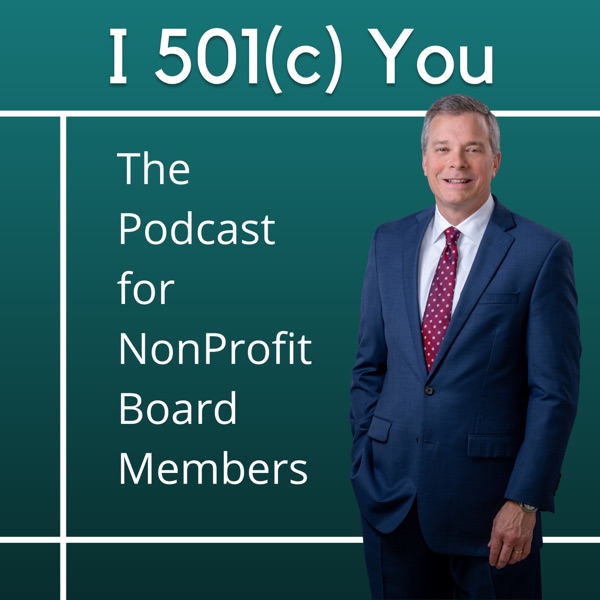
The show is I 501(c) You, the podcast for nonprofit board members, hosted by Michael. Peter joins it wearing two hats, as board chair of the Miami County Community Foundation in Kansas and as a fractional chief marketing officer, and the conversation quickly stops being about content production. It becomes a conversation about sequence: what a nonprofit decides first, what it decides last, and who is expected to carry the result.
The answer he keeps returning to is that the camera comes last and the objective comes first, and that the board itself is the distribution channel most organizations already own and never use. That reframing is the useful part of this episode for anyone sitting on a board and wondering what, exactly, they are meant to do about marketing.
Key Takeaways
1. Storytelling Is Getting Someone Who Does Not Care Yet to Care
Peter’s definition is narrow on purpose. Storytelling is “helping somebody who currently doesn’t care and doesn’t know about you, helping them care.” He treats that as a human need rather than a marketing tactic, arguing that people need to be connected and to feel understood before they feel fulfilled. “If I’m able to understand your story, I will care about something tomorrow that I didn’t today.” For a board, that turns content from an output to be produced into a transfer of caring from one person to another.
2. Start With the Objective, Not the Tripod
The most common mistake he sees is the order of operations. Executive directors and chief executives start with the videographer, the tripod, the lights and the microphone. “You need to start off with an objective and then you need to line that up with the messenger in the story.” Distribution comes last. He also wants the goal kept deliberately small: “the smaller the objective, the more successful you would be.” His worked example is a story designed to make ten people want to join your board, not one built to reach millions.
3. The Board Is the Distribution Channel
Content does not only go out from the organization. It goes to the board with a specific ask attached, because, as he puts it, “we’re the people who are already connected.” New board members get a screenshot with an arrow on it showing where the repost button is, plus a nudge to add their own words. The team also writes stories about individual board members and tags them on Facebook and LinkedIn, so accepting a tag pushes the story into that member’s own network. Speed matters too. He says the faster a post goes out, the more the algorithms amplify it.
4. Do Not Translate Data Into a Story, Find the Story Behind the Data
Asked whether there is ever a moment a nonprofit should skip storytelling, Peter could not name one. What he named instead was a failure mode. “If you have data, don’t translate that into story, go find the story that is backed up by the data.” The arithmetic version, where two plus two produces a narrative, does not work. His instruction is to ask what sits underneath the numbers and what made them, then go out into the world and find that story.
5. Invite the Audience to Become the Messenger
For a film about Tanganyika Wildlife Park, the team ran a user-generated campaign across social media with an unusual restriction. Only people who had never visited could apply. “We wanna invite you to be part of our story.” He says on the episode that hundreds of people sent in videos and signed waivers, and that the one chosen was a 75-year-old woman from Oregon. She drove across the country, met the hippo, and the park’s story was told through her rather than through staff.
6. One Event Should Produce a Year of Content
For a nonprofit with no documentary budget, his advice is to pick something already on the calendar. A fundraiser, a change of executive director, the annual thing everyone