
B2B companies often face growth challenges when founder-led strategies and basic marketing efforts stop delivering results. This is where senior marketing leadership becomes essential to align sales and marketing, reduce inefficiencies, and drive revenue. However, hiring a full-time CMO can be costly and time-consuming, making fractional CMOs or marketing consultants a practical alternative. If you want to go further, start with our guide to how B2B demand generation works, then read about how we run B2B marketing for clients.
Key Takeaways:
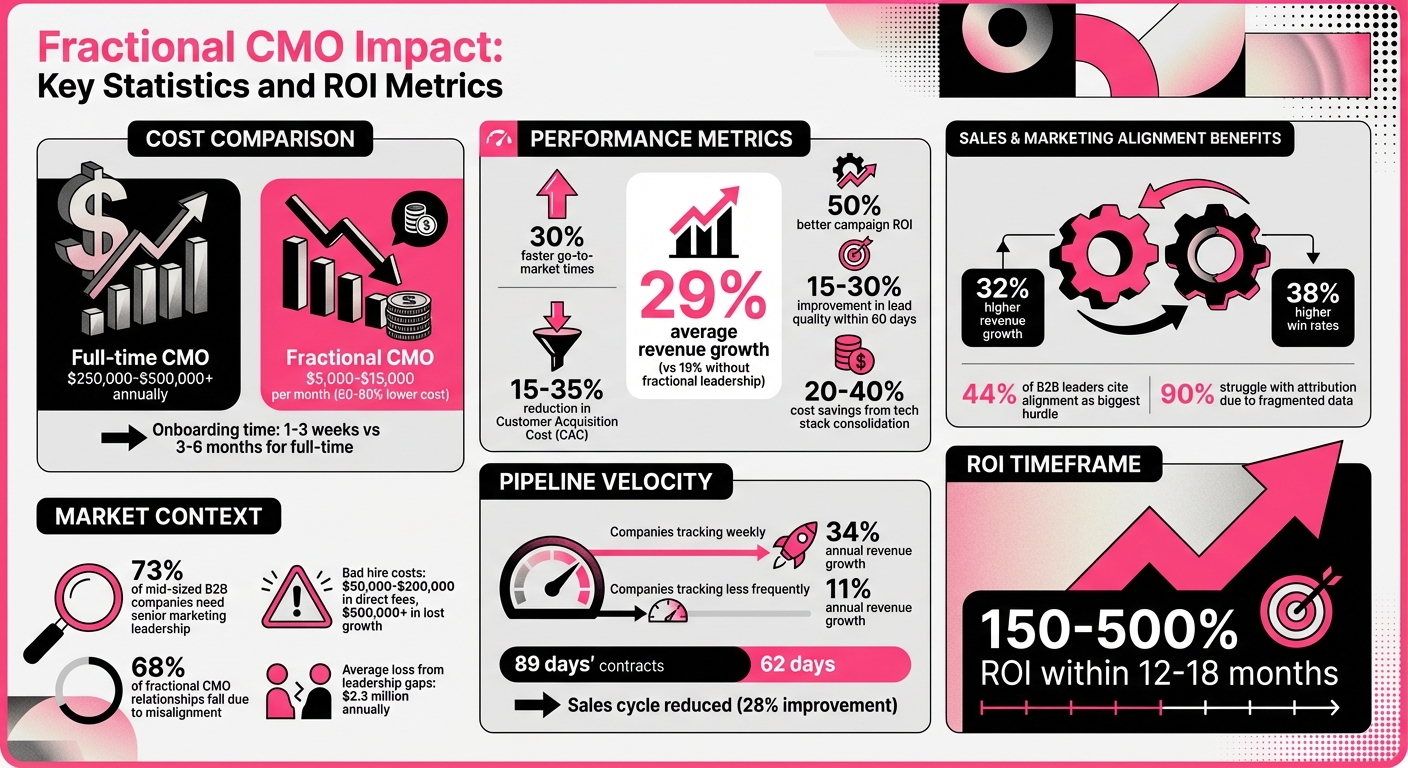
- Fractional CMOs provide high-level marketing leadership at 60–80% lower cost than full-time hires, with fees ranging from $5,000–$15,000 per month.
- They can be onboarded in 1–3 weeks and deliver results like 30% faster go-to-market times and 50% better campaign ROI.
- Common issues they address include sales-marketing misalignment, long sales cycles, high customer acquisition costs, and underutilized resources.
- Companies with aligned sales and marketing teams see 32% higher revenue growth and 38% higher win rates.
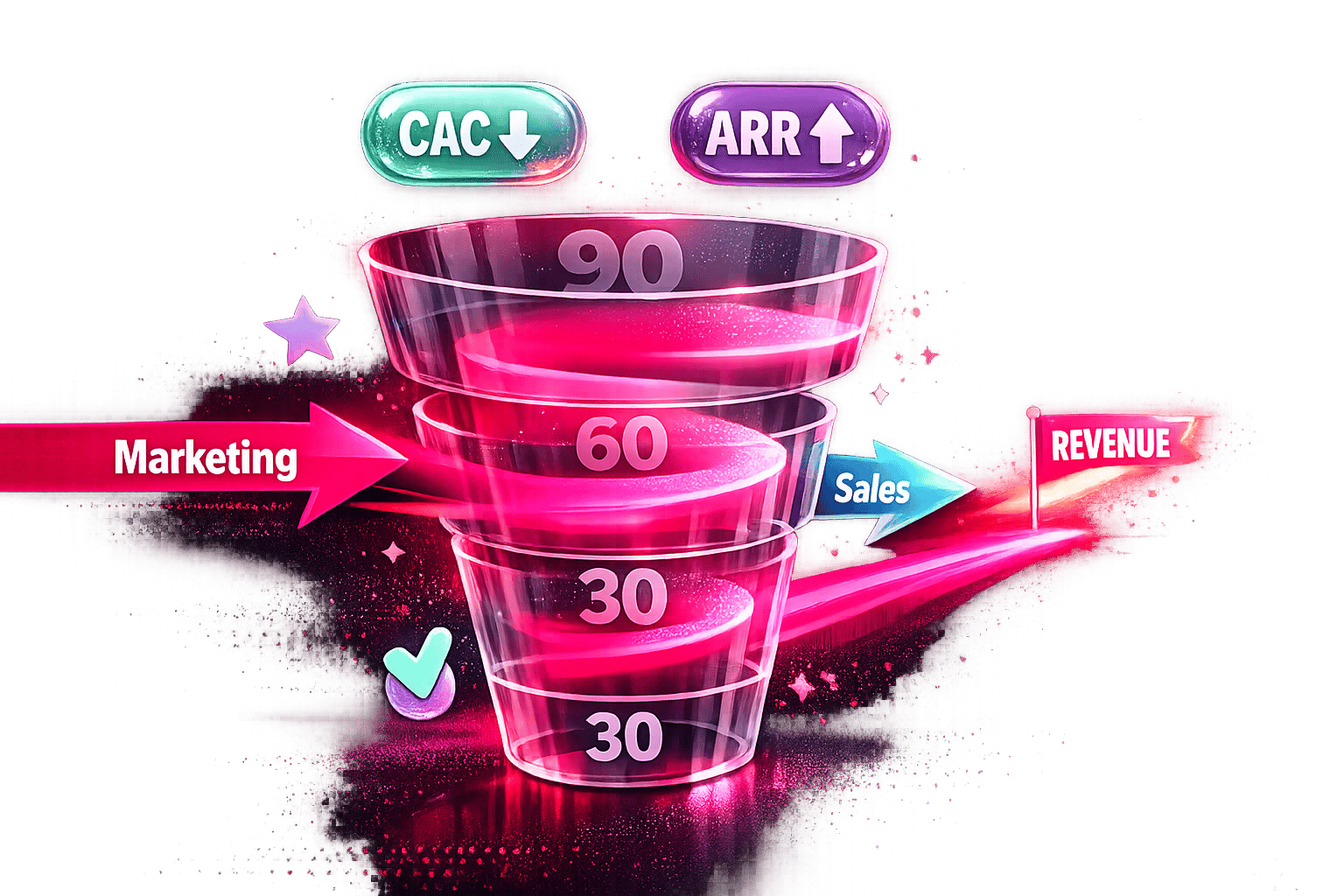
- A 90-day roadmap helps fractional leaders assess gaps, set up tracking systems, and launch revenue-focused campaigns.
Hiring a fractional CMO is ideal for businesses spending over $500,000 annually on marketing or facing stalled growth, market expansion, or product launches. The right candidate combines strategic expertise, industry knowledge, and technical skills to transform marketing into a revenue engine.
Fractional CMO Impact: Key Statistics and ROI Metrics for B2B Companies
Common Growth Challenges in Complex B2B Organizations
Sales and Marketing Misalignment
When sales and marketing teams operate on different wavelengths, B2B companies often pay the price. Marketing tends to focus on metrics like lead volume and engagement, while sales and finance prioritize predictable revenue and pipeline performance. This divide can be costly: 44% of B2B leaders identify sales and marketing alignment as their biggest hurdle, and nearly 90% struggle with attribution due to fragmented data systems.
"Marketing spend without strategic ownership produces activity, not revenue."
- Kamyar Shah, Founder, World Consulting Group
The solution lies in strategic marketing leadership. By defining shared terms – like what constitutes a Marketing Qualified Lead (MQL) versus a Sales Qualified Lead (SQL) – and creating Service Level Agreements (SLAs) for seamless handoffs, teams can work together more effectively. Closed-loop reporting also helps marketing teams understand which leads convert into customers. Companies that align sales and marketing report 32% higher revenue growth and 38% higher win rates. With the guidance of a fractional CMO, organizations can see improvements in lead quality of 15–30% within 60 days. Misalignment is just one of many challenges that complex B2B organizations need to address.
Managing Long Sales Cycles and High Customer Acquisition Costs
Long sales cycles and high customer acquisition costs (CAC) are more than just frustrating – they’re structural issues that demand attention. Many B2B companies mistakenly treat CAC as a fixed expense, rather than a variable that can be improved through better targeting, messaging, and conversion strategies.
Relying too heavily on last-click attribution and inconsistent pipeline tracking can obscure which channels are performing well. Companies that track pipeline velocity weekly experience 34% annual revenue growth, compared to just 11% for those that review it less frequently.
For example, in 2025, a B2B SaaS company working with Jolly Marketer shortened its sales cycle from 89 days to 62 days, a 28% improvement. This was achieved by monitoring weekly metrics, identifying bottlenecks in the sales process, and refining campaign targeting in real time. Similarly, a fintech startup paired a fractional CMO with an agency to implement LinkedIn and Google retargeting campaigns, resulting in 203% membership growth within 120 days.
Strategic leadership can also reduce CAC by 15–35% through methods like refining messaging, optimizing conversion rates, and treating CAC as part of a broader system. This includes setting a CAC ceiling based on Lifetime Value (LTV), running separate brand and non-brand campaigns, and testing landing pages alongside ad creative. Beyond improving conversions, tackling resource constraints is another critical area for mid-sized B2B firms.
Limited Resources in Mid-Sized B2B Companies
Mid-sized B2B companies face a unique challenge: 73% acknowledge the need for senior marketing leadership, but the cost of hiring a full-time CMO – ranging from $250,000 to $500,000+ annually – is often out of reach. This resource gap leaves many teams stuck in "firefighting mode", addressing immediate needs instead of focusing on long-term growth strategies.
The average mid-market company manages over 160 different applications, but limited resources often lead to poor integration and underutilized tools. This "technology bloat" drains budgets, while teams lack visibility into what’s actually driving results. On top of that, the 3–6 months it takes to hire a full-time CMO can stall progress during critical growth periods.
"Hiring a full-time CMO can feel like buying a race car when all you need is a skilled driver."
- Sanjeev Arora, Fractional CMO Partners
Fractional CMOs offer a practical solution, delivering senior-level expertise at 60–80% lower cost than full-time hires, with monthly fees typically between $5,000 and $15,000. They can be onboarded in 1–3 weeks, and their involvement scales to match business needs or funding cycles. Companies leveraging fractional executives report 30% faster go-to-market times and 50% better ROI on campaigns. Additionally, many achieve 20–40% cost savings by consolidating their tech stacks.
sbb-itb-8f8c601
What Every B2B Leader Should Know About Fractional CMOs | Carlos Hidalgo | Ep 73
What Marketing Leadership Should Focus On
Dealing with challenges like misalignment and lengthy sales cycles, effective marketing leadership shifts the focus entirely toward driving revenue. Fractional CMOs and senior consultants take ownership of the marketing profit and loss (P&L) and ensure every effort ties directly to Monthly Recurring Revenue (MRR). This approach redefines marketing, transforming it from a series of activities into a core revenue engine.
"One of the highest-value contributions a fractional CMO consultant makes is connecting marketing activity to business outcomes. Many growing companies have marketing in motion… but no clear picture of what is actually driving revenue."
- Peter Geisheker, B2B and SaaS Fractional CMO
This leadership philosophy tackles misalignment and resource constraints head-on. By aligning marketing efforts with revenue goals, optimizing lead-generation channels, and fine-tuning customer journeys, leaders aim to reduce acquisition costs while increasing customer lifetime value. Proven frameworks, like Porter’s Five Forces for positioning and VRIO analysis for channel selection, guide decision-making, ensuring strategies are grounded in data and not guesswork. Additionally, shared KPIs between marketing and sales – such as MQL-to-SQL conversion rates and cost per opportunity – create unified goals for both teams.
A demand generation engine is the backbone of this approach. By integrating positioning, messaging, and multi-channel execution, marketing leaders create predictable pipeline outcomes. This means moving beyond superficial metrics like social media likes or website traffic to focus on what truly matters: revenue attribution, Customer Acquisition Cost (CAC), and Lifetime Value (LTV).
Connecting Marketing Activities to Revenue Goals
Marketing leaders begin by defining success in financial terms. This involves setting clear targets for Marketing Qualified Leads (MQLs), Sales Qualified Leads (SQLs), and pipeline contributions, then implementing systems to measure progress against these goals. The focus shifts from asking "how many leads did we generate?" to "how much revenue did those leads contribute?"
The process often starts with a 90-day roadmap divided into three phases:
- Assessment: Audit current performance and identify gaps.
- Foundation: Set up dashboards and attribution tools.
- Execution: Launch campaigns with built-in revenue tracking.
During the assessment phase, seasoned leaders can quickly identify structural issues, like mismatched messaging or broken sales handoffs, often within the first 20 minutes of diagnostic discussions. Addressing these "quick wins" early builds momentum and demonstrates immediate value.
Strategic frameworks play a critical role throughout. For B2B SaaS companies, the T2D3 framework (Triple, Triple, Double, Double, Double) provides a clear roadmap for scaling revenue. Before increasing ad spend, leaders ensure the Ideal Customer Profile (ICP) and value proposition resonate strongly with the target audience. Without these foundational elements, even the best campaigns risk underperforming.
Data-driven attribution is essential. Leaders go beyond last-click attribution to understand the touchpoints that truly influence purchasing decisions. This involves tracking how marketing spend affects pipeline velocity, monitoring CAC relative to LTV, and ensuring every dollar spent delivers measurable outcomes. This revenue-first mindset naturally extends to optimizing inbound and performance marketing channels.
Improving Inbound and Performance Marketing Channels
Inbound and performance marketing are where strategy meets execution. Leaders develop systems to consistently generate qualified leads and improve conversion rates over time. This requires a deep understanding of which channels resonate with the target audience, how to optimize them, and when to reallocate resources based on performance data.
Account-Based Marketing (ABM) has emerged as a key strategy for complex B2B environments. Instead of targeting a broad audience, ABM focuses on high-value accounts, treating each one as its own market. For instance, in 2025, OutSystems generated a $1.2 million pipeline in just four weeks by targeting Tier 2 banks in the ANZ region with ABM. Similarly, Feedzai saw 82% penetration of target accounts and secured 15 high-value meetings with Tier 1 financial institutions in the APAC region.
SEO strategies now emphasize topic clusters – comprehensive content hubs covering core business topics. These clusters build authority and attract search traffic across every stage of the buyer journey. Performance marketing leaders also rely on tools like LinkedIn Sponsored Content and Google Ads to target high-intent buyers. In 2025, Adobe boosted brand awareness by 45% through LinkedIn Sponsored Content aimed at a professional audience.
Lead scoring and progressive profiling are essential for converting traffic into pipeline. By collaborating with sales teams, marketing leaders define what makes a lead "sales-ready", using demographic and behavioral data like website visits and content downloads. Progressive profiling simplifies the process by collecting data incrementally, reducing friction and ensuring only qualified leads are passed to sales. This improves conversion rates and minimizes wasted effort.
Analyzing and Improving B2B Customer Journeys
The complexity of B2B customer journeys provides an opportunity for marketing leadership to shine. On average, these journeys involve 13 stakeholders across multiple departments. Leaders map these intricate buying networks rather than focusing solely on individual leads, creating experiences that address the needs of the entire decision-making group.
The trend toward self-service buying is rapidly growing. Today, 70% of B2B decision-makers are open to making fully self-serve or remote purchases exceeding $50,000, with 27% willing to spend more than $500,000 through these channels. This shift requires marketing leaders to optimize digital experiences for buyers who prefer independent research. Websites, content libraries, and automated workflows must deliver value at every stage without requiring direct sales interaction.
Journey optimization begins with analyzing buying signals across all touchpoints, such as website visits, e-book downloads, webinar attendance, and in-person meetings. Tools like HubSpot help map these interactions and set up workflows that deliver tailored content based on lead behavior and demographics. Consistent A/B testing of landing pages, email subject lines, and funnel structures ensures continuous improvements in conversion rates.
Post-purchase engagement is equally critical. Marketing leaders collaborate with customer success teams to enhance retention and turn customers into advocates. Metrics like churn rate, Customer Lifetime Value (CLV), and Average Revenue Per User (ARPU) help track the health of these relationships. However, 81% of buyers recently expressed dissatisfaction with their chosen provider, highlighting significant gaps in the customer experience that strategic leadership must address.
| Metric Category | Key Performance Indicators | Purpose |
|---|---|---|
| Acquisition | MQLs, SQLs, CAC | Evaluate top and middle funnel efficiency |
| Conversion | Traffic-to-Lead Rate, Trial-to-Paid Rate | Measure effectiveness of journey touchpoints |
| Retention | Churn Rate, CLV | Assess long-term engagement and relationship health |
| Revenue | ARPU, ACV (Avg Contract Value) | Align marketing efforts with business growth |
How to Evaluate and Hire Fractional CMOs or Marketing Consultants
Hiring a fractional CMO or marketing consultant can be a game-changer for businesses looking to achieve measurable revenue growth. The right leadership can drive growth by 150% and provide long-term competitive advantages. However, 68% of fractional CMO relationships fail to meet expectations, often due to mismatched goals or poor strategic alignment. And the stakes are high – bad hires can cost anywhere from $50,000 to $200,000 in direct fees, with lost growth opportunities exceeding $500,000. With the demand for fractional CMOs rising by over 60% in the past five years, understanding when and how to hire one is critical.
When to Hire a Fractional CMO or Consultant
The best time to bring in a fractional CMO is when your annual marketing spend surpasses $500,000, and the founder or leadership team can no longer effectively handle key positioning decisions. Companies earning between $2 million and $50 million benefit greatly from C-suite expertise at a fraction of the cost of a full-time hire.
Signs that it’s time to hire include stalled growth, preparing for funding rounds, entering new markets, launching new products, post-acquisition integration, or rebranding efforts. If your internal team is strong on execution but lacks strategic guidance – or you’re hesitant about committing to a full-time CMO – a fractional engagement provides a low-risk way to test the waters.
"In scaling organisations, growth rarely slows because teams stop trying. It slows because decision-making becomes fragmented as complexity increases." – Paul Mills, Founder, VCMO
Timing is everything. Companies with fractional CMOs report an average revenue growth rate of 29%, compared to 19% for those without such leadership. These leaders also shorten time-to-market for new products by 48% on average. If your marketing feels like a series of disconnected efforts rather than a unified revenue-driving strategy, it’s time to bring in a strategic leader.
Once you’ve decided to move forward, the next step is defining clear criteria to evaluate potential candidates.
What to Look for When Choosing a Partner
When evaluating fractional CMOs, look beyond their resumes. The most effective candidates typically have 15–20 years of leadership experience, often including prior roles as full-time CMOs. They should demonstrate strong business acumen, with the ability to discuss P&Ls, revenue attribution, and pipeline velocity without leaning on marketing jargon or vanity metrics.
"The best fractional CMOs are strategic business thinkers who happen to specialize in marketing. They understand P&Ls, talk comfortably with CFOs, and frame everything in terms of business impact." – Peter Geisheker, CEO, The Geisheker Group, Inc.
Candidates with diverse industry experience can identify growth bottlenecks quickly and apply proven frameworks. For B2B companies, prioritize expertise in handling long sales cycles, high customer education needs, and multi-touchpoint buyer journeys. Industry-specific knowledge is also crucial – leaders who understand your market, customer behavior, and regulatory challenges are better equipped to offer tailored guidance.
Technical skills are another must-have. Candidates should be familiar with modern B2B MarTech stacks and data tools that enable scalable marketing operations. Whether your team uses HubSpot, Salesforce, or another platform, the right leader should know how to optimize these tools while mentoring junior staff and building efficient systems.
To evaluate candidates effectively, consider these steps:
- Request a 90-day plan or conduct a 90-minute paid session to gauge their strategic insights.
- Ask them to analyze your current strategy within 20 minutes – a strong candidate should quickly pinpoint structural gaps.
- Perform backchannel reference checks by speaking with former colleagues, vendors, or board members.
| Evaluation Criteria | What to Assess | Red Flags |
|---|---|---|
| Strategic Depth | Ability to connect marketing to revenue and P&Ls | Overemphasis on short-term tactics |
| Industry Expertise | Familiarity with your market and sales cycles | Generic, one-size-fits-all approach |
| Team Development | Proven track record of mentoring and system-building | Focus on personal achievements over team growth |
| Technology Alignment | Proficiency with your MarTech stack | Reliance on outdated tools or methods |
| Accountability | Ownership of revenue and pipeline outcomes | Vague metrics or excessive "storytelling" |
Fractional CMOs typically cost 60–70% less than full-time hires, with monthly retainers ranging from $4,000 to $20,000. Before signing any agreements, clearly define your goals by establishing metrics like qualified leads, pipeline value, or brand positioning to measure ROI. A one-page growth brief outlining your Ideal Customer Profile (ICP), revenue targets, and current funnel health can help candidates present a clear plan. Finally, assess cultural compatibility – whether you need a decisive leader or a collaborative partner, the right fit can make all the difference.
Case Study: How Strategic Pete Delivers B2B Marketing Leadership
Strategic Pete provides fractional CMO services tailored for B2B and SaaS companies seeking senior-level marketing expertise without the cost of a full-time executive. Their approach focuses on aligning marketing strategies with revenue goals, improving go-to-market execution, and optimizing inbound and performance channels.
The process starts with a Strategic Audit, which includes market positioning analysis, opportunity mapping, and a detailed growth roadmap. This framework often identifies key issues within the first 20 minutes, delivering quick wins and building momentum. Strategic Pete specializes in helping companies evaluate consultants, fractional executives, and agencies, offering the clarity and accountability needed to drive results.
Their services include sales pipeline optimization, customer journey automation, PR campaigns, real-time performance tracking, and SEO/PPC consulting – all designed to deliver measurable revenue outcomes. By ensuring alignment across marketing, sales, and leadership, every initiative ties directly to business growth.
Founded by Peter Murphy Lewis, Strategic Pete leverages extensive B2B experience to guide leadership teams in making data-driven decisions. With expertise in vendor and channel evaluation, they ensure companies invest in the right tools and partners for sustainable growth. Through educational resources and proven case studies, Strategic Pete demonstrates how to transform marketing from a collection of activities into a revenue-driving engine – without the need for a full-time CMO.
Measuring Results and Building Scalability with Fractional Leadership
Fractional marketing leadership only pays off when the focus is on measurable results and creating systems that can scale. Successful engagements often deliver a return on investment (ROI) of 150–500% within 12–18 months. Achieving these results requires clear frameworks for measurement and operational systems that function independently of any one person.
Tracking Marketing Performance Metrics
Start by setting baseline metrics – like revenue, Customer Acquisition Cost (CAC), conversion rates, and team productivity – before your fractional leader begins. Without these benchmarks, it’s impossible to measure progress effectively. A good measurement strategy should cover four main categories:
- Financial: Metrics like revenue growth, marketing-attributed pipeline, and Customer Lifetime Value (LTV).
- Efficiency: Improvements in CAC, Cost Per Lead, and shorter sales cycles.
- Operational: Faster decision-making, improved execution speed, and better reporting processes.
- Strategic: Greater clarity in brand positioning, team independence, and expanded market share.
A straightforward scorecard can simplify tracking. For instance, monitor one primary business metric (e.g., pipeline), two efficiency metrics (e.g., CAC and payback period), and one conversion metric. Take the example of a SaaS company that boosted its marketing-attributed Annual Recurring Revenue (ARR) from $480,000 to $1.5 million in a year while cutting its Cost Per Lead by 35% – from $250 to $162.
Success unfolds in phases. In the first 30 days, focus on creating clarity by delivering a go-to-market (GTM) strategy, fixing tracking issues, and refining positioning. By 60 days, expect results like better conversion rates, higher-quality leads, and a steady team rhythm. At 90 days, you should see measurable pipeline growth, improved CAC efficiency, and a repeatable roadmap. Companies using fractional CMOs report an average revenue growth of 29%, compared to 19% for those without one.
Don’t overlook "hidden value" metrics, like reduced risks, access to vetted vendors, and knowledge transfer to your team. These benefits often provide lasting advantages beyond immediate revenue gains. To calculate ROI, use this formula:
(Financial Impact – Annual Fee) / Annual Fee × 100.
For instance, if a fractional CMO costs $120,000 annually and generates $600,000 in incremental pipeline, the ROI is 400%.
Defining these metrics sets the foundation for sustainable marketing operations.
Building Marketing Operations for Long-Term Growth
Once you’ve confirmed progress through metrics, the next step is to integrate these improvements into your marketing operations. Fractional leaders don’t just provide guidance – they establish a marketing system designed to sustain success after their tenure ends. This system includes strategy, people management, processes, and technology, all aimed at creating operational independence.
A 90-day phased roadmap can guide this process:
- Days 1–30: Conduct diagnostic audits, interview stakeholders, and pinpoint gaps.
- Days 31–60: Develop KPI dashboards, align the team, and optimize marketing channels.
- Days 61–90: Launch integrated campaigns and set up board-ready reporting systems.
To maintain consistency, implement weekly execution meetings, monthly reviews, and quarterly roadmap updates. Also, ensure alignment between sales and marketing by defining shared criteria for Marketing Qualified Leads (MQLs) and Sales Qualified Leads (SQLs). For example, one SaaS startup used a 90-day alignment playbook to increase lead generation by 32% and MQLs by 35% in just one quarter.
Streamlining your tech stack is another critical step. Most companies can eliminate 2–3 ineffective tools out of every 5 and reallocate those resources to more impactful systems. Within the first 60 days, a fractional leader should also create a "single source of truth" dashboard to make performance data accessible and actionable. This reduces guesswork and speeds up decision-making.
"Marketing has to be the shepherd that brings everything together into cohesive ICP, positioning, and messaging that aligns all departments." – Clement, Co-founder, The Growth Syndicate
The beauty of the fractional model lies in its ability to build systems that don’t rely on one person’s constant effort. By the time the engagement ends – or transitions to a full-time hire – your marketing operations should run efficiently on their own. This ensures that your marketing leadership continues to drive growth as your business evolves.
Conclusion: Achieving B2B Growth Through Marketing Leadership
Leadership gaps in complex B2B firms can lead to costly inefficiencies, with companies losing an average of $2.3 million annually due to misaligned strategies. This is where fractional CMOs and strategic marketing consultants step in, offering C-level expertise at 30–50% of the cost. Even better, they help build systems that drive growth long after their engagement ends.
The benefits of fractional leadership go beyond cost savings. Companies leveraging this model see higher revenue growth (29% vs. 19%), faster market entry (30% faster), and better campaign ROI (50% improvement). These results come from shifting the focus of marketing to revenue-driving activities – like pipeline growth, MQL-to-SQL conversion, and customer acquisition efficiency – instead of vanity metrics.
What sets fractional leaders apart from traditional hires is their integration into the executive team. By embedding themselves at this level, they foster rapid alignment across departments. For example, bringing in a fractional CMO ensures that sales, product, and marketing teams are all working toward shared revenue goals.
"The CEO should be the champion of the CMO you’re bringing in because they need to get power of attorney to do stuff" – Joliene van Grieken, The Growth Syndicate
Fractional leadership also acts as a low-risk testing ground. It allows companies to determine whether they need a strategist, technical expert, or operations leader without committing to a full-time hire that might not be the right fit.
A skilled fractional partner doesn’t just plug holes – they create a foundation for growth. They establish clear positioning, scalable processes, and strong team alignment, turning fragmented marketing efforts into a predictable growth engine. This approach transforms marketing into a precise, revenue-focused function that integrates seamlessly with the rest of your operations, ensuring growth that’s both measurable and sustainable.
FAQs
Do I need a fractional CMO or a marketing consultant?
Whether you should hire a fractional CMO or a marketing consultant comes down to what your business needs and where you are in your growth journey. A fractional CMO steps in as an executive leader, focusing on aligning marketing strategies with revenue goals and ensuring different departments work seamlessly together. This option works well if you’re scaling up or venturing into new markets.
On the other hand, a marketing consultant provides targeted, project-specific expertise. They focus on addressing specific challenges or goals but typically don’t take responsibility for overall strategy or long-term results. Your choice should depend on whether you need strategic leadership or specialized, short-term support.
How can I measure ROI from a fractional CMO?
To gauge the return on investment (ROI) of a fractional CMO, focus on key performance indicators (KPIs) that demonstrate both financial outcomes and strategic contributions. Start with the basic ROI formula:
ROI = (Value Generated – Cost of Investment) / Cost of Investment × 100
Some important metrics to track include:
- Marketing-attributed revenue: Revenue directly linked to marketing efforts.
- Pipeline generated: The value of new opportunities created through marketing initiatives.
- Customer acquisition cost (CAC): Any reductions in the cost of acquiring new customers.
- Marketing ROI: The overall profitability of marketing campaigns.
By consistently monitoring these KPIs, you can clearly assess the impact and value a fractional CMO brings to your business.
What happens in the first 90 days?
The first 90 days with a fractional CMO are all about laying the groundwork for success. During the first month, their focus is on understanding the business inside and out. This includes analyzing current operations, aligning on goals, and pinpointing areas with growth potential.
In the second month, the emphasis shifts to fine-tuning strategies and acting on immediate opportunities. This might involve implementing quick wins and setting up systems to streamline processes.
By the third month, the priority becomes scaling efforts. The CMO works on optimizing campaigns, building momentum, and putting performance tracking systems in place. Throughout the process, clear communication and measurable milestones are key to staying aligned with revenue objectives.
Related Blog Posts
- Fractional CMO for SaaS: The Growth Problems This Model Actually Solves
- When Should CEOs Hire a Marketing Consultant?
- External CMO: What to Expect From Outside Leadership
- B2B Fractional CMO: Aligning Sales, Marketing and Revenue


