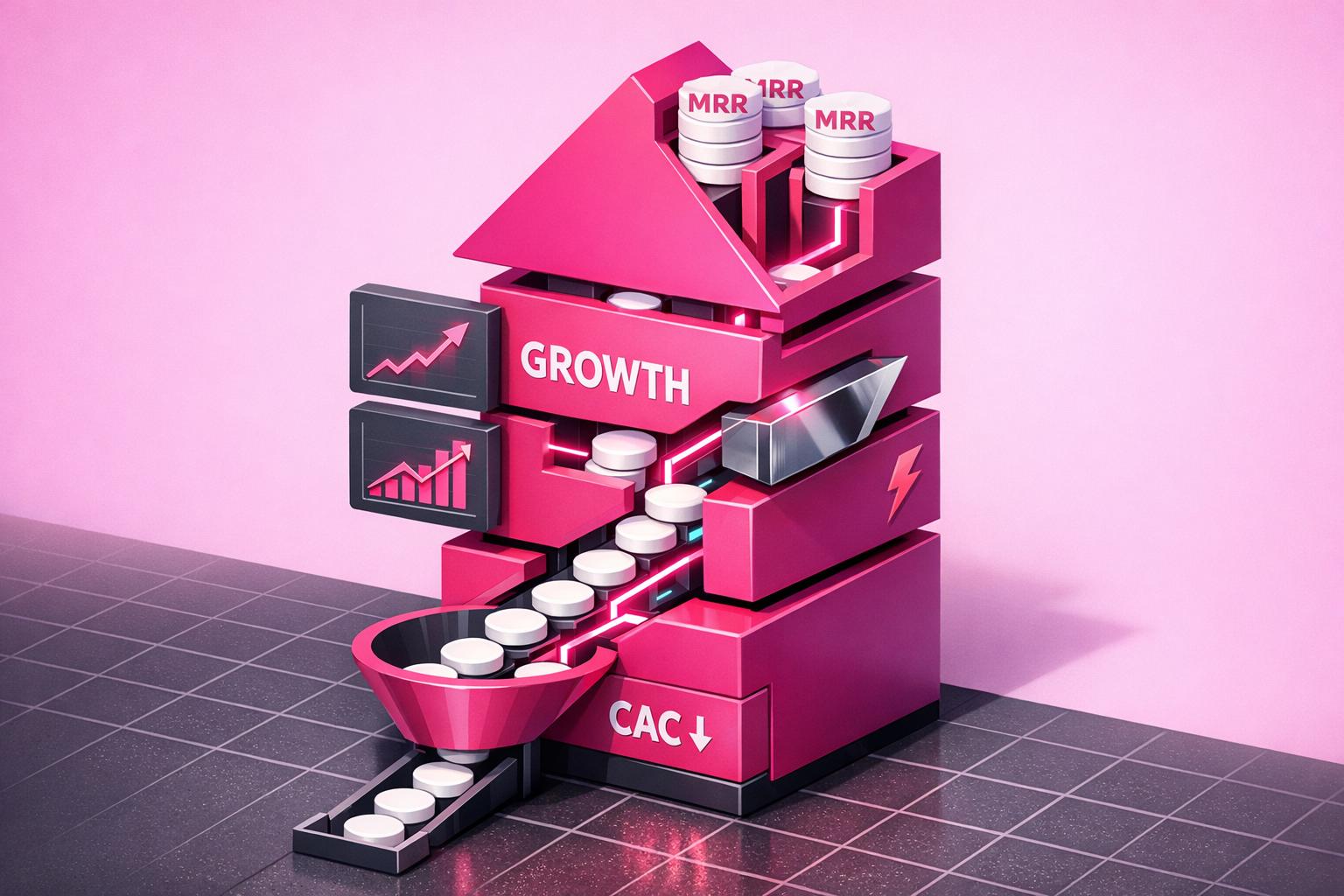
Why companies hire a fractional CMO
- Get senior marketing leadership without a full-time executive salary
- Build or fix go-to-market strategy faster
- Improve CAC, pipeline quality, and conversion performance
- Add strategic direction during growth, fundraising, or team transition
- Cost: Fractional CMOs save 50–80% compared to full-time CMOs.
- Impact: They focus on go-to-market strategies, pricing, and performance marketing.
- Results: Expect measurable improvements in CAC, MRR, and pipeline within 90 days.
How a Fractional CMO Can 10X Your B2B SaaS Growth | Ultimate Guide
What Is a Fractional CMO?
A fractional CMO is an outsourced or part-time chief marketing officer who leads marketing strategy, prioritization, and performance without joining the company as a full-time executive. They are usually hired by growing companies that need senior guidance on positioning, demand generation, pricing, and team structure, but do not yet need or cannot justify a permanent CMO hire. SaaS startups with $2M to $10M ARR often face a tough choice: they need experienced marketing leadership but can’t justify the cost of hiring a full-time CMO. As a solution, many are turning to fractional CMOs – experienced professionals who offer high-level expertise without the high cost of a permanent executive. The appeal lies in three main advantages: lower costs, adaptability to changing needs, and specialized knowledge of SaaS metrics like CAC (Customer Acquisition Cost), LTV (Lifetime Value), and pipeline velocity. Unlike consultants who provide advice and leave, fractional CMOs take ownership of results. They actively participate in leadership meetings, manage budgets, and are accountable for driving revenue growth.Lower Costs Than Full-Time Executives
Hiring a full-time CMO can be a massive financial commitment. A $250,000 base salary can balloon to over $450,000 annually when you factor in bonuses, benefits, and recruiting fees. For startups, this kind of investment could instead fund product development or marketing campaigns. Fractional CMOs, by comparison, provide strategic leadership for $60,000 to $120,000 per year – saving startups 50% to 80% of the cost of a full-time hire.“A fractional CMO gives you 80% of the value at 25% of the cost.” – Alexander Chua, Co-Founder, PipelineRoadBeyond salary, fractional CMOs eliminate other costs associated with full-time executives, such as equity dilution (typically 0.25% to 1.0% for CMOs) and the financial risks of a bad hire. A failed executive hire can cost upwards of $500,000 when you factor in severance, lost time, and team rebuilding expenses. Fractional CMOs often start with a trial period, usually three months, allowing companies to evaluate the partnership before committing long-term.
| Cost Component | Full-Time CMO (Year 1) | Fractional CMO |
|---|---|---|
| Base Salary/Retainer | $220,000 – $350,000 | $60,000 – $120,000 |
| Bonuses & Benefits | $58,000 – $127,500 | $0 |
| Recruiting Fees | $55,000 – $105,000 | $0 |
| Equity Package | 0.25% – 1.0% | Usually $0 |
| Total Annual Cost | $358,000 – $682,500 | $60,000 – $120,000 |
Flexibility for Changing Business Needs
Fractional CMOs can start contributing within 2 to 4 weeks and typically work on month-to-month or quarterly contracts. This flexibility allows startups to adjust quickly after funding rounds or strategic changes without the burden of a long-term commitment. Their role evolves as the business grows. Early on, they might spend 80% of their time on strategy, focusing on messaging and initial campaigns. By Series A, their efforts shift toward team building and setting up demand generation systems. Once the company reaches $10M to $20M ARR, they help transition to a full-time CMO, having already laid the groundwork for scalable growth.“As your company grows and ages, you’ll need less strategic marketing leadership and more tactical support.” – Stijn Hendrikse, Founder, Kalungi
Deep Knowledge of SaaS Metrics and Growth
Unlike generalist marketers who focus on vanity metrics like clicks and impressions, fractional CMOs with SaaS expertise target revenue-driving metrics. They emphasize data points such as CAC payback periods, net retention rates, and lead velocity. Even small improvements, like decreasing churn by 5%, can greatly boost profitability. Their aim is to achieve at least $3 in customer lifetime value for every $1 spent on acquisition. Take Michael Chen, CEO of CloudFlow SaaS, as an example. In 2024, his company was at $2M ARR when he brought on a fractional CMO. Over 18 months, they scaled to $8M ARR by implementing strategies that reduced CAC by 40% to 60%. The fractional CMO didn’t just run campaigns – they built a repeatable growth system that kept delivering results even after transitioning to a full-time executive.“Our fractional CMO took us from $2M to $8M ARR in 18 months. They didn’t just build our marketing engine – they created a scalable growth system.” – Michael Chen, CEO & Founder, CloudFlow SaaSThis expertise is becoming even more critical as the SaaS industry shifts from prioritizing rapid growth to focusing on efficient growth. With AI now handling around 40% of mid-level marketing tasks, senior leaders are increasingly focused on strategic oversight rather than routine execution. Next, we’ll dive into the specific strategies fractional CMOs use to drive scalable growth for SaaS startups.
What Does a Fractional CMO Do?
When it comes to boosting a SaaS startup’s marketing efforts, a fractional CMO doesn’t just give advice – they take the lead. They start by conducting a comprehensive audit of your marketing assets, analyzing competitors, and diving into market trends. This helps them identify gaps and opportunities. From there, they develop systems designed to generate consistent revenue growth, align sales and marketing efforts, and build a repeatable customer acquisition strategy that produces results.“A go-to-market (GTM) strategy isn’t just about launching a product – it’s about aligning every marketing and sales asset toward accelerated growth.” – Fulton365Their role spans three key areas: developing go-to-market strategies, fine-tuning pricing models to maximize revenue, and managing performance marketing to generate high-quality leads. Unlike agencies that focus on execution, fractional CMOs are the strategic minds behind the plan – they decide what needs to be done and why.
Building Go-to-Market Plans
Using in-depth market insights, fractional CMOs craft go-to-market plans that leverage your startup’s strengths. They start by identifying your Ideal Customer Profile (ICP) and creating messaging that sets your product apart from competitors. This process is data-driven – analyzing market trends, interviewing customers, and studying competitors to zero in on the most profitable audience segments. For instance, in 2025, a SaaS company acquired by a private equity firm worked with Fulton365. The fractional CMO developed a content-driven lead funnel, shifted underperforming ad spend, and created a 12-month roadmap. Within just 90 days, the company saw a 42% jump in qualified leads. Another example involves Exec Capital, which partnered with a tech startup struggling with brand awareness. By conducting a detailed market analysis and launching a multi-channel strategy that included digital advertising and strategic partnerships, the fractional CMO helped deliver a 150% increase in lead generation and doubled sales in six months. Fractional CMOs also ensure that sales and marketing teams are on the same page. They define funnel benchmarks, set lead-scoring criteria, and establish shared definitions for Marketing Qualified Leads (MQLs) and Sales Qualified Leads (SQLs).Refining Pricing and Revenue Models
Pricing isn’t just about numbers – it’s a strategic tool. Fractional CMOs review SaaS pricing models to ensure they match market demands and revenue targets. They examine competitor prices, gauge customer willingness to pay, and analyze the perceived value of your product. This helps them find the optimal price point. Additionally, they maximize marketing budgets by balancing automated tools with personalized sales efforts.Managing Performance Marketing and Lead Generation
Fractional CMOs manage the implementation of paid media campaigns, SEO strategies, and account-based marketing (ABM) programs. They track campaign performance closely, reallocate budgets, and pause underperforming ads to maximize pipeline growth. For enterprise SaaS businesses, they design ABM programs that focus on high-value accounts through tailored outreach. For startups with product-led growth models, they emphasize conversion rate optimization (CRO) by running A/B tests on landing pages, email sequences, and calls-to-action, ensuring every interaction drives conversions. Take the example of a cybersecurity SaaS startup that partnered with One Rawr in 2026. After six months of stagnant growth and a 40% spike in customer acquisition costs (CAC), the fractional marketing team introduced an ABM strategy and refined the company’s product-led growth tactics. This resulted in a 300% increase in their enterprise pipeline and a 45% reduction in CAC, which ultimately helped them secure Series B funding.“The fractional CMO is the architect. Everyone else is a builder.” – PipelineRoad
Fractional CMO vs Full-Time CMO: What’s the Difference?
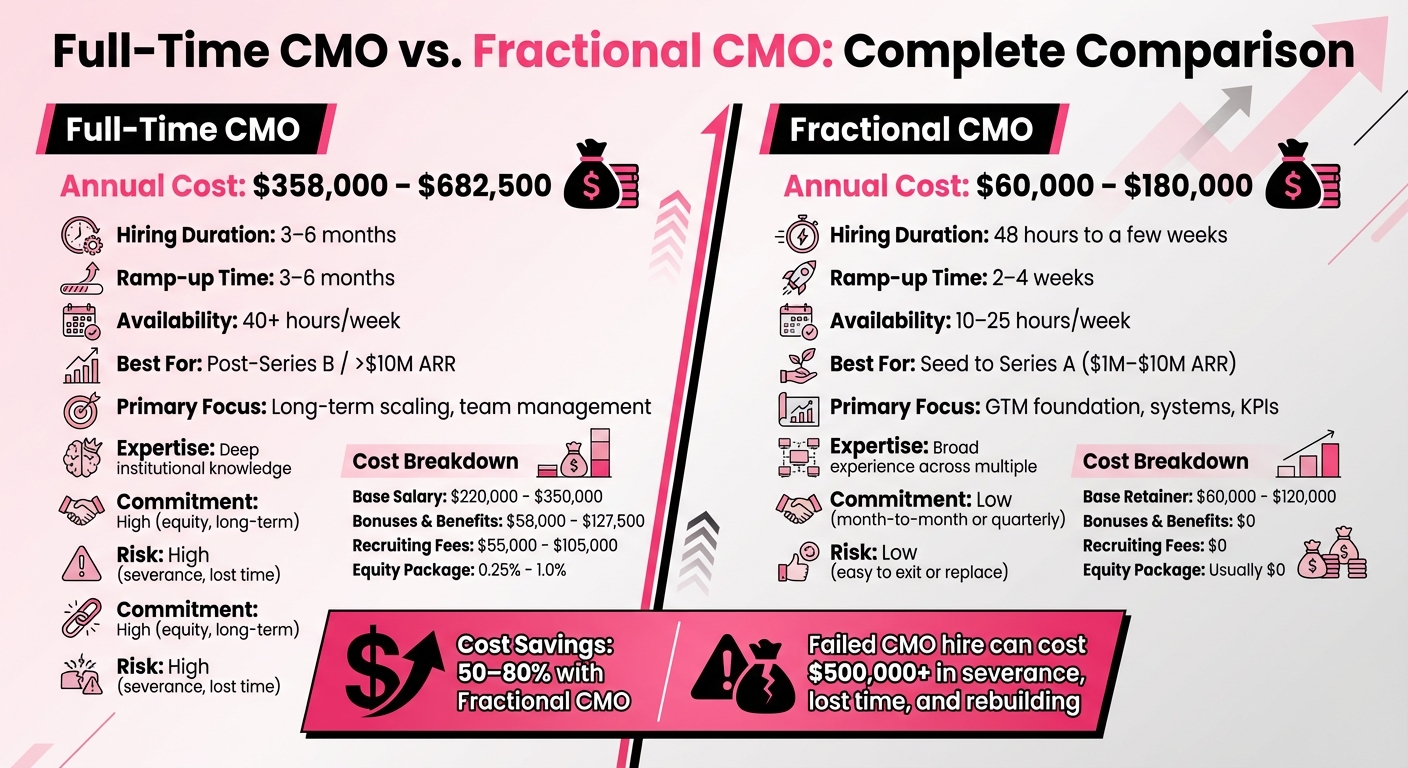
Full-Time CMO vs Fractional CMO Cost Comparison for SaaS Startups
“SaaS companies can spend six months finding and onboarding your CMO, then another three to six months to get ramped up, implement a strategic plan, and start delivering results.”The risks of hiring the wrong full-time CMO are also important to consider. A failed hire, which occurs in more than 40% of cases, can cost over $500,000 when accounting for severance, lost time, and the need to regain momentum. Alexander Chua, Co-Founder of PipelineRoad, stresses this point.
“A failed CMO hire can cost $500,000+ when you factor in severance, lost time, and rebuilding.”Fractional CMOs, however, offer flexibility. Most engagements are month-to-month or quarterly, allowing companies to adjust or exit without major financial repercussions. This adaptability, combined with lower risk, makes fractional CMOs especially appealing for startups still defining their growth strategies. To better understand the differences, here’s a side-by-side comparison:
| Feature | Full-Time CMO | Fractional CMO |
|---|---|---|
| Annual Cost | $358,000 – $682,500 | $60,000 – $180,000 |
| Hiring Duration | 3–6 months | 48 hours to a few weeks |
| Ramp-up Time | 3–6 months | 2–4 weeks |
| Availability | 40+ hours/week | 10–25 hours/week |
| Best For | Post-Series B / >$10M ARR | Seed to Series A ($1M–$10M ARR) |
| Primary Focus | Long-term scaling, team management | GTM foundation, systems, KPIs |
| Expertise | Deep institutional knowledge | Broad experience across multiple SaaS companies |
| Commitment | High (equity, long-term) | Low (month-to-month or quarterly) |
| Risk | High (severance, lost time) | Low (easy to exit or replace) |
sbb-itb-8f8c601
How a Fractional CMO Improves Growth, CAC, and Retention
Fractional CMOs are all about driving measurable results. In today’s landscape, the emphasis has shifted to efficient growth, where every marketing dollar must justify its impact on revenue per marketing employee. Their strategies focus on three key areas: cutting customer acquisition costs, increasing revenue per customer, and improving customer retention.Lowering Customer Acquisition Costs
One of the first things a fractional CMO will do is audit your marketing spend to identify and eliminate waste. Did you know that up to 40% of a startup’s marketing budget often generates clicks without contributing to the pipeline? Here’s an example: A PE-backed B2B software company was spending $35,000 a month on paid media without proper attribution. Within three weeks, a fractional CMO revamped their tracking and uncovered that 40% of the budget was wasted. By reallocating funds to high-performing channels, the company doubled its marketing-sourced pipeline in just 60 days – without increasing the overall budget. As Lou Hughes, CEO of Moving Minds, summarized:“Pipeline contribution from marketing doubled in 60 days – not from spending more, but from stopping waste.”The approach often involves scaling back on top-of-funnel paid ads and focusing instead on cost-effective channels like cold email campaigns, influencer partnerships, and organic social media. Paid ads are reserved for retargeting high-intent leads. Looking ahead, SEO strategies are evolving into Generative Engine Optimization (GEO), which uses AI-driven tools to target high-intent users and can deliver returns of 6–15x. Fractional CMOs also analyze your data thoroughly. They compare six months of ad spend with pipeline metrics to identify inefficiencies. By integrating your CRM, sales tools, and marketing platforms, they make sure that downstream events—like signed contracts or subscriptions—are fed back into ad platforms for better algorithm optimization. This tracking helps improve key metrics such as LTV:CAC ratios and pipeline velocity. Once acquisition costs are under control, the focus shifts to maximizing revenue per customer.
Increasing Average Revenue Per User
After trimming acquisition waste, the next step is increasing revenue from your existing customers. Fractional CMOs achieve this by driving upsells and cross-sells. They’ll refine user journeys and trial experiences to encourage upgrades and adoption of higher-tier plans, often using product-led growth (PLG) strategies. A big part of this involves integrating Revenue Operations (RevOps). By unifying CRM, marketing automation, and analytics, fractional CMOs track the entire customer journey and identify upsell opportunities. For example, they might flag when a customer is ready for an upgrade based on usage patterns or team growth. By 2026, 85% of fractional CMO contracts are expected to include RevOps integration to create a centralized view of customer data. Another tactic is intent conquesting, which targets high-intent searches like competitor pricing or alternative solutions. This helps capture users looking for more robust or premium options. Fractional CMOs also create sales enablement tools – like comparison landing pages or pitch decks – that help your team close larger deals or promote add-ons. As Aaron Rovner from SaaS Hero explains:“Focus often shifts from raw lead volume to pipeline quality, sales enablement assets, and lifecycle programs that increase expansion and reduce churn.”
Improving Customer Lifetime Value
Finally, retaining customers longer is essential for sustainable growth. Fractional CMOs use predictive churn analysis to identify at-risk customers early and implement targeted campaigns to keep them. Adding RevOps into their strategy can cut churn by up to 25%, which directly increases lifetime value and stabilizes average revenue per user. Mapping the customer journey is a key starting point. This ensures consistent messaging and support across touchpoints. Automated email workflows and nurturing campaigns keep customers engaged with content tailored to their behavior. For example, TripMaster, a B2B SaaS company, achieved $504,758 in Net New ARR in one year by working with a fractional CMO. Their strategy included intent conquesting, revenue tracking, and conversion optimization, delivering a 650% ROI with an 80-day payback period. To maintain a strong LTV-to-CAC ratio (ideally between 3:1 and 4:1), fractional CMOs often lean on organic marketing channels like SEO, webinars, and email campaigns, which can push LTV-to-CAC ratios above 4:1. They also implement loyalty programs, offering rewards like discounts, early access to features, or exclusive content to strengthen relationships. By analyzing customer feedback and behavior, they fine-tune onboarding processes to reduce early churn and improve satisfaction. The “land and expand” model plays a vital role here. Expansion revenue from current customers helps offset churn and increases overall LTV. Continuous A/B testing of landing pages, email subject lines, and CTAs ensures your existing customers stay engaged and invested in your product.SaaS Growth Problems and How a Fractional CMO Solves Them
Problem 1: Stalled Revenue Growth
Revenue plateaus often occur when teams are busy executing tasks – like running ads, publishing blog posts, or sending emails – but lack a cohesive strategy to tie these efforts to actual revenue. The issue isn’t a lack of effort; it’s the absence of leadership to transform scattered activities into a reliable growth engine. Common culprits include weak demand generation, low trial-to-paid conversion rates, and high churn rates. Addressing these issues can turn fragmented efforts into measurable progress.
A fractional CMO steps in to repair the most critical leaks in your funnel. They fine-tune onboarding processes, sharpen messaging, and connect ads directly to conversion paths. For example, a productivity SaaS startup saw its MRR increase 4x in just nine months after a fractional CMO introduced an internal CRM, mapped out buyer journeys with data-driven inbound content, and linked ads to onboarding flows. Another company improved its sign-up rate by 25% in three months by refining onboarding and messaging.
This level of executive insight doesn’t just fix leaks – it can also boost customer retention. With strategic lifecycle marketing, customer retention rates can improve by 15%, converting one-time buyers into long-term revenue sources.
Problem 2: High Customer Acquisition Costs (CAC)
When your CAC keeps climbing, it’s often because you’re relying on brute-force paid acquisition – pouring money into ads without a clear strategy. A B2B SaaS company in the project management space experienced a 240% increase in CAC over 18 months, reaching $890 per customer. This is unsustainable and a common issue for companies scaling ad spend without optimizing their targeting or messaging.
A fractional CMO addresses this by conducting a thorough ad spend audit to identify inefficiencies. They shift focus to intent-driven keywords, implement account-based marketing (ABM) to target specific Ideal Customer Profiles, and introduce lead scoring systems. This ensures your sales team concentrates on qualified leads. In the case above, a fractional CMO reduced CAC from $890 to $285 in just 90 days – a 68% reduction – while increasing lead quality by 145% and boosting ROI by 3.2x.
“The CAC reduction achieved by EverCMO was game-changing for our business. We went from burning cash on unqualified leads to building a sustainable, profitable growth engine.” – VP of Growth, B2B SaaS Company
Additionally, they enhance SEO and website architecture to drive organic traffic. One SaaS startup saw a 60% year-over-year increase in organic traffic after implementing a refined SEO strategy under fractional leadership. The focus shifts from quantity to quality, attracting fewer but higher-intent prospects who convert faster and cost less to acquire. Lowering CAC creates a foundation for sustainable growth.
Problem 3: Sales and Marketing Misalignment
When sales and marketing teams operate in isolation, the result is poor lead quality and a sluggish pipeline. Marketing accuses sales of slow follow-ups, while sales blames marketing for delivering unqualified leads. Meanwhile, the CEO is stuck mediating conflicts instead of driving growth. This misalignment comes at a cost – longer sales cycles, lower win rates, and missed revenue targets.
A fractional CMO resolves this by aligning both teams with shared KPIs and OKRs focused on revenue outcomes rather than vanity metrics like clicks or impressions. They establish Service Level Agreements (SLAs) that clearly define Marketing Qualified Leads (MQLs) and Sales Qualified Leads (SQLs), including follow-up timelines and recycling rules. Regular operating cadences, such as weekly “funnel delta” meetings or monthly revenue reviews, help identify and address pipeline issues in real time.
One company cut its sales cycle from 42 days to just 4 days – a 90% reduction – by improving lead qualification and aligning sales and marketing efforts. The fractional CMO also developed a unified messaging framework, ensuring marketing campaigns and sales pitches told a consistent story. Sales enablement tools, like battlecards and objection-handling guides, equipped the sales team with practical resources grounded in execution. This alignment drives cohesive, high-velocity growth across teams.
“A fractional CMO is not a part-time marketer. You are buying executive-level marketing leadership that installs strategy, decision rights, measurement discipline, and team alignment.” – Kamyar Shah
Problem 4: Weak Go-to-Market (GTM) Strategy
Launching a product without a well-defined GTM strategy often results in unclear positioning, generic messaging, and a broad Ideal Customer Profile (ICP). Founders can become bottlenecks, leading to scattered execution, premature hiring, and costly mistakes that slow progress.
A fractional CMO creates a customized GTM playbook that prioritizes your ICP with strict vertical and geographic focus. They clarify your differentiators, helping you avoid “paying to compensate for unclear positioning”. They also craft a repeatable narrative that translates product features into buyer-friendly messaging at every funnel stage. This disciplined approach accelerates market entry and builds a scalable sales playbook.
Companies leveraging fractional executives report 30% faster go-to-market timelines. A fractional CMO can also conduct a diagnostic audit before scaling, identifying gaps in customer personas, competitive positioning, and tech stacks. By focusing on a 90-day sprint to establish core messaging and sales foundations, businesses avoid scaling broken strategies. Fractional leadership often delivers 50% better ROI across campaigns, proving that strategic clarity outperforms sheer volume of execution.
sbb-itb-8f8c601
Case Study: Strategic Pete‘s Impact on SaaS Marketing
This case study highlights how Strategic Pete uses fractional CMO strategies to breathe new life into struggling SaaS marketing efforts. By leveraging a diagnostic framework, the firm pinpoints revenue leaks and inefficiencies. Their proprietary “Marketing OS” evaluates funnels, competitor positioning, and budget use. Within just 30 days, they typically uncover 15% to 25% of wasted budget. These early insights lay the groundwork for targeted improvements across marketing funnels.
Audit and Optimization of Marketing Funnels
The first step is a deep dive into marketing funnels to identify conversion barriers. This includes analyzing customer journeys, reviewing analytics, and benchmarking against competitors. Once problem areas are clear, Strategic Pete rolls out their Marketing OS within 8 weeks. This process is structured with standard operating procedures (SOPs), walkthrough videos, and an acceptance checklist. A standout tactic is prioritizing case studies to re-engage prospects and push leads closer to decision-making. As a result, companies often see a 25% to 50% boost in their marketing-sourced pipeline contribution within six months.
Reducing CAC Through Targeted Strategies
After diagnosing inefficiencies, Strategic Pete refines marketing spend to lower customer acquisition costs (CAC). By shifting budgets away from underperforming channels and focusing on high-intent traffic sources, they help SaaS companies make their ad spend work harder. Paid ads and SEO are optimized to target commercial intent, cutting waste while driving better results. Over 12 to 18 months, businesses working with Strategic Pete often experience revenue growth of 1.5X to 2.5X, all while building a scalable, sustainable marketing system.
Aligning Sales and Marketing Teams
Sustained growth requires more than just budget fixes – it demands alignment between sales and marketing teams. Strategic Pete tackles this by introducing clear lead scoring frameworks, defining MQL (Marketing Qualified Lead) and SQL (Sales Qualified Lead) criteria, and setting up Service Level Agreements (SLAs) between teams. They also streamline the MarTech stack by integrating CRM and marketing automation tools, creating a unified view of pipeline data. One B2B SaaS company saw its MQL-to-SQL conversion rate jump from 12% to 31% after improving lead handoffs and scoring. The same company reduced its sales cycle by 30%, cutting it from 112 days to 78 days, thanks to regular alignment meetings and monthly attribution reviews. If you are new to the topic, start with our guide to how fractional CMO companies compare.
“Marketing now drives half our pipeline. Should’ve brought him in a year earlier.” – CEO, B2B SaaS Company
Tracking Results and Planning for the Future
Metrics to Monitor
To measure the impact of a fractional CMO, it’s essential to track both revenue and efficiency metrics. Start with key indicators like Monthly Recurring Revenue (MRR) or Annual Recurring Revenue (ARR), Customer Acquisition Cost (CAC), and Customer Lifetime Value (LTV). Beyond these, focus on the quality of your pipeline. Metrics such as marketing-qualified pipeline value and SQL-to-close conversion rates often provide more actionable insights than simply counting raw leads. Pipeline velocity is another critical metric – it shows how quickly opportunities move from initial contact to closed deals. Pair this with an analysis of channel ROI and CAC payback periods to ensure your marketing dollars are being spent wisely. By the 90-day mark, you should see measurable improvements tied to clear KPIs and pipeline performance. Operational metrics also play a big role. Assess CRM hygiene, decision velocity, and the delivery of foundational frameworks like a Go-to-Market strategy or positioning framework – ideally within 4–6 weeks. Regular check-ins, such as a brief weekly sync between the CEO and fractional CMO, help maintain alignment and momentum. Once these metrics are in place, the focus shifts to creating a marketing system that drives sustainable growth.Creating a Repeatable Marketing System
The ultimate goal of a fractional CMO’s engagement is to leave behind a marketing system that continues to deliver results long after their role ends. This involves creating playbooks, establishing standardized dashboards, and empowering the team to operate independently. Take VenturEd Solutions, for example. In February 2026, this EdTech SaaS company enlisted fractional CMO Matthew Deal to fix a problematic HubSpot and Salesforce integration. By documenting over 60 data fields and streamlining processes across teams, VenturEd Solutions nearly doubled its MQL-to-SQL conversion rate – jumping from 8–11% to 17% in just three months. They also saved 30 hours per week in manual tasks. As Deal explains:“The fractional CMO’s job is to build an experimentation framework where every campaign teaches you something, and every insight feeds the next decision.”This example highlights the importance of a strong marketing infrastructure. A repeatable system starts with clear attribution—linking your CRM, marketing automation, and analytics tools to create a single source of truth. This removes data silos and cuts down on manual reconciliation. Incorporating marketing automation for tasks like lead nurturing and customer segmentation keeps the system flexible and scalable. Shared dashboards that provide real-time insights into metrics like CAC, LTV, and pipeline velocity enable leadership to make well-informed decisions without needing constant updates. Many SaaS startups work with fractional CMOs for 6–18 months to build a strong marketing engine before hiring a full-time executive. When a permanent leader arrives, the organization will have well-documented systems and processes, setting them up for success. As Alexander Chua, Co-Founder of PipelineRoad, states:
“The goal of a fractional CMO engagement is to build toward independence – either by hiring a full-time marketing leader or by building systems that run without daily CMO involvement.”
Conclusion
Growing a SaaS startup takes smart marketing leadership, but not every company can afford a full-time executive. That’s where a fractional CMO steps in – offering high-level expertise with the flexibility to adapt as your business grows. For SaaS companies with ARR between $1M and $20M, this approach has become increasingly popular. A fractional CMO offers extensive SaaS expertise, helping optimize key metrics like CAC, LTV, and ARR while implementing effective go-to-market strategies and pricing models. Unlike the lengthy process of hiring a full-time executive, a fractional CMO can be onboarded within weeks. This allows you to address urgent growth challenges without the delays or risks associated with a bad hire. Additionally, it’s a cost-effective way to align your marketing efforts with scalable growth, setting your startup up for long-term success. The real value of a fractional CMO lies in their ability to build systems that last beyond their tenure. Whether it’s creating repeatable processes, defining clear KPIs, or empowering your team to operate independently, their goal is to leave your company stronger. As Alexander Chua from PipelineRoad puts it:“The goal of a fractional CMO engagement is to build toward independence – either by hiring a full-time marketing leader or by building systems that run without daily CMO involvement”.
FAQs
What is a fractional CMO?
A fractional CMO is a part-time or outsourced marketing executive who leads strategy, prioritization, and performance without the cost of a full-time CMO. They help companies build marketing systems, improve go-to-market execution, and make better growth decisions.
How much does a fractional CMO cost?
A fractional CMO typically costs far less than a full-time CMO because companies pay only for the level of involvement they need. The exact cost depends on scope, experience, and weekly commitment, but the model is designed for businesses that need senior marketing leadership without a full-time executive salary.
When should a SaaS company hire a fractional CMO?
A SaaS company should consider a fractional CMO when growth has stalled, messaging is unclear, lead generation is inconsistent, or the business needs senior marketing leadership before it is ready for a permanent executive hire.
What’s the difference between a fractional CMO and a marketing consultant or agency?
A fractional CMO owns marketing direction at a leadership level. They set strategy, align teams, define priorities, and stay accountable for outcomes. Consultants usually advise on specific issues, while agencies mainly execute defined channel work.
Is a fractional CMO worth it?
For companies that need executive-level marketing leadership but cannot justify a full-time CMO, a fractional CMO can be a cost-effective way to improve strategy, performance, and accountability without taking on a permanent executive cost.