
A strong SaaS startup marketing strategy connects positioning, customer acquisition, pipeline growth, and retention into one measurable system. For startups between $1M and $20M in ARR, the challenge is rarely a lack of marketing activity. It is usually a lack of senior strategy tying campaigns, channels, budget, and revenue goals together.
That is where fractional leadership can outperform both agencies and full-time executive hires. A fractional CMO gives SaaS startups experienced marketing direction without the cost, hiring risk, or long ramp time of a full-time CMO. This article explains when the model works, what it should deliver, and how to use it to build a scalable SaaS marketing engine.
- Cost-Effective Leadership: A fractional CMO costs $60K–$120K annually, compared to $250K–$400K+ for a full-time CMO.
- Faster Results: They bring proven playbooks and connections, avoiding the 3–6 month onboarding period of full-time hires.
- Focus on Revenue: Fractional CMOs align marketing directly with revenue goals, improving pipeline efficiency by up to 25%.
- Flexible Engagement: Startups can scale their involvement based on needs – 10 hours/week for seed-stage companies, up to 20 hours/week for Series A/B.
For startups struggling with fragmented marketing efforts, high CAC, or slow growth, a fractional CMO can streamline operations and deliver measurable results in 6–18 months. This approach reduces hiring risk, frees up CEO time, and builds a scalable marketing engine.
When to hire: If your ARR is $3M–$7M and marketing consumes 20–30% of the CEO’s time, it’s time to bring in a fractional CMO.
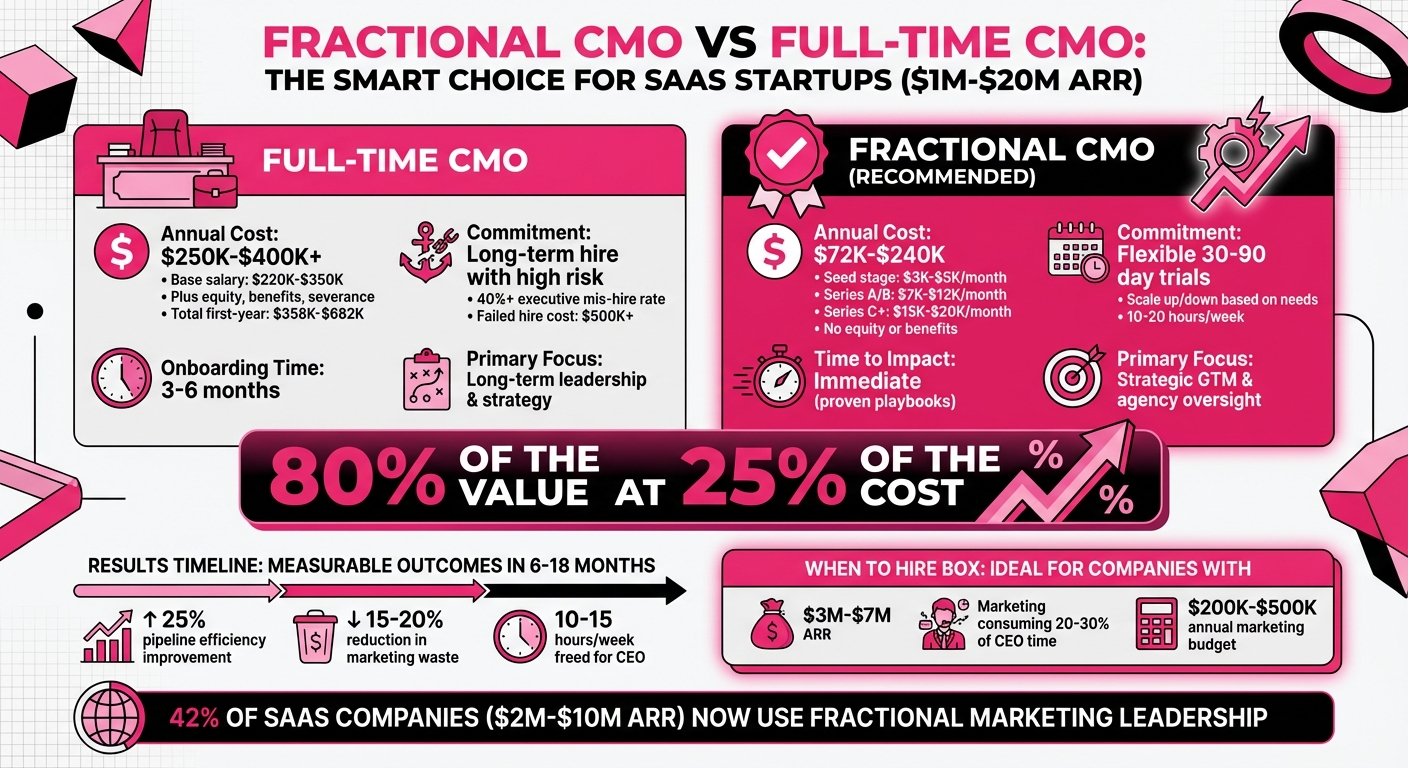
Fractional CMO vs Full-Time CMO Cost and Value Comparison for SaaS Startups
How a Fractional CMO Can 10X Your B2B SaaS Growth | Ultimate Guide
sbb-itb-8f8c601
What a SaaS Startup Marketing Strategy Should Include
A SaaS startup marketing strategy should define who you are targeting, why they should choose your product, which channels will generate a qualified pipeline, and how success will be measured. Before scaling spend, startups need a clear system for:
- Ideal customer profile and segmentation
- Positioning and messaging
- Demand generation channels
- Content and SEO strategy
- Paid acquisition and conversion paths
- Sales and marketing handoff
- CAC, LTV, ARR, pipeline, and payback tracking
Without these pieces, marketing becomes a collection of disconnected campaigns. With them, marketing becomes a repeatable growth engine that supports revenue goals.
Main Challenges in SaaS Marketing
SaaS startups generating annual recurring revenue (ARR) between $1 million and $10 million often face hurdles that make it tough to scale their marketing efforts. These challenges create a gap that neither junior marketers nor agencies can fully bridge on their own.
High CMO Salaries and Limited Budgets
For early-stage startups, hiring a full-time CMO can feel financially out of reach. The base salary alone for a CMO ranges from $220,000 to $350,000, and when you factor in total first-year expenses, the cost balloons to $358,000–$682,500. That’s a huge chunk – if not all – of a typical startup’s marketing budget, which is often around $500,000.
Because of these costs, many founders take on marketing responsibilities themselves. But here’s the catch: most CEOs don’t have the 10 to 20 hours per week required to build a cohesive go-to-market strategy. The result? Marketing efforts end up scattered and disconnected, failing to drive meaningful revenue growth.
Scaling Without a Clear Strategy
Without senior marketing leadership, startups often lean on junior employees or agencies. While they might execute tasks, the lack of strategic oversight leads to poorly aligned campaigns, ineffective ads, and unqualified leads. This creates a patchwork of efforts rather than a unified marketing engine.
In fact, about 42% of SaaS companies with $2 million to $10 million in ARR now turn to fractional marketing leadership to fill this gap.
“Marketing without strategy is a collection of activities. Marketing with strategy is a growth engine.”
- Alexander Chua, Co-Founder, PipelineRoad
The stakes are high. Acquiring a new customer can cost five to seven times more than retaining an existing one. Yet many startups ramp up marketing spend too soon, before locking in a repeatable go-to-market process. This often leads to wasted budgets, high churn, and an inability to achieve scalable growth. With markets constantly shifting, the need for a well-defined strategy becomes even more pressing.
Fast-Moving Market Conditions
External market dynamics only add to the complexity. Globally, there are roughly 30,800 SaaS companies, and around 500 new competitors enter the scene every year. This creates intensely crowded markets where similar solutions fight for attention – true “gladiator arenas”.
On top of that, today’s B2B buyers do much of their research independently, often long before they ever speak to a sales rep. This means marketing must deliver SaaS inbound marketing to make an impact. Companies that struggle to adapt quickly risk falling behind, especially when leadership is already stretched thin with product development and fundraising efforts.
How a Fractional CMO Strengthens Your SaaS Startup Marketing Strategy
Fractional CMOs address many challenges startups face by offering high-level expertise, proven strategies, and immediate impact. They help streamline marketing efforts, optimize spending, and reduce onboarding time.
Lower Costs Compared to Full-Time Hires
For early-stage startups, hiring a full-time CMO can be financially out of reach. Fractional CMOs provide a more affordable alternative with flexible retainer models. Costs vary depending on the company’s stage:
- Seed-stage startups: $3,000–$5,000 per month
- Series A and B companies: $7,000–$12,000 per month
- Series C+ companies: $15,000–$20,000 per month
This caps annual expenses at roughly $240,000, excluding additional costs such as equity, benefits, or severance. If you need a VP rather than a CMO, the same model applies to a fractional VP of marketing. Here’s a quick comparison of costs and focus areas:
| Role | Annual Cost (Est.) | Primary Focus |
|---|---|---|
| Full-Time CMO | $250,000–$400,000+ plus equity | Long-term leadership & strategy |
| VP of Marketing | $150,000–$220,000 | Execution-focused management |
| Fractional CMO | $72,000–$240,000 | Strategic GTM & agency oversight |
| Marketing Agency | $60,000–$240,000 | Specialized execution (SEO, Paid Ads) |
“A fractional CMO gives you 80% of the value at 25% of the cost.”
- Alexander Chua, Co-Founder, PipelineRoad
Unlike full-time hires that require months to onboard, fractional CMOs hit the ground running with established playbooks and networks. This efficiency reduces risks and accelerates growth, making them an attractive option for startups looking to scale smartly.
Access to Senior-Level SaaS Expertise
Fractional CMOs bring years of hands-on experience in SaaS marketing, often with a track record of building go-to-market strategies, optimizing funnels, and scaling teams. Their expertise spans key areas like:
- Defining the Ideal Customer Profile (ICP)
- Managing complex buyer journeys
- Keeping Customer Acquisition Costs (CAC) below $2,500
- Driving ambitious growth targets, such as “T2D3” (Triple, Triple, Double, Double, Double annual revenue)
“The Fractional CMO should have a wealth of templates and playbooks to pull from, remove the repetitive tasks, and focus your marketing function’s strategic elements.”
- Stijn Hendrikse, Author and Marketing Leader
This depth of knowledge not only improves marketing efficiency but also reduces the risk of costly hiring mistakes. With executive mis-hires occurring at rates of 40% or more – and a failed full-time CMO hire potentially costing over $500,000 – fractional CMOs offer a safer way to test leadership fit before committing long-term.
Flexible Engagement Models
Fractional CMOs adapt their involvement based on your company’s stage and needs. For example:
- Seed-stage startups: 10 hours per week for messaging and positioning
- Series A/B companies: 15–20 hours per week for SaaS demand generation and agency oversight
- Mature organizations: 3–4 days per week to prepare for IPO readiness
Contracts are often flexible, starting with 30-day sprints or 90-day trials. This allows startups to scale support during critical periods, like product launches or fundraising, and reduce involvement when less support is needed.
“A fractional CMO is not a part-time marketer. You are buying executive-level marketing leadership that installs strategy, decision rights, measurement discipline, and team alignment without the cost and risk of a full-time CMO hire.”
- Kamyar Shah, Fractional COO & CMO
Fractional CMOs are typically a transitional solution. They help establish systems and strategies, then assist in hiring and training a full-time CMO once the company reaches $8 million to $15 million in ARR.
Faster Product and Campaign Launches
In competitive markets, speed is essential. Fractional CMOs leverage their networks and proven processes to accelerate campaign execution. By 2026, AI is expected to handle around 40% of mid-level marketing tasks, such as content creation and campaign optimization. This allows fractional CMOs to focus on the most critical decisions, like capital allocation, positioning, and channel prioritization.
“A Fractional CMO’s value in 2026 is more of capital allocation in addition to strategy and execution guidance.”
- Sathish Nagarajan, Founder & SaaS Growth Architect, SaasConsult
With clear decision-making frameworks, fractional CMOs can double or triple pipeline efficiency within six to 12 months. This eliminates bottlenecks and ensures campaigns launch quickly, giving startups the momentum they need without the delays of onboarding a full-time executive.
When to Hire a Fractional CMO
As discussed earlier, budget constraints and scattered execution can only take a company so far. At some point, strategic leadership becomes indispensable.
For many SaaS startups, growth often plateaus between $3 million and $7 million in annual recurring revenue (ARR). Despite increasing marketing budgets, returns can be underwhelming. CEOs spend 20–30% of their time on tasks like managing ad campaigns or coordinating with agencies—time that could be better spent on investor meetings or sales strategy. Meanwhile, marketing teams focus on tactical execution without linking their efforts to revenue goals. This inefficiency is compounded by unexplained spikes in customer acquisition costs—sometimes as high as 60%. These challenges underscore the importance of bringing in a strategic leader.
The data paints a clear picture of the leadership gap. About 65% of CEOs report that marketing execution consumes a significant portion of their time, and 70% of small businesses experience stalled growth within three to five years. When early-stage marketing tactics stop delivering results and founder-led efforts become a bottleneck, it’s time to consider a fractional CMO. This role can provide the strategic direction needed to align marketing with sales, streamline operations, and build scalable systems.
Timing matters. Startups with less than $1 million in ARR should focus on product-market fit rather than executive-level strategy. However, once a company is investing $200,000 to $500,000 annually in marketing and gearing up for a Series A or B funding round within the next 6 to 12 months, a fractional CMO becomes crucial. This leader can analyze why paid channels aren’t scaling, develop growth metrics that resonate with investors, and craft a compelling narrative for the board.
“When the highest-paid executive spends 20–30% of their time on marketing decisions a CMO should own, the company has outgrown founder-led marketing.” – Shashank Shalabh, Fractional CMO
The sweet spot for hiring a fractional CMO is typically between $5 million and $20 million in ARR. At this stage, a fractional CMO can free up 10 to 15 hours per week for the CEO, reduce marketing waste by 15–20%, and improve overall performance by 25%. These engagements usually last 6–18 months and serve as a bridge to hiring a full-time CMO.
Additionally, poor lead quality and weak alignment between sales and marketing often signal that execution alone won’t solve the problem. Only 8% of companies report strong alignment between these two functions, while siloed teams can lead to a 24% drop in revenue growth. A fractional CMO can address these issues by setting shared KPIs, improving lead handoffs, and ensuring that marketing efforts directly contribute to revenue growth. In short, they transform disjointed efforts into a scalable growth engine, filling the leadership gap that hinders progress.
How to Build and Execute a SaaS Startup Marketing Strategy with Fractional Leadership
Once you’ve identified the need for fractional leadership, it’s essential to integrate this role as a genuine executive position. When bringing on a fractional CMO, ensure they have full access to data and establish clear expectations right from the start. To make the most of their expertise, you need a well-defined leadership strategy.
Running a Marketing Audit
The first 30 days should be all about understanding your current marketing setup. A fractional CMO will dive into your CRM to audit data hygiene, review the performance of existing channels, evaluate team and agency capabilities, and gather insights from stakeholders. The goal? To determine whether your challenges stem from strategy or execution.
Within two weeks, they should craft a 90-day plan with 3–5 measurable outcomes and achievable quick wins. Make sure all key systems and leadership insights are accessible to them, and establish clear decision-making guidelines, including budget limits and hiring authority.
Connecting Marketing to Revenue Goals
Marketing efforts need to shift from focusing on impressions to driving revenue. Key performance indicators (KPIs) like customer acquisition cost (CAC), lifetime value (LTV), annual recurring revenue (ARR), and pipeline velocity should take center stage. A fractional CMO bridges the gap between marketing activities and financial outcomes, justifying budgets with ROI forecasts and CAC payback periods.
To achieve this, they need to be deeply involved in sales pipeline reviews, lead-quality assessments, and the definition of shared metrics such as sales-qualified leads (SQLs). Service-level agreements (SLAs) for lead follow-up should also be established. Additionally, joining sales calls gives them firsthand insight into why deals close, not just why leads enter the funnel.
Improving SEO, PPC, and Inbound Channels
A fractional CMO focuses on crafting the overarching strategy – setting goals for keyword rankings, budget allocation, and ROI – while leaving the technical execution to the team. For SEO, this means creating topic clusters around pillar pages targeting high-traffic keywords, supported by SaaS content marketing services targeting long-tail keywords. For PPC, they’ll apply the “Rule of 40”, scaling paid campaigns only when the sum of growth and profit margin exceeds 40%, ensuring healthy unit economics.
Conversion rate optimization (CRO) through A/B testing of landing pages is another critical task. They’ll also establish a measurement system to track weekly leading indicators and monthly primary KPIs. Companies that combine a fractional CMO with a dedicated execution team often see a stronger pipeline. A weekly 30-minute sync between the CMO and CEO ensures alignment and clears roadblocks.
Which Marketing Channels Should a SaaS Startup Prioritize?
The right SaaS marketing channels depend on ARR stage, sales cycle, deal size, and buyer intent. Early-stage startups should usually focus on channels that validate messaging and create fast feedback, such as founder-led content, outbound testing, customer interviews, and targeted paid campaigns.
As the company grows, the strategy should shift toward scalable demand generation. That often includes SEO topic clusters, comparison pages, case studies, lifecycle email, paid search, LinkedIn campaigns, partner marketing, and sales enablement content.
A fractional CMO helps decide which channels deserve budget now, which should wait, and which need better measurement before scaling.
“The fractional CMO is the architect. Everyone else is a builder. If you hire a fractional CMO who’s writing LinkedIn posts and building landing pages themselves, you didn’t hire a CMO – you hired an expensive content marketer.” – Alexander Chua, Co-Founder, PipelineRoad
Case Study: Strategic Pete
How Strategic Pete Works
Strategic Pete operates on a 90-day framework, breaking leadership tasks into three clear phases. This method shows how fractional leaders can quickly establish scalable, revenue-driven marketing strategies.
- Weeks 1–4: The focus is on analyzing 24 months of pipeline data, defining the Ideal Customer Profile (ICP), refining the value proposition, and setting up a baseline KPI scorecard.
- Weeks 5–8: This phase includes testing CRM and marketing automation tools, creating a 12-week content calendar, and running experiments with LinkedIn and paid advertising.
- Weeks 9+: Efforts shift to scaling high-ROI channels, building performance dashboards, and documenting workflows to streamline onboarding for future hires.
Strategic Pete enforces the “One-Screen Rule”, ensuring all critical KPIs fit on a single dashboard without the need to scroll. This keeps leadership focused on metrics that directly impact revenue rather than being distracted by vanity metrics. Another key principle is the “Launch at 80%” approach – campaigns are launched when they’re 80% ready, allowing for real-time adjustments based on immediate feedback.
This structured approach has consistently set the stage for success, as illustrated in the following client stories.
Client Example: Go-to-Market Success
The framework has delivered measurable results for clients. For instance, WebStreet, a digital asset acquisition platform, partnered with Strategic Pete’s Managing Partner, Mike Vranjkovic, to implement a case-study-driven content strategy. This approach re-engaged dormant leads and brought in new conversions. The focus wasn’t just on creating content – it was about leveraging customer success stories to address objections and speed up decision-making during the sales process.
Another success story comes from Tanganyika Wildlife Park. Under Strategic Pete’s guidance, the organization saw dramatic improvements. LynnLee Schmidt from Tanganyika shared:
“Peter is a true multiplier for those around him. Since we began working together, we’ve 2X’d our revenue and 10X’d our reach with his project management and strategic guidance”.
These examples highlight how fractional leadership can drive significant growth and market reach without the expense of hiring a full-time executive.
Conclusion
For SaaS startups scaling from $1M to $20M in ARR, fractional leadership isn’t just cost-effective—it’s often the smarter move. While hiring a full-time CMO can cost $250,000 to over $400,000 annually and take 3–6 months to show results, a fractional CMO delivers about 80% of the value at just 25% of the cost, with measurable outcomes in weeks. The numbers back it up: 42% of SaaS companies in the $2M–$10M range now rely on fractional marketing leadership, a significant jump from 18% in 2021.
But this approach isn’t just about saving money. Fractional leadership delivers real strategic value. It aligns marketing efforts directly with revenue goals at a time when growth is critical. As Alexander Chua, Co-Founder of PipelineRoad, aptly puts it:
“The most expensive marketing mistake isn’t hiring the wrong agency. It’s operating without senior marketing leadership during the years when your growth trajectory is being set”.
A fractional CMO doesn’t just consult – they own pipeline outcomes, tie marketing investments to ROI, and contribute as a key member of your leadership team.
If your CEO is spending more than 10 hours a week managing ad campaigns or approving content, it’s a clear sign you need fractional leadership. Start with a 90-day trial by setting clear goals, granting access to your CRM and financial data, and scheduling regular syncs with the CEO to maintain alignment.
This model works because it reduces the risk of costly hiring mistakes—which occur in over 40% of cases—while providing the senior expertise needed to build scalable marketing systems. Whether you eventually transition to a full-time CMO or continue with a fractional partnership, the goal remains the same: to build a marketing engine that drives consistent, measurable growth.
Fractional leadership takes scattered marketing efforts and turns them into a unified growth strategy. For SaaS startups ready to scale, it’s not just a temporary fix – it’s the strategic boost your business needs.
FAQs
What is the best marketing strategy for a SaaS startup?
The best SaaS startup marketing strategy starts with a clear ideal customer profile, strong positioning, and a small number of measurable acquisition channels. Instead of trying every tactic at once, startups should focus on the channels most likely to create qualified pipeline, then scale what proves repeatable.
How much should a SaaS startup spend on marketing?
Marketing spend depends on stage, growth goals, funding, and customer acquisition costs. A startup preparing for Series A or B may invest more aggressively, while an earlier-stage company should prioritize product-market fit, messaging, and efficient channel testing before scaling spend.
Which SaaS marketing metrics matter most?
The most important SaaS marketing metrics usually include CAC, LTV, CAC payback period, ARR growth, pipeline velocity, conversion rates, churn, and marketing-attributed revenue. These metrics show whether marketing is creating sustainable growth rather than just activity.
How do I know if I need a fractional CMO or just better execution?
If your SaaS startup is pulling in revenue between $3 million and $7 million but growth has hit a plateau – even with more marketing spend – a fractional CMO could be the solution for refining your strategy. Some clear signs it’s time to consider this option include:
- Rising customer acquisition costs are eroding profitability.
- A lack of a clear, cohesive marketing strategy to guide your efforts.
- Marketing bottlenecks caused by founder involvement slow overall progress.
If your team is executing well but seems to lack strategic direction, a fractional CMO can step in to align your efforts with long-term goals. However, if the issue is more about operational execution than strategy, it’s better to strengthen those processes before bringing in high-level strategic leadership.
What should I expect a fractional CMO to deliver during the first 90 days?
In the first 90 days, a fractional CMO focuses on evaluating and strategizing for your business. They start with a go-to-market audit, which involves reviewing your marketing and sales systems, analyzing your competitive positioning, assessing campaign performance, and diving into customer data.
From there, they develop a strategic plan that identifies key growth opportunities and lays out a roadmap for scalable marketing efforts. By the end of the first 30 days, you can expect to see clear priorities, actionable plans, and measurable progress toward boosting your marketing’s overall effectiveness.
How do I measure ROI from a fractional CMO engagement?
To evaluate the ROI of a fractional CMO, track key metrics such as marketing-attributed revenue, pipeline growth, and improvements in customer acquisition cost (CAC). The ROI formula is straightforward:
ROI = (Value Generated – Cost of Investment) / Cost of Investment × 100
Compare the financial results they produce – like higher revenue or reduced operational costs – against their annual fee, which typically ranges between $60,000 and $200,000+. This comparison helps you determine their overall value and contribution to your business.