
When B2B growth stalls, the problem is often not a lack of marketing activity. It is usually a handful of strategic mistakes that weaken positioning, attract the wrong leads, slow sales cycles, or make it harder for buyers to understand why they should choose you.
- Unclear Messaging: Confusing, jargon-heavy language drives website visitors away and reduces conversions.
- Focusing on Features Over Benefits: Highlighting technical details instead of real-world outcomes makes it harder for prospects to see value.
- Ignoring Urgency (“Why Now”): Failing to create urgency leads to lost opportunities as prospects deprioritize your solution.
- Sales and Marketing Silos: Poor collaboration between teams results in wasted leads and lost revenue.
- Chasing Lead Volume Over Revenue: Prioritizing quantity over quality floods the pipeline with unqualified leads.
- Overlooking Competitors: Not differentiating your offering makes you blend in and lose pricing power.
- Never Updating Messaging: Stale messaging fails to resonate as markets and buyer needs evolve.
- Not Supporting Sales Teams: Without the right tools and materials, sales teams struggle to close deals. When the gap is leadership rather than tools, fractional sales leadership can fix it without a full-time VP of Sales hire.
Quick Takeaways:
- Clear, benefit-driven messaging is key to engaging prospects.
- Align sales and marketing efforts with shared revenue goals.
- Create urgency and focus on high-quality leads over sheer volume.
- Regularly test and refine messaging to stay relevant.
- Equip sales with the tools they need to convert leads into revenue.
Addressing these issues helps turn marketing from scattered activity into a clearer revenue engine. The first step is identifying which mistake is creating the biggest drag on growth. An outside view helps here, which is where a B2B marketing consultant earns the fee.
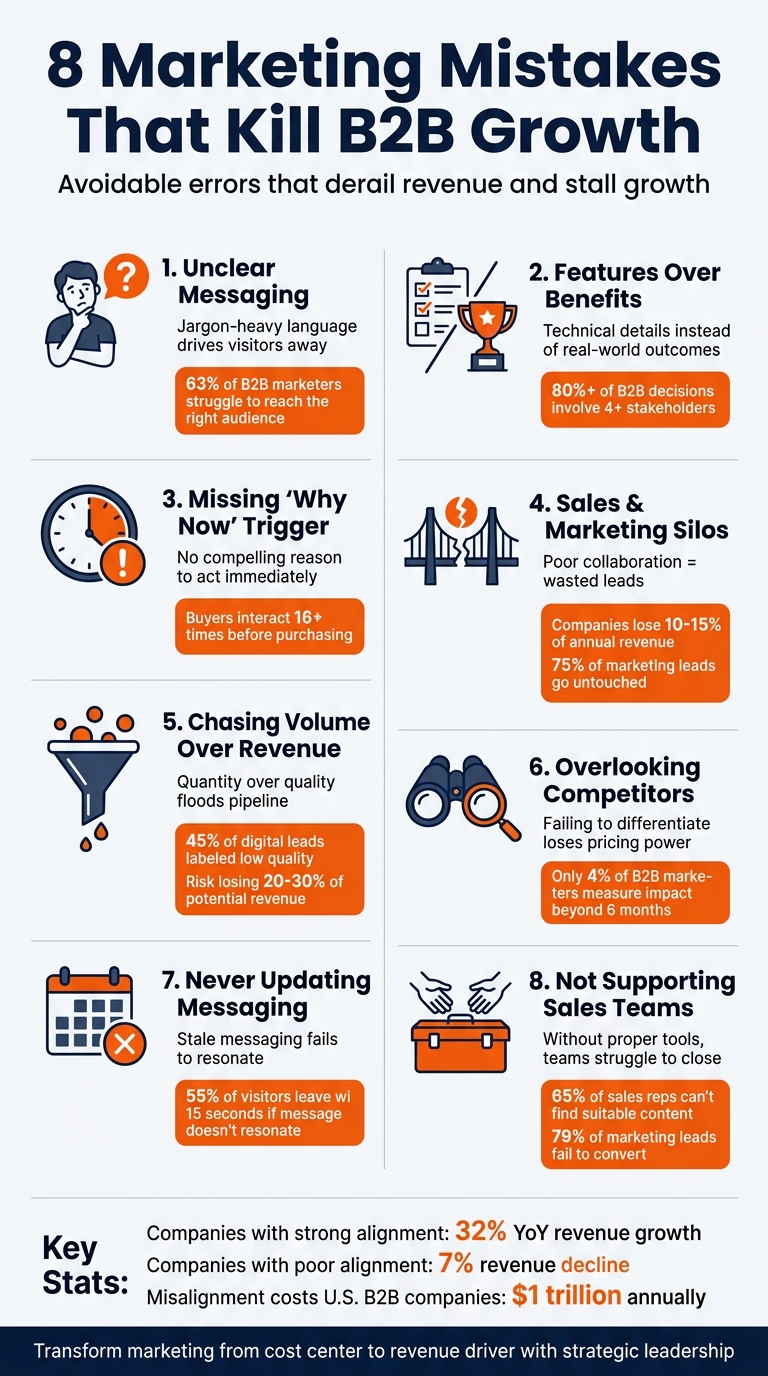
8 B2B Marketing Mistakes That Kill Revenue Growth
8 Marketing Mistakes That Kill B2B Growth
sbb-itb-8f8c601
1. Unclear Messaging
Using vague, jargon-heavy phrases like “empowering strategic innovation through tailored digital transformation solutions” can leave potential customers scratching their heads. When your messaging is packed with buzzwords, visitors are left to figure out what you actually mean – and most won’t bother.
“If your audience has to work to understand you, they won’t stick around. Confused visitors don’t convert. They bounce.” – Rajat Kapoor, Copywriter and Marketer
The goal isn’t to sound overly professional; it’s to build trust. If your value proposition is unclear, prospects might assume your offering is generic or lacks substance. Worse, unclear messaging can create a gap between marketing and sales, leading to qualified leads being dismissed as “unqualified”.
Impact on B2B Growth
Unclear messaging has measurable downsides. High website bounce rates are often a direct result of confusing or generic content. In B2B, where multiple stakeholders need to grasp your message, this can be a dealbreaker. Generic messaging that fails to connect with specific buyer personas quietly erodes conversion rates. In fact, 63% of B2B marketers cite reaching the right audience as a significant challenge.
How to Fix It
Clear messaging is the foundation of effective marketing. Start by talking to your most satisfied customers. Ask them why they chose your product or service and what problems you solved for them. Then, use their actual words in your marketing copy. Focus on outcomes rather than features. For example, instead of saying “AI-powered analytics platform with real-time dashboards”, say, “We help CFOs cut monthly close time from 10 days to 3 days.”
“Your latest features are truly awesome but customers do not care about technicalities, but about the problem it solves for them.” – Emelie Malmquist, Head of Marketing, Adnami
Conduct a jargon audit of your website. Replace phrases like “tailored digital transformation solutions” with straightforward, specific statements like “We build conversion-focused websites for B2B service businesses”. Additionally, revisit your Ideal Customer Profile (ICP) every year. As market conditions shift, updating your ICP ensures your messaging stays sharp and relevant.
Why This Hurts B2B Growth
This mistake often shows up when marketing teams are busy but not aligned around a clear revenue message. Strong marketing leadership can help turn scattered campaigns into a sharper positioning strategy that sales can actually use.
“In most B2B companies, marketing’s job is to help sales succeed.” – Helen Shorthouse, Fractional CMO
Clear messaging doesn’t just improve conversions; it ensures that marketing and sales are aligned. If your website isn’t converting visitors into qualified leads, or sales consistently rejects marketing-generated leads, it’s a sign you need strategic leadership to rebuild your messaging. This issue is often part of a larger misalignment that senior marketing leaders are uniquely equipped to resolve.
2. Talking About Features Instead of Benefits
Many B2B websites end up reading like technical manuals. They’re packed with details about capabilities, integrations, and platform features – but often fail to explain why these matter. When someone visits your site, they shouldn’t have to decode phrases like “AI-powered analytics with real-time dashboards” into something meaningful like “this will save me 20 hours a week.” If you make them do that mental work, they’ll probably just leave.
“When your value isn’t obvious, people assume it’s not valuable.” – Rajat Kapoor, Copywriter and Marketer
This isn’t just a writing issue – it’s a strategic one. Focusing on features forces potential buyers to figure out the value on their own, which adds unnecessary friction. And in the B2B world, where prospects often leave quickly if the message isn’t clear, this confusion can be costly. Plus, when your messaging leans too heavily on features, you risk blending in with competitors who offer similar specs. Without emphasizing outcomes, you become just another name in a crowded market.
Impact on B2B Growth
When your messaging is too feature-heavy, it doesn’t just hurt your website’s conversion rates – it can stall your entire sales pipeline. If prospects can’t immediately understand how your solution impacts their business, they’re less likely to engage, book demos, or share your content. Overloading your communication with jargon and technical details creates confusion, and confused buyers rarely convert.
This issue becomes even more pronounced when multiple stakeholders are involved in the decision. In fact, over 80% of B2B purchase decisions involve four or more decision-makers. If your messaging doesn’t clearly explain the benefits for each role – whether it’s the CFO, VP of Operations, or IT Director – it makes it harder for your internal advocates to pitch your solution. This can lead to longer sales cycles and increase the chances of decisions being delayed or abandoned.
How to Fix It
To shift from features to benefits, start with feature-benefit mapping. For each feature, identify its direct business benefit and any emotional benefits, such as reducing stress, saving time, or helping your buyer advance in their career. Use the “So That” method to reframe features into outcomes. For example: “Our platform integrates with your CRM so that your sales team can access real-time lead data without switching tools”.
Another effective approach is the before-and-after framework for case studies and landing pages. Highlight the customer’s challenge (before), show the transformation (after), and, when possible, include measurable results. Instead of saying, “We implemented our enterprise solution”, say something like, “Before, the finance team spent 10 days on monthly close; now, they complete it in 3 days, freeing 140 hours monthly for strategic planning”.
Lastly, talk to your best customers. Ask them why they chose your solution, which problems you solved, and what surprised them most. Their feedback often uncovers benefits you hadn’t considered – like boosting team morale or reducing interdepartmental friction – that can resonate with future prospects.
Why This Hurts B2B Growth
Many leadership teams mistake marketing activity for marketing strategy. They see campaigns running – content being published, ads going live, trade shows happening – but the pipeline isn’t growing. The problem isn’t a lack of effort; it’s a lack of strategic focus. Feature-first messaging is often a symptom of this deeper issue.
“A list of tactics is not a plan. It’s a reaction to the fear of standing still.” – The Fractional CMO Company
This is where fractional CMOs come in. They bring the strategic oversight that execution-focused teams often lack. Instead of just managing campaigns, they ensure that every piece of content, every ad, and every sales conversation builds a clear and compelling case for why your solution is the best choice. When messaging is bogged down with features, it creates misalignment between marketing and sales, making it harder for qualified buyers to move forward.
Fractional CMOs also understand that only 4% of B2B marketers measure marketing impact beyond six months – a critical window for building brand recognition and category leadership. If your marketing efforts aren’t translating into revenue and your messaging isn’t resonating, it’s a sign that you need experienced leadership to realign your strategy. This kind of leadership doesn’t just refine your messaging; it also lays the groundwork for sustainable growth in a competitive market.
3. Missing the “Why Now” Trigger
To achieve consistent B2B growth, your marketing efforts need to do more than just target the right audience – they must also create urgency. Even if you’re reaching the right prospects, failing to explain why they should act immediately can cost you deals. The “Why Now” trigger is what pushes a prospect from casual interest to active decision-making. This could be something like a business expansion or a major investment that demands immediate attention. Without addressing this urgency, prospects may lose interest – not because your solution doesn’t meet their needs, but because there’s no compelling reason to prioritize it right now.
Impact on B2B Growth
Ignoring the “Why Now” trigger can lead to prospects quietly slipping out of your sales funnel. This happens when marketing doesn’t address their immediate needs or follow-up efforts are too slow. In B2B, where sales cycles can last anywhere from six months to three years, this gap can be a major setback. On average, buyers interact with a brand 16 or more times before making a purchase. If your messaging doesn’t resonate during this critical period, a competitor may seize the opportunity.
Take this real-world example: A California law firm spent $120,000 over nine months on a fractional CMO who focused solely on impressions rather than building systems to capture buyer triggers. After revamping their approach – with tools like a robust CRM, custom pipelines, and automated lead routing that reached 91% of leads within 45 minutes – the firm signed 219 cases within 12 months, generated $17 million in revenue, and saw an 18.6x ROI.
How to Fix It
To address this, start with intent-based lead scoring tied to your Ideal Customer Profile (ICP). Track key actions like visits to your pricing page, demo requests, or case study downloads.
Then, build automated workflows to nurture stalled deals and unresponsive leads. A well-timed email sequence that addresses objections or shares relevant updates can re-engage prospects when their “Why Now” moment arises.
Finally, review your lead routing and response times. Establish Service Level Agreements (SLAs) between sales and marketing to ensure high-priority leads are contacted quickly. For instance, delays like waiting a week to respond to a demo request can result in lost opportunities. Streamlining these processes ensures your team can act swiftly when urgency strikes, directly impacting revenue growth.
Why This Hurts B2B Growth
When considering fractional CMOs, it’s essential to differentiate between “coordinators” and “builders”. Coordinators focus on strategy and deliver polished plans but often lack the technical expertise to implement systems like CRM workflows, attribution tracking, or automated follow-ups. These services typically cost $3,000–$5,000 per month. On the other hand, builders, who charge $8,000–$12,000 monthly, develop operational systems that your company retains long after the engagement ends.
For example, a real estate private equity sponsor once spent $25,000 on a strategy deck that produced no leads. After switching to a builder who created a custom acquisition system targeting investor intent, they raised $6.3 million in capital within ten days. The difference was clear: the builder implemented infrastructure that could identify and act on urgent buying signals.
“The ‘cheaper’ route ends up costing more – because it buys activity, not outcomes.” – Incitrio
Missing the “Why Now” trigger isn’t just a messaging issue; it’s a disconnect between marketing and revenue goals. Effective marketing leadership doesn’t stop at creating campaigns – it builds the systems that ensure your brand is ready and persuasive when prospects are prepared to act. Addressing this gap is a critical step in aligning marketing efforts with measurable revenue results.
4. Sales and Marketing Working in Silos
When sales and marketing operate in isolation, it’s not just a communication issue – it’s a direct hit to revenue. Companies with misaligned teams lose an estimated 10–15% of their potential annual revenue, with some losing as much as 38%. On the flip side, organizations with strong alignment enjoy 32% year-over-year revenue growth, while their misaligned counterparts experience a 7% decline.
Impact on B2B Growth
The numbers paint a clear picture. Poor coordination during lead handoffs means nearly 75% of marketing-qualified leads (MQLs) go untouched. This breakdown happens when marketing celebrates hitting MQL goals, but sales dismisses those leads as unqualified. The result? Lost revenue, longer sales cycles, and higher acquisition costs.
Another issue: 60–70% of B2B content created by marketing never gets used in sales conversations. Resources like case studies and one-pagers often sit unused because sales teams can’t find them, don’t trust them, or think they’re irrelevant.
“The hidden price of departmental silos is a creeping erosion of competitiveness. While companies look outward for innovations and growth opportunities, they often lose more internally through poor alignment than they can gain externally.” – Dr. Michael Schmidt, Senior Advisor, Boston Consulting Group
Acknowledging these challenges is the first step toward better collaboration between sales and marketing.
How to Fix It
Breaking down silos requires a structured approach. Begin by establishing formal Service Level Agreements (SLAs) that clearly define what qualifies as an MQL versus a Sales Qualified Lead (SQL). These SLAs should also set response times – ideally within 24 hours. Shift the focus from vanity metrics like clicks and impressions to shared revenue goals. Both teams should track metrics like pipeline contribution, lead-to-customer conversion rates, and revenue driven by marketing efforts.
A practical way to start is with a 90-day sprint:
- Diagnose: Audit your pipeline to identify gaps.
- Align: Create shared definitions and processes for leads and goals.
- Systematize: Automate handoffs and set up unified dashboards.
Integrating your CRM is also critical. Ensure it allows for seamless data flow between marketing automation tools and sales systems. Finally, prioritize regular team meetings – 87% of aligned teams meet weekly to discuss goals, lead quality, and upcoming initiatives.
Why This Hurts B2B Growth
With fewer than 10% of companies achieving strong alignment, the need for unified leadership is clear. When considering fractional CMOs, look for those with expertise in Revenue Operations (RevOps). This approach brings together people, processes, and technology to create alignment across departments. By 2025, 75% of the fastest-growing companies are expected to adopt a RevOps model.
Mid-market companies in the US, particularly those with revenues between $2 million and $30 million, are especially at risk. They’re large enough for misalignment to hurt but often lack the resources for a dedicated RevOps team. A fractional CMO can bridge this gap, offering high-level strategic guidance without the $300,000 to $500,000+ price tag of a full-time CMO. These leaders focus on creating systems that tie marketing efforts directly to closed deals, ensuring sustainable growth.
| Metric | Siloed Environment | Aligned Environment |
|---|---|---|
| Primary Focus | Lead Volume (MQLs) | Pipeline & Revenue |
| Sales Cycle | 30% Longer | Optimized/Shorter |
| Lead Follow-up | 73% of leads ignored | Defined SLA (<24 hours) |
| Retention | Standard | 36% Higher |
| Data | Fragmented/Siloed | Single Source of Truth (CRM) |
The disconnect between sales and marketing is more than a personality clash – it’s a revenue drain. Fixing it takes strategic leadership, clear processes, and the right tools to build trust between teams. This is exactly where outsourced marketing leadership shines, helping businesses close the gap and reclaim lost revenue.
5. Chasing Lead Volume Instead of Revenue
One common pitfall in marketing is prioritizing lead volume over revenue, which often results in a misaligned pipeline and wasted effort. While a dashboard showing 5,000 new leads might look impressive, it’s meaningless if only a small percentage of those leads are qualified. This is the essence of the “digital lead trap” – a pipeline that appears full but converts poorly.
Impact on B2B Growth
The consequences of chasing volume instead of quality can be severe. Companies risk losing 20–30% of potential revenue due to weak lead-to-order conversion rates. Shockingly, up to 45% of digital leads are labeled as low quality by sales teams. Compounding the issue, only 4% of B2B marketers evaluate marketing’s impact beyond six months – a critical timeframe for building brand equity and pricing strength. When marketing celebrates hitting MQL targets while sales struggles with poor-quality leads, the focus shifts dangerously away from revenue generation to superficial metrics.
How to Fix It
Start by clearly defining your ideal customer profile (ICP). This should include specifics like company size, industry, revenue range, and key decision-makers. A list of 50 well-qualified leads aligned with your ICP will always outperform a list of 500 poorly matched ones. Conduct a thorough audit of your funnel to identify where leads drop off – whether it’s from MQL to SQL or SQL to opportunity – and address those gaps.
Refocus your metrics from outputs (like clicks and impressions) to outcomes, such as marketing-sourced pipeline, SQL conversion rates, and revenue impact. Establish service-level agreements (SLAs) with sales to ensure prompt lead follow-up. For instance, responding to a lead within five minutes can boost qualification odds by up to 21 times compared to waiting 30 minutes. Finally, adopt revenue-based scoring systems that prioritize leads based on purchase intent and potential deal size, rather than simply counting form submissions. These adjustments shift efforts from tactical lead generation to strategic revenue growth.
Why This Hurts B2B Growth
For businesses evaluating outsourced marketing leadership, this issue highlights the value of a fractional CMO. These leaders focus on revenue outcomes rather than vanity metrics. A fractional CMO brings the expertise to align sales and marketing, turning lead volume into a reliable revenue engine. They create “handshake” dashboards within your CRM, ensuring both teams track marketing’s contribution to closed-won deals. This level of strategic oversight is exactly what mid-market companies need when they’re stuck in a cycle of high activity but stagnant pipeline growth.
6. Ignoring What Competitors Are Doing
Most B2B companies don’t struggle because of competitors themselves – they struggle because they fail to stand out. If buyers can’t tell your offerings apart from three other vendors, you lose the ability to charge premium prices. The goal isn’t to copy competitors but to understand the market well enough to carve out your own space.
Impact on B2B Growth
Overlooking competitive positioning can weaken three critical growth drivers: brand equity (why buyers choose you over similar options), category recall (being the first name buyers think of), and pricing power (maintaining margins even when competitors discount). If your messaging blends in with everyone else, you risk being dragged into a price war. Your sales team may also struggle to explain what makes you different.
The long-term impact is clear: only 4% of B2B marketers measure marketing success beyond six months. This shows just how often businesses miss the mark on strategies that build lasting differentiation.
How to Fix It
Start with the Three-Question Test:
- Who are we for (and NOT for)?
- What do we “own” that no one else can?
- What have we chosen not to do?
If your answers sound like your competitors, your strategy needs work. Real strategy requires making tough choices. Focus on what sets you apart so that buyers can see your value – even without your logo or brand name. Shift your priorities from chasing short-term clicks to tracking long-term indicators like brand equity, category recall, and pricing power.
“Better to be a lighthouse for ten people than a candle for ten thousand.” – The Fractional CMO Company
Why This Hurts B2B Growth
To turn competitive challenges into opportunities, you need strong leadership. While earlier mistakes may focus on messaging or lead quality, ignoring competitive positioning directly threatens your market presence.
For B2B CMOs, positioning and differentiation are often the hardest challenges to tackle. Internal teams tend to play it safe, trying to appeal to everyone, which waters down a company’s unique value. A fractional CMO, however, can bring fresh insights as a “Positioning Architect”, bridging the gap between big-picture strategy and actionable tactics. This approach helps mid-market companies in crowded spaces transform competitive noise into a true advantage, building marketing efforts that fuel revenue growth.
7. Never Testing or Updating Your Message
Many B2B companies fall into the trap of treating messaging as a one-and-done task. They launch a website, craft ad copy, and move on to the next project. The issue? Markets are constantly shifting. Customer priorities evolve, competitors reposition themselves, and economic conditions fluctuate. If your message stays static, it risks becoming outdated and ineffective.
Impact on B2B Growth
Stale messaging often leads to what experts call the “Activity Trap” – businesses stay busy with social media posts, blog updates, and campaigns, but none of it drives meaningful revenue. Without consistent testing, you’re operating on guesswork. Here’s a telling statistic: 55% of website visitors leave a site within 15 seconds if the message doesn’t immediately resonate. That’s barely enough time to communicate your value, let alone convince someone to take action.
Over time, this disconnect creates serious challenges. Customer acquisition costs climb without clear reasons, and teams struggle to figure out why leads aren’t converting. Shockingly, only 4% of B2B marketers track the long-term impact of their efforts beyond six months. Add to this the fact that over 80% of B2B buying decisions involve four or more stakeholders, and it’s clear that your messaging needs to connect with multiple decision-makers – not just one. If you’re not testing and refining for these diverse audiences, you’re likely leaving revenue untapped.
How to Fix It
Start by engaging with your best customers. Ask them why they chose your company and what sets you apart. Use their exact words in your messaging, steering clear of buzzwords like “strategic innovation” or “tailored digital transformation solutions”. Clarity is key.
Regularly audit your content for relevance and test alternate messaging using performance metrics like demo requests and conversion rates. Replace vague statements with specific, outcome-driven language. For example, instead of saying, “We help businesses grow”, try, “We build conversion-focused websites for B2B service businesses”.
“In most B2B companies, marketing’s job is to help sales succeed.” – Helen Shorthouse, Fractional CMO, Shorthouse Consulting
Ensure consistency across all channels – your ads, website copy, and sales conversations should tell the same story. Make it a habit to revisit your messaging at least once a year to reflect changes in your business, market dynamics, and customer needs. This proactive approach not only sharpens your brand’s voice but also signals adaptability, a critical quality for effective leadership.
Why This Hurts B2B Growth
If your marketing efforts feel like a flurry of activity without measurable ROI, you’re not alone. Many B2B teams mistake busyness for strategy, which can be a costly error. Regular message testing creates a feedback loop between your marketing initiatives and revenue results – a key metric for any strategic marketing leader. A fractional CMO can step in to introduce data-driven testing and hold vendors accountable for results, not just deliverables.
This level of oversight is particularly valuable when internal teams lack the time or expertise to consistently test and refine. A fractional CMO brings the experience needed to identify what’s working, cut wasteful spending, and pivot quickly based on real performance data. For mid-market companies stuck in the activity trap, this kind of leadership can turn scattered efforts into a cohesive strategy that drives growth.
8. Not Giving Sales the Tools They Need
One of the biggest challenges for sales teams is the lack of proper tools and support, which directly impacts revenue. Often, sales teams are handed leads with no context, rely on outdated materials, and struggle with disjointed CRM systems. This creates inefficiencies, with 65% of sales reps unable to find suitable content to share with prospects, and half their time wasted on unproductive prospecting.
Impact on B2B Growth
When sales teams lack the right tools, revenue takes a hit at every stage of the funnel. A staggering 79% of marketing leads fail to convert due to poor nurturing systems. The financial toll is massive – misalignment between sales and marketing costs U.S. B2B companies an estimated $1 trillion annually. Companies with poor alignment face a 4% revenue decline, while those with strong alignment see 32% year-over-year revenue growth.
The solution requires more than just effort – it demands the right infrastructure. Sales teams thrive when they have access to effective lead scoring systems, shared revenue dashboards that track meaningful metrics (beyond just clicks), and tailored sales enablement content for every stage of the buyer journey.
How to Fix It
- Audit Your Pipeline: Start by diagnosing your lead flow to pinpoint where revenue leaks occur.
- Define “Sales-Ready” Leads: Collaborate with marketing to create a shared definition of sales-ready leads using closed-won data. Set SLAs that establish lead volume expectations and enforce rapid follow-up – such as responding to high-intent leads within two hours.
- Upgrade Metrics: Use your CRM to create shared dashboards that follow leads from their first interaction through to closed-won deals, prioritizing revenue-impact metrics over vanity stats.
- Clean Up Content: Review your content library and remove outdated materials. A shocking 91% of marketing content goes unused by sales because it’s either irrelevant or too hard to find.
These steps not only improve conversions but also reinforce the unified revenue strategy necessary for sustainable growth.
Why This Hurts B2B Growth
Equipping sales with the right tools is just as critical as aligning messaging and team efforts. For mid-market companies ($2M–$30M), the stakes are particularly high – they’re large enough to lose millions to misalignment but often too small to justify a full-time Revenue Operations team. A fractional CMO can fill this gap by building the necessary RevOps infrastructure. This includes integrating CRM systems, automating lead routing, and creating closed-loop reporting.
“In most B2B companies, marketing’s job is to help sales succeed.” – Helen Shorthouse, Fractional CMO, Shorthouse Consulting
When considering outsourced leadership, ensure their expertise includes sales development representative (SDR) enablement. This involves creating landing pages, refining tracking systems, cleaning CRM data, and designing nurture workflows for stalled deals. The right leader won’t just deliver leads – they’ll ensure sales teams have everything they need to turn those leads into revenue. Companies with strong alignment see 24% faster three-year revenue growth and 27% faster profit growth. That’s the kind of growth that turns challenges into opportunities for scale. For the wider picture, see our guide to demand generation for B2B companies. To see how we handle this for clients, read about B2B marketing with Strategic Pete.
Conclusion
The eight mistakes discussed all stem from one core issue: mistaking activity for effective strategy. When marketing leaders get bogged down in tasks like copy reviews and calendar management, the essential strategic work often gets sidelined. The outcome? Packed schedules that mask an underperforming pipeline.
Fixing these mistakes starts with clarity: clear positioning, clear buyer priorities, clear sales handoffs, and clear revenue metrics. Once those foundations are in place, marketing stops being a collection of disconnected activities and becomes a system for creating qualified demand. For the brand-side version of this list, see the mistakes in marketing brands still make in 2026.
For mid-market B2B companies that need senior marketing leadership but are not ready for a full-time CMO, Strategic Pete provides fractional CMO support focused on practical revenue systems, sharper messaging, and better sales and marketing alignment.
“Strategy is the art of sacrifice, and sacrifice is uncomfortable.” – The Fractional CMO Company
The most successful businesses focus on smarter marketing, not just doing more. They’ve answered the three big questions: Who is their target audience (and who isn’t)? What sets them apart from competitors? And what are they intentionally choosing not to pursue? By building a system that prioritizes these answers, companies can drive smarter marketing and achieve sustainable growth.
FAQs
What are the most common marketing mistakes that kill B2B growth?
The most common mistakes are unclear messaging, focusing on features instead of business outcomes, failing to create urgency, misalignment between sales and marketing, chasing lead volume instead of revenue, weak competitive differentiation, stale messaging, and poor sales enablement.
Which B2B marketing mistake hurts growth the fastest?
Unclear messaging often causes the fastest damage because it affects every stage of the funnel. If buyers cannot quickly understand what you do, who you help, and why it matters, they are less likely to convert, book a call, or bring your solution to other decision-makers.
How do you know if your marketing is slowing B2B growth?
Warning signs include high website traffic but low conversion rates, lots of leads that sales rejects, long sales cycles, weak differentiation from competitors, inconsistent messaging across channels, and marketing reports that focus on activity instead of pipeline or revenue.
Which of these 8 mistakes is hurting us most right now?
The biggest misstep often stems from poor strategic leadership – like failing to make the most of a fractional CMO. When this happens, it can take a serious toll on your ROI and stall your growth. Tackling this problem head-on can help refocus your marketing strategy and deliver stronger outcomes.
What metrics show marketing is driving revenue (not just leads)?
Key metrics to track include the percentage of marketing-generated leads that successfully convert into sales, the revenue directly attributed to marketing efforts, and how well marketing activities align with measurable revenue outcomes. It’s also essential to tackle the issue of marketing-sales misalignment, which can result in a loss of 10-38% of potential revenue, making it a critical factor in showcasing marketing’s contribution to overall revenue.
When should we hire a fractional CMO instead of a full-time CMO?
When your business requires strategic marketing leadership but isn’t ready for the expense of a full-time executive, it might be time to consider a fractional CMO. This option works well if your company is in a growth phase, doesn’t yet need a full-time CMO, or thrives with flexible, project-based leadership that focuses on delivering a strong return on investment.