
Your marketing budget may look productive on metrics like clicks and impressions, but your marketing budget isn’t generating revenue. Here’s the problem: 47% of marketing spend is wasted, and 79% of leads never convert into paying customers. This happens because marketing focuses on activity-based metrics, while executives prioritize revenue and profit. Misaligned strategies, poor ROI tracking, and a lack of leadership are the main culprits.
Key Issues:
- Misaligned Goals: Marketing teams celebrate leads; executives care about revenue.
- Weak Tracking: 40-60% of budgets are wasted due to poor measurement practices.
- Leadership Gaps: Without senior oversight, budgets often fund ineffective campaigns.
Solutions:
- Audit Spending: Identify waste and reallocate to high-ROI channels.
- Track ROI Accurately: Use proper attribution models and tools to tie spend to revenue.
- Align Teams: Ensure sales and marketing work together with shared goals.
- Hire Leadership: Fractional CMOs can provide expert guidance at a lower cost.
By addressing these issues, you can turn your marketing budget into a revenue driver instead of a cost center.
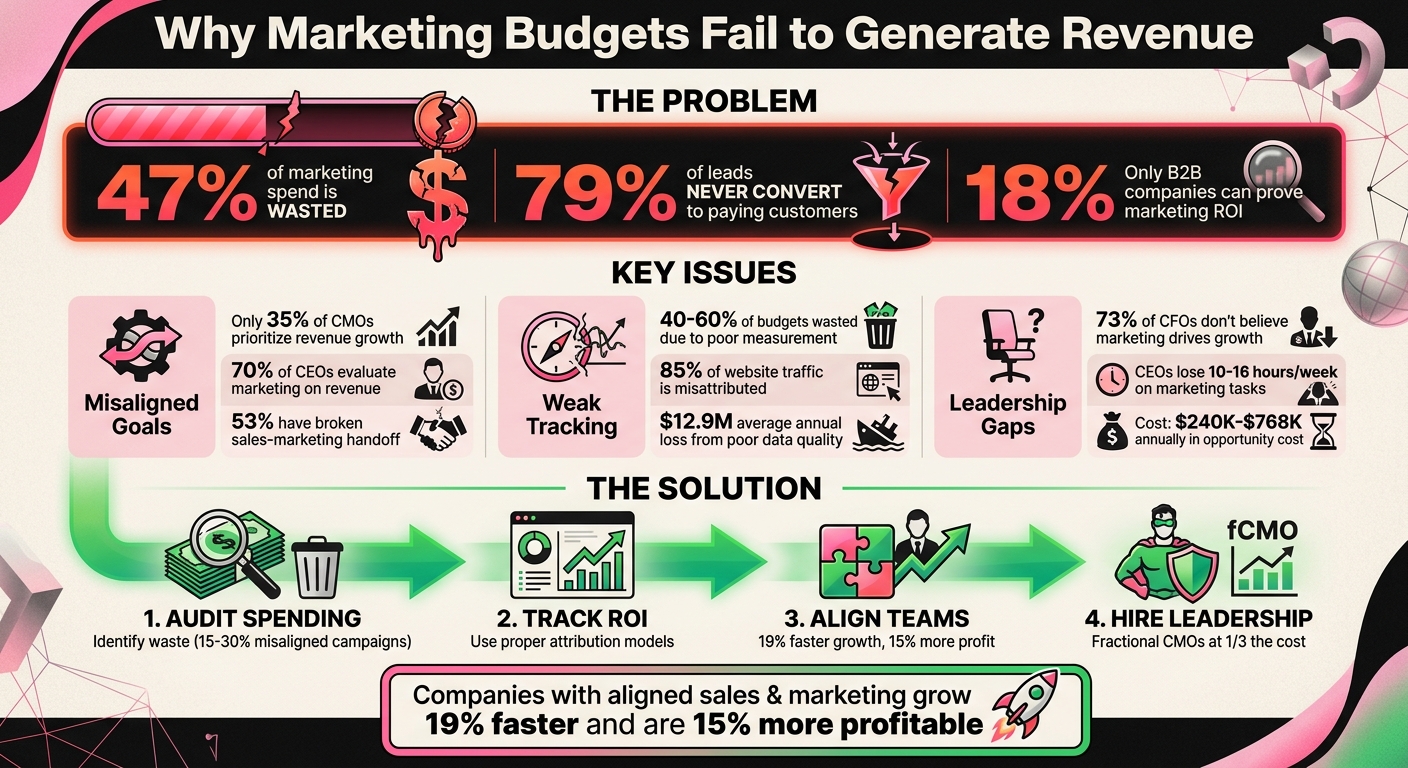
Marketing Budget Waste: Key Statistics and Solutions
The Budgeting Mistake Costing You a 10x ROI
sbb-itb-8f8c601
Misaligned Strategies: Spending Without Revenue Goals
Marketing budgets often crumble when they focus on vanity metrics rather than driving revenue. While executives prioritize year-over-year revenue growth, only 35% of CMOs consider it a top priority. This disconnect leads to marketing celebrating achievements that executives don’t value, creating a cycle of poor decisions that undermine marketing ROI.
Common Strategy Mistakes
One of the biggest mistakes is jumping into tactics without a clear strategy. For instance, companies might invest in social media hires, paid campaigns, or website redesigns without first defining their Ideal Customer Profile or mapping out the revenue funnel. As Darrin Caldwell, Founder of True Fulcrum, aptly says:
“Execution without strategy is expensive noise”.
This leads to plenty of activity – posts, clicks, and impressions – but rarely translates into closed deals.
When metrics are misaligned, revenue outcomes remain unclear. Add deeper strategic flaws, and your budget becomes even less effective. For example, combining Customer Acquisition Costs into a single figure obscures individual channel performance. Imagine your Google Ads deliver a 16:1 ROI, while Facebook ads return just 0.78:1. If you only look at the blended average of 8:1, you’ll keep funding underperforming channels.
Another issue is the disconnect between marketing and sales teams. 53% of organizations report a broken handoff between the two, leaving leads to languish in unmanaged CRM queues. This lack of follow-up wastes potential revenue.
Marketing teams also tend to commission studies or adopt frameworks only to abandon them when switching agencies. A different approach can yield better results. For example, National Indoor RV Centers implemented a systems-based strategy, boosting quarterly lead volume by 175.6% without increasing agency spending. The secret? Focusing on a cohesive strategy, not just scattered tactics.
The Cost of Strategy Misalignment
Strategic missteps don’t just waste marketing budgets—they directly affect your bottom line. When growth slows, marketing budgets are cut 8% to 20% faster than sales or product budgets. While 86% of marketing leaders feel pressured to make major changes, many lack the clarity to implement changes that actually work. As a result, companies continue funding the 80% of activities that yield minimal results, while neglecting the 20% that truly drive success.
Consider the work Darrin Caldwell did with Roots Management Group between 2023 and 2026. By unifying three brands and integrating a fragmented CRM, the team implemented a revenue-focused strategy that generated 127,000 leads and millions in annual revenue. Lead volume grew by 47% in both Year 1 and Year 2, while sales alignment efforts boosted home sales by 83% year-over-year. The difference wasn’t a bigger budget – it was aligning every action with revenue goals from the start.
Poor ROI Tracking and Measurement Problems
Even with a strong strategy in place, weak tracking systems can sabotage your ability to prove marketing’s impact. Shockingly, between 40% and 60% of marketing budgets are wasted due to poor measurement practices. This gap in tracking and analysis costs the average organization $12.9 million annually in lost opportunities from poor data quality alone. Without accurate measurement, even the most well-planned strategies can fail to turn investments into measurable revenue.
Why ROI Tracking Is Necessary
Without proper tracking, businesses are essentially operating in the dark. It becomes nearly impossible to distinguish which channels are genuinely driving revenue and which are merely taking credit. The reality? Only 18% of B2B companies can definitively prove how their marketing efforts impact revenue. On top of that, 65% of marketing leaders admit they struggle to demonstrate financial results to their executive teams.
As KISSmetrics aptly states:
“Marketing has a credibility problem. We know our campaigns drive revenue, but when the CFO asks for proof, we have only anecdotes”.
Effective ROI tracking ties every dollar spent to actual revenue generated. Take XYZ Marketing Agency, for example. In Q1 2026, they faced a potential 50% budget cut. By implementing full-funnel tracking with tools such as dynamic call tracking and AI-driven intent scoring, they demonstrated $1,847,000 in marketing-generated revenue for the quarter. Their findings showed that Facebook ads had a weak 0.78:1 ROI, Google Ads delivered a 16.2:1 ROI, and partner webinars achieved an impressive 28.9:1 ROI. Instead of losing funding, the agency secured a 19% budget increase. This highlights how precise tracking can completely shift the narrative.
Common Measurement Problems
While accurate tracking is crucial, flawed measurement systems often become a major obstacle. The root issue isn’t the tools themselves – it’s the data architecture behind them. Attribution success depends 90% on data engineering and only 10% on the tools used. Most tracking systems fall short, identifying only 5% to 15% of website visitors. That means 85% or more of traffic is misattributed to generic categories like “direct” or “organic”. Additionally, these systems often fail to connect cross-device behavior, leading to revenue credit being assigned to the wrong channels.
Platform self-reporting compounds the problem. Companies like Google, Meta, and LinkedIn have a vested interest in overstating their impact. For instance, Billy Footwear tackled this issue by adopting first-party identity resolution through LayerFive in March 2026. By moving beyond platform-reported data and focusing on identity-resolved tracking, they achieved 72% year-over-year revenue growth with just a 7% increase in ad spend.
Other common issues include fragmented systems – marketers reportedly use an average of eight different tools – and a lack of standardized UTM governance or clear lifecycle definitions. Without clear, automated rules for what qualifies as an MQL (Marketing Qualified Lead) versus an SQL (Sales Qualified Lead), accurately measuring funnel progression becomes nearly impossible.
| Attribution Model | Best For | Key Limitation |
|---|---|---|
| Last Touch | Simple audits; identifying closing channels | Overcredits retargeting; ignores awareness journey |
| First Touch | Top-of-funnel investment decisions | Ignores conversion-stage channels |
| Linear | Balanced channel assessment | Treats all touches as equally valuable |
| Multi-Touch | Full-funnel optimization | Requires high data volume and clean architecture |
Choosing the right attribution model is critical to aligning marketing budgets with revenue-driving outcomes. The solution begins with standardizing UTM parameters, defining a single source of truth (like your CRM), and aligning marketing, sales, and finance teams on shared definitions. As Sushil Goel, CEO of LayerFive, points out:
“The CMO who can’t explain to the CFO why Meta should get a 23% budget increase based on attribution data is a CMO whose budget recommendations will be questioned every quarter”.
The Need for Senior Marketing Leadership
Without experienced leadership, marketing budgets often splinter into scattered efforts that fail to drive meaningful revenue. The issue isn’t just about managing campaigns – it’s about having someone who can strategically connect spending to business goals. Without that guiding hand, companies end up with disjointed activities like blog posts, trade shows, and social media campaigns that don’t deliver long-term results.
The numbers tell the story. While 70% of CEOs evaluate marketing based on revenue growth, only 35% of CMOs prioritize revenue tracking. This disconnect means no one is fully accountable for turning leads into sales, leaving 79% of marketing leads to never convert. Senior leadership is essential to bridge this gap.
Why Leadership Drives Revenue Alignment
Senior marketing leaders are the key to aligning budgets with revenue goals. They ensure every dollar spent has a clear path to revenue. Without this oversight, companies typically waste 15–30% of their budgets on poorly aligned campaigns and another 10–20% on ineffective channel allocation. And when CEOs take on tactical marketing decisions themselves, they lose 10–16 hours a week – an opportunity cost that can range from $240,000 to $768,000 annually.
Consider a case from Azarian Growth Agency in 2025. During a diagnostic for a financial services company, the team found that 55% of paid leads were stuck in a “dead queue” within the CRM due to a simple field error during a platform migration. This oversight cost the company over $1.5 million in potential pipeline.
“The problem is that nobody gave them the scope that connects to revenue.”
- Hamlet Azarian, CEO of Azarian Growth Agency.
Leadership also helps avoid the “AI trap.” While AI reduces execution costs, it can amplify poor strategies if not guided by experienced judgment. High-performing teams use AI to enhance decision-making, but without leadership, AI can flood channels with irrelevant content, often causing a 40% drop in engagement.
“AI democratizes execution. It does not democratize strategy.”
- Darrin Caldwell, Founder of True Fulcrum.
| Waste Category | Typical Loss Without CMO Oversight |
|---|---|
| Misaligned campaigns | 15–30% of spend |
| Poor channel allocation | 10–20% of spend |
| Redundant tools/platforms | 5–15% of spend |
| Unoptimized creative | 10–25% of spend |
Source: FractionalChiefs, 2026
To address these challenges, many companies are turning to fractional CMOs for strategic oversight.
Fractional CMOs and Consulting as Alternatives
For businesses hesitant to invest $180,000–$250,000 annually in a full-time CMO, fractional CMOs and strategic consultants offer a cost-effective solution. These professionals typically charge $5,000 to $15,000 per month, providing senior-level expertise without the high cost or lengthy hiring process.
A great example is National Indoors RV Centers (NIRVC). Fractional CMO Darrin Caldwell revamped their lead architecture and Salesforce setup, boosting quarterly lead volume from 2,348 to 6,472 – a 175.6% increase – without raising agency costs.
Unlike agencies that focus on specific tasks like SEO or paid media, fractional CMOs oversee and unify all marketing efforts to ensure structural integrity and ROI. Companies like Strategic Pete specialize in offering this level of senior leadership, helping B2B, SaaS, and growth-stage businesses with executive-level strategy, demand generation, and growth planning – without the expense of a full-time hire.
This shift toward fractional leadership reflects a growing trend. Today, 64% of CMOs are held accountable for company profitability, and boards are increasingly exploring fractional roles to ensure marketing decisions drive revenue outcomes rather than merely tracking activity metrics.
“The most expensive executive is the one you don’t have.”
- FractionalChiefs Editorial Team.
How to Diagnose Budget Inefficiencies: A 3-Step Audit
Identifying where your marketing budget falls short is crucial to aligning your spending with your revenue goals. Often, the issue isn’t just poor strategy – it’s that many organizations don’t track their spending closely enough to see what’s working and what isn’t. By conducting a straightforward three-step audit, you can pinpoint inefficiencies and decide where to reallocate resources for better results.
Step 1: Review Your Current Spending
Start by collecting all your marketing expenses from the past quarter. Break them into three categories: personnel (salaries, contractors, agency fees), media (ads, sponsorships, events), and technology (software, tools, platforms). A common discovery? Many companies overspend on technology, often using only 40% of the enterprise tools they’ve paid for.
One frequent mistake is investing heavily in advanced marketing tools without having a solid content strategy in place – this is often called the “martech-before-motion” trap. To avoid this, compare your spending to the following benchmarks:
| Growth Stage | People & Agencies | Media | Technology |
|---|---|---|---|
| Building the motion | 50–60% | 20–25% | 10–15% |
| Scaling what works | 35–40% | 35–40% | 20–25% |
| Optimizing at scale | 30–35% | 40–50% | 20–25% |
Source: Foes Inc. Allocation Framework
Next, take a closer look at your platform data. Aggregated reports from platforms like Google, Meta, and LinkedIn can sometimes inflate performance numbers by 150–300% due to “double or triple-counting”. This can make every channel seem more effective than it is. By clarifying where your money is going, you’ll have a clearer picture of how spending aligns with your revenue goals.
Step 2: Match Spending to Revenue Stages
Use backward budgeting to align your spending with each stage of the customer journey. Start with your revenue target and work backward through your funnel metrics to determine how much to invest at each stage. For example, if you’re aiming for $5 million in new revenue and your average deal size is $50,000, you’ll need 100 closed deals. With a 25% close rate, that means 400 qualified opportunities. Continue working backward through your SQLs and MQLs to map your pipeline.
Here’s where many B2B companies hit roadblocks: 60–70% of buying decisions happen in the “dark funnel” – the part of the journey where prospects research independently before filling out forms. Often, phone calls account for 60% of revenue, yet they’re poorly tracked. To close this gap, consider using dynamic call tracking, assigning unique numbers to each ad or landing page.
Another key step is to evaluate channel performance by revenue efficiency. Group your channels into three tiers:
- Tier 1: High-intent channels like Google Search and retargeting, which should yield a 10:1+ ROI.
- Tier 2: Demand-creation efforts such as SEO and LinkedIn ABM, with returns ranging from 3:1 to 10:1.
- Tier 3: Awareness-focused channels like display ads, typically returning 0:1 to 3:1.
If you’re overspending on Tier 3 channels while neglecting Tier 1, you’ve identified a misalignment that needs correction.
Step 3: Find Low-Performing Channels
Once you’ve aligned spending with revenue stages, the next step is to evaluate each channel’s performance. Rank your channels by their CAC payback period – the time it takes to recover customer acquisition costs. Channels that recover costs within 12 months merit more investment, while those exceeding 18 months should be paused or cut.
It’s also important to move beyond last-click attribution, which can overvalue bottom-funnel tactics like branded search while underestimating top-of-funnel efforts. A great example comes from Billy Footwear in 2025. Initially, their last-click model showed Google Shopping as their top performer, prompting increased investment. After implementing unified identity resolution, they found that Meta awareness campaigns drove three times more downstream conversions than Google Shopping. By reallocating budget from Google Shopping to Meta, they saw a 72% jump in ad revenue with only a 7% increase in spend – a 10.3X efficiency boost.
A good rule of thumb is to follow the 70/20/10 model:
- 70%: Invest in proven channels.
- 20%: Allocate flexibly based on performance.
- 10%: Experiment, but with strict criteria for cutting underperformers.
“The biggest shift I see in marketing leaders who succeed at budget conversations versus those who struggle is simple: the ones who win come in with revenue math. The ones who lose come in with marketing math.” – Jared Kwart, Partner, Foes Inc.
Redirecting Spend to High-Return Revenue Opportunities
Once your audit identifies where your budget is leaking, it’s time to reallocate those funds to areas that drive revenue. The goal isn’t to spend more but to spend smarter. Focus your efforts on channels that deliver measurable results and maximize your return on investment.
High-Return Marketing Tactics to Focus On
Not all marketing channels are created equal. Start with Tier 1 channels that consistently deliver a 10:1 or better ROI. These include Google Search Ads targeting high-intent keywords, retargeting campaigns for website visitors, and partner webinars where your audience is already engaged. Once those are optimized, shift attention to Tier 2 tactics, such as SEO, LinkedIn ABM campaigns, and owned webinars, which typically yield returns between 3:1 and 10:1.
Digital advertising now accounts for over 75% of media budgets, thanks to its measurable outcomes. But tracking the wrong metrics can lead you astray. Forget vanity metrics like impressions or clicks. Instead, focus on metrics that matter: CAC payback periods and LTV:CAC ratios. Channels that recover acquisition costs within 12 months deserve more investment, while those taking longer than 18 months should be paused or cut.
A good rule of thumb? Follow the 70/20/10 framework: allocate 70% of your budget to proven channels, 20% to emerging tactics, and 10% to experimental efforts. This approach balances reliability with innovation. Keep in mind, roughly 20% of your marketing activities drive 80% of your revenue. Your job is to pinpoint that 20% and double down.
“The fix isn’t adding more budget to test more things. The fix is killing what doesn’t perform and reinvesting in what does.” – Michael Porter, Marketing Leadership & Governance
This targeted reallocation creates a strong foundation for better collaboration between your sales and marketing teams.
Aligning Sales and Marketing Teams
Even the best channel strategy will fail if your sales and marketing teams aren’t on the same page. When marketing generates leads but sales doesn’t follow up quickly – or worse, when leads fall into a “dead queue” in your CRM – you’re essentially burning cash.
One financial services company learned this the hard way. A diagnostic revealed that 55% of their paid leads were being routed to a dead queue because of an incorrect CRM field default during a platform migration. The result? Over $1.5 million in potential pipeline went untouched.
Fixing this requires shared definitions, clear SLAs, and consistent feedback loops. Both teams need to agree on what makes a lead “qualified”, set response times in minutes (not days), and hold weekly meetings to review lead quality. Companies with strong sales-marketing alignment grow 19% faster and are 15% more profitable than their misaligned counterparts.
| Metric | Misaligned GTM | Aligned GTM |
|---|---|---|
| Lead-to-SQL Conversion | 5% – 10% | 15% – 25% |
| Primary Focus | Lead Volume / Activity | Revenue / Pipeline Quality |
| Growth Impact | Stalled pipeline / Finger-pointing | 19% faster growth / 15% more profit |
Source: rogemabag.com, Azarian Growth Agency
Using Fractional CMOs for Expert Direction
If your team lacks alignment or strategic leadership, an external expert can fill the gap. Without senior marketing leadership, reallocating spend effectively is nearly impossible. But hiring a full-time CMO – costing $236,000 to $438,000 annually – is out of reach for many growing companies. That’s where fractional CMOs come in.
A fractional CMO offers executive-level expertise at about one-third the cost of a full-time hire, typically providing 15–25 hours of strategic leadership per month. They can audit your spending, pinpoint inefficiencies, establish revenue-focused KPIs, and align your sales and marketing teams around a shared Ideal Customer Profile. Most importantly, they translate marketing efforts into revenue metrics that resonate with CFOs.
“Marketing is the front end of your revenue engine – and if it’s not being led by someone who thinks in those terms, you’re driving with one eye closed.” – Darrin Caldwell, Fractional CMO/CRO, True Fulcrum
Strategic Pete specializes in helping B2B, SaaS, and growth-stage companies that need top-tier marketing strategy without the cost of a full-time hire. Whether your challenges are misaligned spending, broken attribution, or poor sales-marketing collaboration, a fractional CMO can turn your marketing budget into a revenue powerhouse.
Building Data-Driven Revenue Frameworks
Once you’ve shifted your budget toward higher-return opportunities, it’s time to create a framework that ensures every dollar contributes to revenue growth. Without a structured approach, decisions can easily fall into guesswork rather than being based on solid evidence.
Setting Revenue KPIs and Dashboards
Forget vanity metrics – focus on KPIs that directly tie to revenue. These include Customer Acquisition Cost (CAC), Customer Lifetime Value (CLV), CAC payback period, and pipeline coverage. Right now, 73% of CFOs don’t believe marketing drives measurable business growth. That perception changes when marketing leaders walk into the boardroom with answers to critical questions: What’s our CAC by segment? Which channels bring in actual customers instead of just leads? How long is our payback period? Where should we allocate the next 20% of our budget?
To answer these questions, you need a single source of truth. That means connecting your CRM, ad platforms, and financial systems to unify attribution. Without it, data discrepancies can range from 50% to 200%. Take Billy Footwear, for example. In 2025, they adopted the LayerFive unified marketing intelligence platform and found that their Meta awareness campaigns were driving three times more downstream conversions than last-click models indicated. By reallocating their budget, they saw a 72% increase in ad revenue while increasing spend by only 7%.
Another key step? Segment your unit economics by channel, customer type, and product line. Blended averages can obscure the truth. For instance, a CLV-to-CAC ratio below 3:1 signals overspending, while anything above 5:1 may mean you’re leaving growth on the table. Companies that nail Ideal Customer Profile (ICP) targeting enjoy conversion rates 2.5 times higher than their peers.
Once you’ve locked in clear revenue KPIs, the next step is rigorous testing to fine-tune performance.
Improving Results Through A/B Testing
A/B testing isn’t about tweaking minor details like button colors – it’s about uncovering the right mix of audience, message, offer, and landing page before scaling your spend. Focus your efforts on testing value propositions, offer structures, and customer segments – these are the elements that truly impact revenue.
Adopt the 70/20/10 rule for your testing strategy: dedicate 70% of your budget to proven strategies, 20% to emerging ideas, and 10% to experimental approaches. This way, you can test quickly, learn fast, and scale what works.
Consider Roots Management Group. Between 2021 and 2024, their Fractional CMO, Darrin Caldwell, implemented a unified marketing system across 200 locations. By aligning their CRM, branding, and sales efforts, they generated 127,000 leads and boosted lead volume by 47% annually. This led to an 83% year-over-year increase in home sales.
“The board wants revenue accountability. The team was built for activity reporting. And nobody built the bridge between the two.” – Hamlet Azarian, CEO, Azarian Growth Agency
These insights from testing lay the groundwork for scaling your marketing operations effectively.
Scaling Marketing Operations Efficiently
To scale marketing operations, you need more than a bigger budget. It’s about aligning your CRM, ad data, and sales processes so marketing becomes a core driver of revenue. Start by establishing shared ICPs, lead-scoring thresholds, and response-time SLAs (measured in minutes, not days). This helps reduce pipeline leakage, which can leave 79% of marketing leads unconverted.
Next, streamline your martech stack. On average, only 42% of martech tools are actually used, leaving over half of these investments wasted. Stick to 5–7 core tools that integrate well to avoid data silos. Simplifying your tech stack can boost outcomes by 10% to 30%.
The results speak for themselves. In 2026, Meritt’s B2B team tripled their weekly pipeline from $100,000 to $300,000 by switching to verified contact data, cutting bounce rates from 35% to under 4%. Similarly, Snyk reduced email bounce rates from 35–40% to under 5%, driving an 180% increase in their AE-sourced pipeline.
If you’re looking to build a framework like this, consider working with a fractional CMO. They can help establish revenue KPIs, implement unified attribution systems, and scale your operations – all without the cost of a full-time hire. A good next read is our guide to B2B demand strategy; for hands-on help, read about B2B marketing for growing companies.
Conclusion: Getting More ROI From Your Marketing Budget
Key Takeaways
As we’ve discussed, misaligned strategies and poor tracking can seriously undermine your revenue potential. A marketing budget fails when spending isn’t tied to revenue outcomes. Fixing this requires three major changes: aligning spending with revenue stages, tracking key metrics such as CAC, LTV:CAC, and pipeline contribution, and engaging senior leadership to connect strategy to results. Companies with strong go-to-market alignment grow 19% faster and are 15% more profitable. It’s about building a strategic framework that works.
Stop funding campaigns on autopilot – audit your spending to find the 20% of activities driving 80% of your results. Use data to refine your Ideal Customer Profile (ICP) and adopt multi-touch attribution to directly link your marketing spend to revenue. Formalize sales-marketing SLAs to address the 79% of leads that typically never convert. And ditch vanity metrics in favor of financial-focused reporting. As Hamlet Azarian, CEO of Azarian Growth Agency, puts it:
“If the answers [to revenue questions] require caveats, asterisks, or follow-up, the marketing function does not have revenue accountability. It has activity reporting.”
These steps lay the groundwork for meaningful, measurable change.
Next Steps for Revenue Leaders
To earn CFO trust and drive growth, it’s time to take action. With 73% of CFOs doubting marketing’s ability to deliver measurable growth, you need to shift the narrative. Start by conducting an independent diagnostic to uncover broken attribution models or CRM issues. Then, evaluate whether your team has the strategic expertise to convert activity into revenue – or if you’re running campaigns without a proper growth framework.
Consider bringing in a fractional CMO. These professionals bring insights from solving similar challenges across multiple companies, often at a fraction of the cost of a full-time executive. They can rebuild the structural elements of your strategy, including refining your ICP, fixing attribution systems, and improving sales-marketing handoffs. If your marketing budget feels more like a cost than an investment, it’s time to reassess your alignment. Strategic Pete specializes in helping B2B and SaaS companies identify inefficiencies, redirect spending to high-return areas, and implement revenue-driven frameworks that CFOs are willing to back.
FAQs on Why Your Marketing Budget Isn’t Generating Revenue
What’s the fastest way to find where my marketing budget is being wasted?
To identify waste in your marketing budget, start by tightening attribution and establishing a clear feedback loop between your campaigns and revenue results. A unified data platform can help by consolidating all your marketing data in one place, giving you better insight into which channels are truly driving conversions. Make it a habit to regularly analyze ROI metrics and performance benchmarks. This will help you spot underperforming campaigns and shift funds where they’ll have the most impact. With accurate attribution, you can avoid relying on guesswork or incomplete reports.
How can I prove which channels actually generate revenue (not just leads)?
To understand which channels drive revenue, implement a robust attribution framework that captures the full customer journey and ties revenue to specific channels. Use clear models, such as multi-touch attribution, to fairly distribute credit across all touchpoints. A unified marketing data platform can help ensure your metrics are precise and actionable. Additionally, use AI-powered analytics to pinpoint the most effective channels and eliminate inefficiencies, ensuring every marketing effort is tied to clear, measurable revenue results.
When should I hire a fractional CMO instead of adding more tools or agencies?
When your marketing efforts are falling short, and the problem isn’t a lack of tools or tactical execution, it might be time to consider hiring a fractional CMO. If growth has plateaued despite increased spending, or you’re facing challenges like misaligned go-to-market (GTM) strategies, unclear priorities, or inefficient use of resources, a fractional CMO can step in to provide the strategic leadership you need.
This option is especially valuable for businesses in the $5M to $20M range that have outgrown founder-led marketing. At this stage, senior-level guidance is crucial to avoid wasting budgets and to ensure that your marketing strategies align with your goals.