
Hiring the right CMO is critical for your company’s growth, which is why understanding how to evaluate a CMO for hire is so important. A good CMO can drive revenue, improve team alignment, and build lasting competitive advantages. But the wrong hire can cost you up to $700,000 in fees and lost opportunities, along with six months of lost momentum. This guide provides a clear framework to evaluate candidates effectively and avoid costly mistakes.
Key Steps to Evaluate a CMO:
- Use a weighted scorecard: Prioritize industry expertise (25%), go-to-market leadership (25%), executive presence (20%), revenue-impact focus (20%), and team fit (10%).
- Focus on revenue-driven experience: Look for candidates who manage metrics like CAC, LTV, and pipeline velocity, not just vanity numbers.
- Assess their vision and knowledge: Test their understanding of product-market fit, sales cycles, and buyer journeys.
- Check leadership and collaboration skills: Ensure they can align marketing with sales, IT, and product teams.
- Watch for red flags: Avoid candidates relying on generic playbooks, vanity metrics, or unrealistic promises.
- Set clear benchmarks: Use a 30/60/90-day plan to track progress on metrics like pipeline growth and conversion rates.
Hiring a CMO is a high-stakes decision. A structured evaluation process ensures you pick someone who can deliver measurable growth and align with your business goals.
The CMO Search: How to Hire the Best Candidate
sbb-itb-8f8c601
Core Criteria for Evaluating a CMO
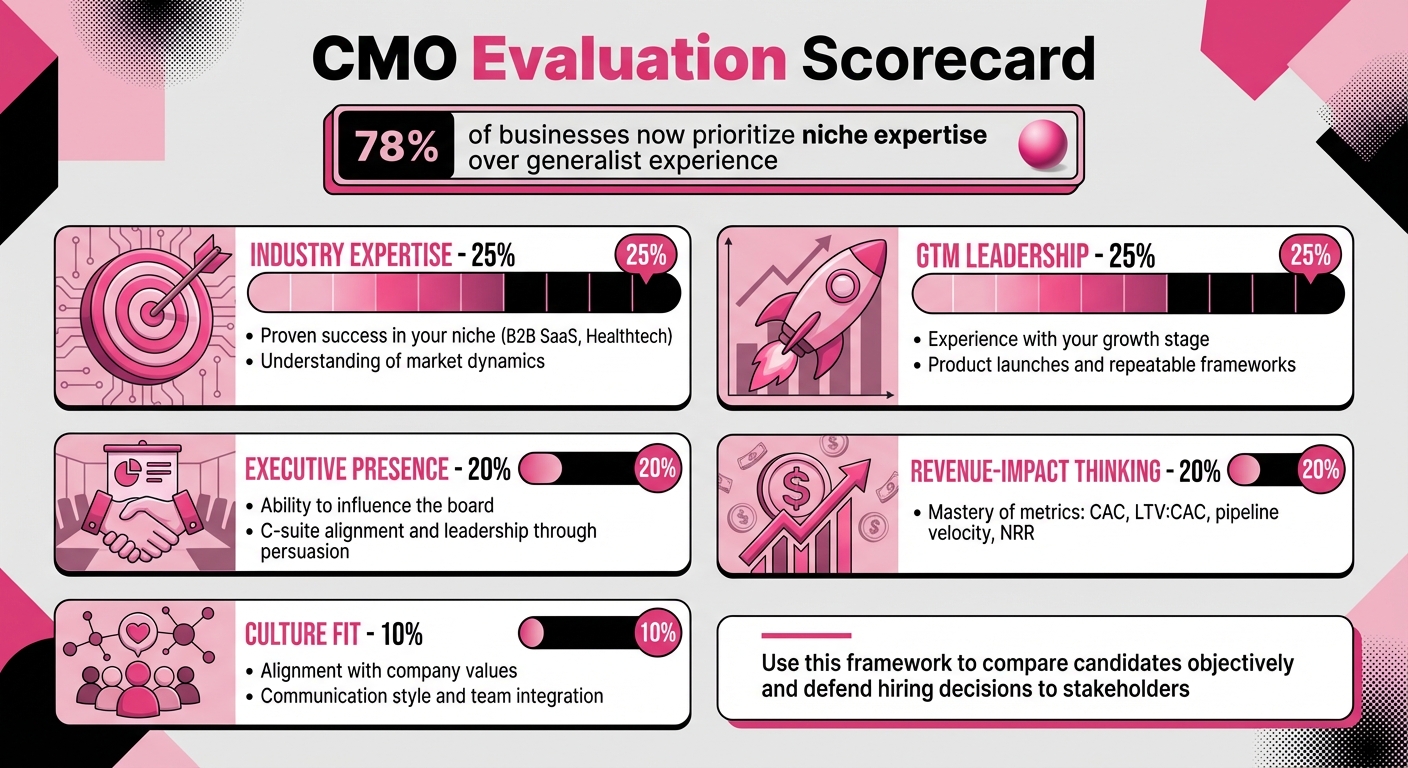
CMO Evaluation Scorecard: Weighted Criteria Framework
Don’t hire a CMO without a scorecard. You need a weighted evaluation framework to compare candidates apples-to-apples before signing anyone. If you are still building a shortlist, start with our side-by-side review of top fractional CMO firms.
Build a scoring system that fits your business stage and goals. Give the heaviest weights to industry expertise and go-to-market leadership at 25% each. Then add executive presence at 20%, revenue-impact thinking at 20%, and culture fit at 10% . This stops you from hiring someone who interviews like a dream but can’t think beyond next quarter’s campaign. It also gives you hard data to defend your choice when the board asks why you picked Candidate A over Candidate B.
Building a Weighted Scoring System
Here’s a practical way to structure your evaluation:
| Category | Weight | Evaluation Focus |
|---|---|---|
| Industry Expertise | 25% | Proven success in your niche (e.g., B2B SaaS, Healthtech) and understanding of market dynamics. |
| GTM Leadership | 25% | Experience with your growth stage, product launches, and repeatable frameworks. |
| Executive Presence | 20% | Ability to influence the board, gain C-suite alignment, and lead through persuasion . |
| Revenue-Impact Thinking | 20% | Mastery of metrics like CAC, LTV:CAC, pipeline velocity, and NRR. |
| Culture Fit | 10% | Alignment with company values, communication style, and team integration. |
These weights reflect a stark reality: 78% of businesses now prioritize niche expertise over generalist experience because it delivers better ROI. These metrics don’t just track past wins – they predict future revenue contributions.
Now let’s look at what separates strategic CMOs from tactical ones: revenue-driven experience.
Focusing on Revenue-Driven Experience
Revenue alignment separates strategic CMOs from campaign managers who just move chess pieces around. Your candidate needs to understand P&L, EBITDA, and how marketing spend actually moves the needle on business outcomes.
“If the business is ultimately measured on revenue and EBITDA, a level of that has to cascade down to marketing. Because during downturns, people who don’t have ownership or direct influence on growth are the most at risk.”
Ask candidates to show you how they’ve improved pipeline velocity, CLV, and NRR . The best CMOs don’t just report these numbers – they actively manage them and can tell you exactly which levers they pulled to move them.
Check whether they focus on measurable revenue impact instead of vanity metrics like impressions or social followers. A strong CMO will show you how their work shortened sales cycles or improved win rates .
Ask about their experience setting up SLAs with sales teams. This reveals whether they understand cross-functional accountability or just work in a marketing bubble.
Assessing Vision and Industry Knowledge
A CMO should clearly understand your product-market fit and how it aligns with your target market segments – whether you’re focused on SMBs or Enterprise customers. They also need to grasp how factors like partner ecosystems and regulatory constraints influence buying decisions. For industries like HealthTech or FinTech, this means having a solid understanding of technical buyer personas and compliance requirements – details that many generalist marketers might miss. This level of clarity complements the revenue-focused evaluation discussed earlier.
The dynamics of your sales cycle can reveal whether a candidate has a strategic mindset. Short sales cycles require precise tracking of spend-to-revenue ratios and accurate forecasting. On the other hand, longer cycles (12–18 months or more) demand patience and a focus on building long-term brand equity. When interviewing candidates, ask how they would tailor their approach for different sales cycle lengths, especially when comparing EBITDA-driven strategies with those focused on market share. Their ability to adapt strategies to these nuances can provide additional validation of their go-to-market (GTM) leadership skills. This strategic understanding naturally leads to assessing how well they align messaging with the buyer journey.
Product-Market Fit and Buyer Journey Understanding
One way to test a candidate’s grasp of product-market fit is to ask them to create a website headline. Their response should highlight the two or three key elements that resonate most with your customers and drive engagement.
Today’s B2B buyers interact with a brand at an average of 10 touchpoints during their sales journey – double the five touchpoints recorded in 2016. A strong CMO candidate should be able to map these interactions, especially when dealing with technical or complex buyers. Present them with a real-world business challenge specific to your industry and evaluate how they approach it. If they fall back on one-size-fits-all strategies, it’s a warning sign. These discussions can also help you assess whether they rely on repeatable frameworks for scaling growth – an essential skill for a CMO.
Repeatable Growth Frameworks
Look for candidates who bring proven systems to the table, such as T2D3 for SaaS businesses or ABM (Account-Based Marketing) for high-value accounts. Here’s an example: in early 2025, GM’s CMO implemented a “fast-twitch metrics” framework that linked portfolio allocation to sales outcomes, leading to a 94% increase in Q1 EV sales.
Ask candidates to explain their repeatable systems for demand generation, sales enablement, and customer-driven growth. They should be able to share how they’ve rebuilt go-to-market systems to handle scalability, rather than just maintaining what’s already in place. It’s also important to confirm whether they’ve personally overseen marketing technology integrations and attribution modeling. A candidate’s depth of experience in these areas can set them apart. If they can’t clearly demonstrate how they’ve used specific frameworks to scale businesses at your company’s stage, it may be a sign to keep searching for the right fit.
Evaluating Leadership and Cross-Team Collaboration
A capable CMO doesn’t just speak the language of marketing – they speak the language of business. Consider this: 80% of CEOs either distrust or are unimpressed with their CMOs. In some industries, the average tenure for marketing leaders is as short as 18 months. The difference between a strategic leader and someone focused only on day-to-day operations often hinges on their ability to collaborate across departments and think in terms of EBITDA, P&L, and LTV – not just clicks and impressions.
“CEOs are looking for marketing leaders who think like business leaders, not just marketers. They want someone who deeply understands the company’s overarching goals and aligns marketing efforts with the broader business strategy.”
– Mandy Walker, Founder, Growth Activated
When evaluating potential candidates, consider conducting 360-degree reference checks. Speak with former colleagues – sales leaders, IT partners, or board members – to assess whether the candidate has built strong systems and relationships. Ask about a time they challenged the status quo without alienating leadership. The most effective CMOs question assumptions, rely on data, and use sound business logic to support their ideas. This approach is often a key indicator of their ability to foster collaboration across departments.
Collaboration with Sales and Leadership Teams
Cross-functional leadership shines when marketing and sales teams are aligned. One way to measure this alignment is through service-level agreements (SLAs). These agreements define processes like lead handoffs, lead scoring, and mutual accountability. A strong CMO ensures these systems are in place and functional. During interviews, ask candidates to explain an SLA they developed and how it impacted pipeline velocity or conversion rates. If the sales side has no senior owner yet, a fractional sales leader can hold that end of the SLA.
“The strongest marketing executives understand that alignment isn’t just about meetings, it’s about systems. They build service-level agreements that actually work.”
– Alan Gonsenhauser, Founder and CEO, Demand Revenue
A CMO’s role extends beyond marketing – it’s about synchronizing efforts with Sales, IT, Product, and Customer Success teams. To assess their ability to integrate these areas, present a real-world business challenge during the interview. Ask how they would design a strategy that leverages your existing tech stack and cross-functional workflows. Be wary of candidates who focus only on top-of-funnel tactics or treat marketing as a silo. Look for examples of sales enablement content they’ve created that has reduced sales cycles or increased deal sizes – these demonstrate their ability to contribute directly to revenue growth.
Network and Tool Access
An effective CMO brings more than experience – they bring a network of external resources. This could include PR firms, martech specialists, sales operations experts, and designers who can be mobilized as your team grows. Review their LinkedIn connections to gauge their industry relationships with technology vendors and strategic service providers. During the interview, ask them to describe their “toolkit.” A well-rounded CMO will have a diverse approach, leveraging resources across PR, content, and sales enablement.
Additionally, access to executive communities – such as Marketing Boards or peer networks – can provide valuable third-party insights and help them stay ahead of industry trends. A candidate who lacks a robust external network or tries to manage everything in-house may struggle to scale your marketing function effectively. The right external collaborations can complement internal leadership, creating a cohesive and scalable marketing strategy.
Identifying Warning Signs and Setting Performance Benchmarks
Hiring the wrong CMO can be a costly mistake – ranging from $50,000–$200,000 in fees and over $500,000 in lost growth. That’s a hefty price tag for a misstep. The key to avoiding this is spotting red flags early and setting clear expectations from the start. Let’s break down the warning signs to watch for and the benchmarks that ensure your hire delivers measurable growth.
Warning Signs to Watch For
Be wary of candidates who jump to quick fixes. If their go-to solutions are things like “run more LinkedIn ads” or “we need to rebrand” without taking the time to understand your business challenges, that’s a red flag. A strong CMO will dig deeper, asking thoughtful questions about your ideal customer profile, sales process, and existing attribution models before recommending strategies. Generic playbooks don’t cut it – your CMO needs to tailor their approach to your industry and growth stage.
“The best fractional CMOs ask better questions. They challenge assumptions. However, they do it in a way that builds consensus rather than burning bridges.”
– Alan Gonsenhauser, Founder and CEO, Demand Revenue
Another warning sign? Candidates who dismiss the importance of brand by labeling it as “not measurable” or those who rely on vanity metrics like impressions and clicks instead of tying their efforts to revenue. A CMO who avoids discussions about dashboards, attribution models, or pipeline growth may not have the skills to drive results. Some companies take brand out of the CMO’s remit altogether and hire a chief brand officer to own it.
Short tenures are also worth questioning. If someone frequently leaves roles in under two years, it might indicate a lack of commitment to delivering ROI. Similarly, candidates who dominate conversations or fail to communicate marketing strategies in business terms – like EBITDA, P&L, or LTV – could struggle to collaborate with leadership effectively.
Pay attention to their approach to scaling. A candidate who insists on doing everything in-house rather than tapping into a network of specialists could hold back your growth. And beware of anyone promising guaranteed results, like doubling revenue in 90 days. Such claims often signal either unethical practices or a misunderstanding of how markets work. These red flags should prompt a review of your hiring criteria.
Once you’ve identified potential concerns, the next step is to establish clear performance metrics to keep your CMO on track.
Defining Success Metrics
From day one, create a clear scorecard to measure success. A 30/60/90-day framework works well for tracking progress. In the first 30 days, the focus should be on clarifying positioning, setting priorities, and refining tracking and attribution methods. By 60 days, you should see improvements in conversion rates and stabilization of key cost metrics. By 90 days, measurable impacts on marketing-sourced pipeline, customer acquisition cost efficiency, and payback periods should be evident.
Balance metrics that marketing directly controls – like conversion rates and cost per qualified lead – with those it influences, such as win rates and sales cycle length. Track early indicators like website traffic and demo bookings alongside lagging metrics like total revenue, customer lifetime value, and churn. Collaborate with your sales team to establish shared KPIs, such as SQL-to-close rates and marketing-influenced pipeline, ensuring both teams are aligned on revenue goals.
“Marketing is filled with intangible efforts… but when a fractional CMO steps in, their goal is to bring clarity and focus to those efforts. That includes tying strategy to tangible outcomes.”
– Unicorn Platform
Another key metric to monitor is execution velocity – the speed at which ideas move from concept to live campaigns. This can offer insight into how quickly your marketing efforts will impact revenue. Keep an eye on demand signals like branded search volume and direct traffic trends to gauge brand strength. A monthly scorecard tracking both primary business metrics and efficiency metrics will help maintain accountability and ensure your CMO stays focused on driving revenue growth.
Evaluation Example: Strategic Pete
Let’s break down how to evaluate a candidate’s approach using Strategic Pete, a fractional CMO consultancy led by Peter Murphy Lewis. This example highlights how to assess their methods and alignment with revenue-focused goals.
Strategic Pete takes a diagnostic-first approach. Instead of diving straight into tactics, the firm starts with audits, market research, and stakeholder interviews to uncover key business challenges before recommending solutions. By avoiding rushed fixes, they gain deeper insights. Their focus on aligning marketing strategies with revenue goals, improving go-to-market execution, and optimizing performance channels reflects an understanding that marketing’s ultimate purpose is to drive measurable business outcomes – not just activity. This structured approach lays the groundwork for a phased and thorough evaluation.
The 90-day roadmap provides a clear structure: immersion during weeks 1–4, strategy development in weeks 5–8, and implementing quick wins in weeks 9–12. This timeline aligns perfectly with the 30/60/90-day framework for tracking success metrics, offering key milestones to measure progress and ensure accountability.
Strategic Pete’s services emphasize cross-functional collaboration. Their offerings – such as sales pipeline optimization, customer journey automation, and vendor evaluation support – show they work across marketing, sales, and leadership teams rather than in isolation. Their focus on data-driven decision-making and executive-level communication demonstrates their ability to speak in terms that resonate with leadership, bridging gaps between departments to drive growth.
When applying the scorecard, look for repeatable frameworks instead of isolated successes or lead generation tactics. Strategic Pete’s expertise in B2B and SaaS industries underscores their understanding of longer sales cycles, complex buyer journeys, and the attribution challenges that are common in these sectors. This specialization highlights their ability to navigate industry-specific nuances, making them a strong candidate for businesses in these spaces.
Conclusion
Hiring the wrong CMO can be a costly mistake, with potential losses ranging from $50,000–$200,000 in fees and over $500,000 in missed growth opportunities. A structured, data-driven evaluation process can safeguard your investment and lay the groundwork for meaningful progress.
Reassess your scorecard to ensure the candidate aligns with your strategic goals, execution needs, and organizational values. Focus on leaders who prioritize financial metrics like EBITDA, customer lifetime value, and P&L impact over superficial metrics like social media impressions. This approach not only ensures alignment but also sets the stage for measurable success.
“Choosing the wrong fractional CMO can cost your company six months of lost momentum, wasted budget, and damaged team morale.” – Sheila Kloefkorn, CEO, KEO Marketing
Define clear, measurable objectives tied to your 12-month business goals. Whether you’re gearing up for Series B funding, entering a new market, or scaling revenue from $5 million to $20 million, your CMO should have a proven track record of delivering those outcomes. Setting 30-60-90 day benchmarks allows you to monitor progress early and make adjustments if needed.
A smart way to validate fit is by starting with a pilot project or a 3-month trial engagement. This gives you insight into the CMO’s working style and strategic abilities before committing to a long-term arrangement. Top-tier CMOs will embrace this approach, using performance metrics to prove their value. With 68% of fractional CMO relationships falling short due to misaligned expectations, taking the time to assess compatibility upfront is a wise move.
FAQs
What metrics should I prioritize when assessing a CMO’s ability to drive revenue?
When assessing a CMO’s ability to drive revenue, focus on metrics that demonstrate real business impact rather than getting distracted by vanity numbers. Here are the key areas to evaluate:
- Pipeline quality: Are they delivering high-value opportunities that align with your sales team’s objectives? The quality of leads matters far more than sheer quantity.
- Strategic progress: Can they clearly connect their marketing initiatives to your company’s long-term growth plans? This shows they’re thinking beyond short-term wins.
- Measurable outcomes: Look for concrete results, like higher customer acquisition rates, improved retention, or noticeable revenue growth. These are the metrics that truly reflect success.
Be cautious about fixating on lead volume, especially in B2B markets where sales cycles tend to be longer. Instead, focus on how well their marketing strategies align with and support your broader business goals.
How does a 30/60/90-day plan ensure a successful start for a CMO?
A 30/60/90-day plan lays out a clear roadmap to help a new Chief Marketing Officer (CMO) settle into their role and start delivering results quickly. It breaks down specific goals, priorities, and measurable outcomes for each of the first three months, ensuring that both the CMO and the organization are on the same page from the start. This structure also makes it easier to track progress and adjust expectations along the way.
By emphasizing early wins – like aligning marketing strategies with business goals or rolling out initial campaigns – the plan provides a way to assess the CMO’s leadership approach and strategic alignment with the company. It minimizes uncertainty, speeds up their impact, and sets the stage for long-term success. In short, it’s a critical tool for effectively onboarding a marketing leader and ensuring they hit the ground running.
What are the red flags to watch for when evaluating a CMO candidate?
When assessing a CMO candidate, be on the lookout for warning signs that might indicate they’re not the right fit. For instance, if they lack strategic clarity or can’t quickly identify your company’s core marketing challenges, it’s a red flag. A strong candidate should have a solid grasp of your business and be able to spot key growth opportunities early in the process. If they seem slow to understand your needs or lean heavily on generic strategies, it could mean they’re not prepared for the role.
Other concerns to watch for include weak communication skills, limited hands-on involvement, or an inability to tailor their strategies to your industry. A capable CMO should inspire trust across teams and have a track record of measurable success in driving revenue. If they can’t clearly explain how their past achievements align with your company’s goals, it’s worth reconsidering their suitability.
Related Blog Posts
- Outsourced CMO Services: What to Expect, What to Avoid, and How to Vet Providers
- External CMO: What to Expect From Outside Leadership
- Fractional Marketing Services for Growth-Stage Companies That Need Strategy, Not Noise
- Startup Fractional CMO: Building Your First Real Marketing Engine