
A Fractional VP of Marketing is a senior marketing leader who helps companies run marketing execution without the cost of a full-time executive hire. They typically manage campaigns, internal teams, agencies, reporting, and cross-functional coordination to make sure an existing strategy actually gets implemented.
This role is usually the right fit when your company already knows its market, offer, and growth priorities but needs stronger day-to-day leadership to improve consistency, accountability, and performance. For many B2B companies in the $1M–$15M ARR range, a Fractional VP of Marketing fills the gap between a strategic advisor and a hands-on marketing manager.
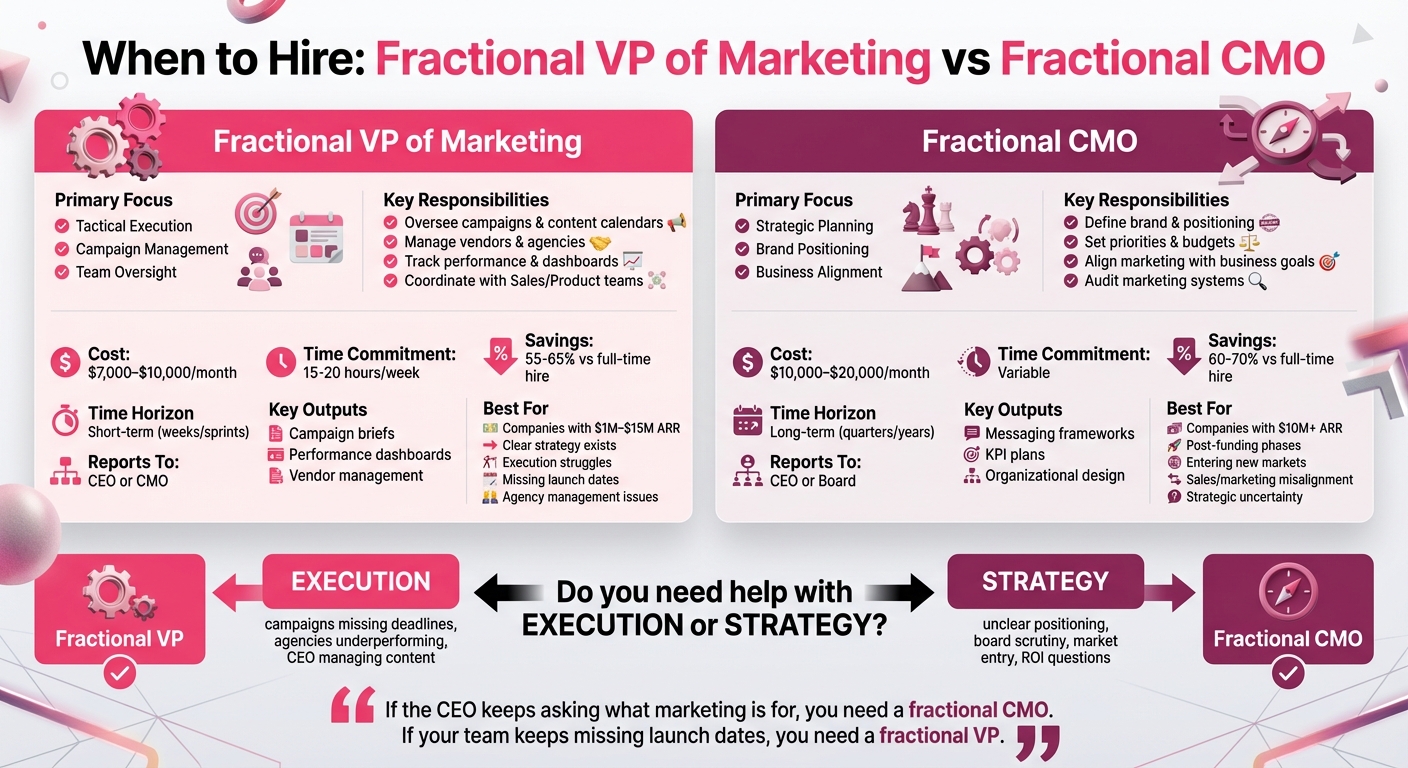
If you are deciding between a Fractional VP of Marketing and a Fractional CMO, the difference is simple: a Fractional VP leads execution, while a Fractional CMO sets the broader strategy.
Fractional VP of Marketing at a Glance
- Primary focus: marketing execution and team leadership
- Typical responsibilities: campaigns, agencies, reporting, workflows, and accountability
- Best for: companies with a clear strategy that need stronger day-to-day marketing leadership
- Typical engagement: 15–20 hours per week
- Typical cost: $7,000–$10,000 per month
Compared with a Fractional CMO, a Fractional VP of Marketing is usually more execution-focused and shorter-term in scope. For the wider picture, see our guide to the nine fractional CMO firms we reviewed.
Fractional VP of Marketing vs Fractional CMO: Key Differences and Decision Guide
How to Hire a Fractional CMO (And What to Expect)
1. What Does a Fractional VP of Marketing Do?
A Fractional VP of Marketing focuses on executing an established marketing strategy. They operate in the space between high-level planning and the hands-on tasks of daily marketing, ensuring strategies are effectively carried out.
“The fractional VP of Marketing is the most misunderstood role in the fractional leadership ecosystem. It sits between a fractional CMO (strategy-focused) and a marketing manager (task-focused).” – Alexander Chua, Co-Founder, PipelineRoad
Scope of Responsibilities
This role involves managing the day-to-day operations of your marketing efforts. Responsibilities include:
- Overseeing content calendars, campaign schedules, and automation workflows.
- Conducting weekly check-ins with your team or external agencies.
- Holding vendors accountable for deliverables.
- Briefing campaigns, reviewing creative and copy, and optimizing performance.
- Turning marketing activities into measurable business metrics via dashboards.
- Coordinating closely with Sales, Product, and Finance teams for lead handoff, launch planning, and budget tracking.
Reporting Structure
For B2B companies with under $20M in annual recurring revenue (ARR), the Fractional VP of Marketing typically reports directly to the CEO. If there’s a Fractional CMO in place, the VP usually reports to the CMO while maintaining a dotted line to the CEO. They act as the operational link between big-picture business goals and the execution of marketing activities.
These professionals often lead teams of 3–10 marketers, agencies, or freelancers. Their projects usually demand 15–20 hours weekly, costing between $7,000 and $10,000 per month—saving up to 65% compared to hiring a full-time employee.
Outcomes
The success of a Fractional VP of Marketing is measured by:
- Launching campaigns on time.
- Maintaining consistent, high-quality content.
- Producing accurate and actionable dashboards.
- Effectively managing agencies and vendors.
Unlike a CMO, they don’t set the overall budget but instead oversee it. Their focus is on short-term, tactical objectives, working within weeks or campaign cycles rather than long-term planning across quarters or years.
When to Hire a Fractional VP of Marketing
A Fractional VP of Marketing is ideal when your company has a well-defined strategy but struggles with execution. This role is particularly suited for B2B companies with annual recurring revenue between $1M and $15M and a small internal marketing team or external agencies that need better oversight.
If your CEO is spending 15–20 hours a week on tasks like content approvals or managing agencies, a Fractional VP can step in to free up that time. However, if your company lacks a clear marketing strategy, hiring a VP isn’t the right move – establish your strategic direction first before bringing in this execution expert.
2. Fractional VP of Marketing vs Fractional CMO: What Changes
Where a VP of Marketing focuses on implementing established plans, a Fractional CMO takes a broader view, shaping the overall marketing strategy. This role involves collaborating with the CEO and board to set priorities and define direction, rather than managing daily operations. Let’s dive into what sets this role apart, emphasizing its strategic leadership.
“A fractional CMO is usually hired to create clarity, momentum, and better decisions. The best ones are especially strong at diagnosis, prioritization, and sequencing.” – Prose Media
Scope of Responsibilities
A Fractional CMO’s work revolves around big-picture strategy and ensuring marketing aligns with the company’s overall business goals. Instead of focusing on campaign execution, they:
- Audit marketing systems to uncover inefficiencies, such as high customer acquisition costs or underperforming funnels.
- Identify the target customer and sharpen the company’s market position.
- Allocate budgets effectively to maximize impact.
- Design the marketing team structure and offer executive coaching to support internal teams.
While VPs focus on running campaigns, CMOs create the strategic framework that determines which campaigns should happen in the first place.
Reporting Structure
Fractional CMOs typically report directly to the CEO or board of directors. They operate as equals to other C-suite leaders, dedicating significant time to aligning marketing strategies with broader business objectives. In cases where a Fractional VP of Marketing is also present, the VP usually reports to the CMO, ensuring a clear hierarchy.
Outcomes
The success of a Fractional CMO is measured by their ability to bring clarity and drive progress. They often develop 90- or 180-day plans, with clearly defined KPIs that directly connect marketing efforts to revenue goals. By prioritizing budgets and channels carefully, they help businesses overcome growth challenges. Their impact is most visible in improved decision-making at the executive level.
Best Fit Scenarios
A Fractional CMO is particularly valuable during pivotal moments, such as:
- Following a new round of funding.
- Entering new markets or repositioning the brand.
- Resolving misalignment between sales and marketing, especially around lead quality or pipeline ownership.
This role is perfect for companies facing strategic questions about their target audience, product positioning, or budget allocation. A Fractional CMO offers the clarity and guidance needed to handle these challenges. Conversely, if the strategy is already set and the main need is executing campaigns effectively, a more execution-focused role might be a better fit. Their strategic leadership complements the operational strengths of VPs, creating a balanced approach to marketing leadership.
sbb-itb-8f8c601
Pros and Cons
Both roles serve important but distinct purposes, so selecting the right one depends on your specific business challenge. Here’s a quick comparison to help you decide which role aligns better with your needs:
| Factor | Fractional VP of Marketing | Fractional CMO |
|---|---|---|
| Cost | $7,000–$10,000/month for standard engagement (15-20 hrs/week); cuts costs by 55-65% compared to a full-time hire | $10,000–$20,000/month; saves 60-70% versus hiring a full-time C-suite executive |
| Primary Focus | Overseeing execution, managing campaigns, and ensuring team accountability | Strategic planning, brand positioning, board-level reporting, and go-to-market (GTM) strategies |
| Best For | Companies with a solid strategy but struggling with execution; typically $1M–$15M ARR | Businesses entering new markets, post-funding phases, or dealing with sales and marketing misalignment |
| Time Horizon | Focused on short-term projects, sprints, and launch schedules | Centered on quarterly or annual planning and budget decisions |
| Risk | May lead to inefficiencies if there’s no clear strategy in place | Could become an overly expensive “traffic cop” if tasked with execution work |
| Key Output | Campaign briefs, dashboards for reporting, and vendor management | Messaging frameworks, KPI plans, and organizational design |
“If the CEO keeps asking what marketing is for, you probably need a fractional CMO. If your team keeps missing launch dates… you probably need a fractional marketing director [VP].” – Prose Media
The table emphasizes the importance of understanding the distinct roles. A Fractional VP is best when implementation is falling behind or agency management needs improvement. Conversely, a Fractional CMO is more suitable for filling strategic gaps or repositioning in the market. Choosing the wrong role can lead to wasted resources, so pick the hire that best addresses your specific challenge.
How to Choose the Right Role for Your Company
To select the best marketing leader for your company, start by identifying your most urgent challenges. For instance, if your CEO often questions the value of marketing or if your brand positioning feels muddled, a Fractional CMO can provide the strategic clarity you need. On the other hand, if deadlines are slipping, agency relationships are faltering, or campaigns feel scattered, a Fractional VP can bring the operational focus required to get things back on track. The key is deciding whether your priority is strategic vision or tactical execution.
Note unresolved marketing decisions. If you need to show marketing ROI to the board, redefine your ICP (Ideal Customer Profile), or assess which markets to target, these are CMO tasks. However, if your issues involve managing marketing tools, holding agencies accountable, or establishing regular reporting systems, a Fractional VP is probably a better option.
For B2B companies with annual revenues between $1 million and $15 million, a Fractional VP is often a smart choice if a solid strategy is already in place but daily operations need better oversight. Conversely, if your company generates over $10 million in ARR, is exploring new market opportunities, or faces scrutiny from the board, a Fractional CMO might be the more suitable option.
Once you’ve pinpointed your marketing needs, consider testing your candidate’s abilities with a short trial period. A 30-day trial is a practical way to evaluate their skills. During the first week, give them access to your marketing dashboard and ask for three observations and two actionable recommendations. This approach helps assess their ability to quickly diagnose issues and deliver improvements.
For companies seeking high-level strategic guidance and go-to-market alignment, services like Strategic Pete offer fractional CMO expertise designed to connect business goals with effective marketing strategies.
Many mid-sized B2B companies find success with a hybrid model – combining a Fractional CMO for quarterly strategic input, a Fractional VP for weekly operational oversight, and an agency for channel execution. This balanced approach can help optimize your marketing outcomes. Avoid mismatched hires; bringing on a CMO when all you really need is someone to manage your content calendar can waste resources and lead to unnecessary frustration.
Conclusion
Choosing between a Fractional VP of Marketing and a Fractional CMO comes down to one key question: Are you looking for help with strategy or execution? A Fractional CMO concentrates on the big picture—defining your positioning, identifying target markets, and prioritizing go-to-market plans. In contrast, a Fractional VP makes sure these strategies are implemented effectively by managing campaign execution, overseeing vendors, and holding the team accountable.
“A full-time CMO and a Fractional CMO are not the same role at different price points. They are entirely different structural instruments designed for different stages of organizational maturity” – Kamyar Shah, Founder of World Consulting Group.
Hiring the wrong role can cause unnecessary problems. For example, bringing in a CMO when your main issue is operational execution can result in brilliant strategies that never get put into action – a “smart bottleneck.” Likewise, hiring a VP when strategic clarity is missing can make someone seem “too tactical,” simply because the foundational strategy isn’t in place.
Here’s a real-world example: In early 2026, a SaaS company with $8M ARR swapped its full-time, brand-focused CMO for a Fractional CMO to address pipeline growth. Within just 90 days, the Fractional CMO cut underperforming agencies, redirected budgets to performance media, slashed marketing spend by 40%, and increased qualified pipeline velocity by 25%. This highlights how the right hire can deliver measurable results, while a misaligned one can stall progress.
For B2B companies with $1M–$15M ARR, the decision often hinges on your current needs. If you already have a solid strategy in place and just need execution, a Fractional VP usually fits best. However, if your challenges are more strategic—such as managing board-level scrutiny or repositioning in the market—a Fractional CMO is the leader you require. The fractional model also provides cost savings of 55–65% compared to full-time roles, offering you flexibility without long-term HR commitments.
Start by identifying your core marketing bottlenecks. If your next steps involve decisions like market selection and revenue accountability, a CMO is likely the right choice. If your focus is on campaign execution and reporting cadence, a VP makes more sense. The key is aligning the hire with your specific challenges to turn marketing into a true revenue driver.
FAQs
What does a Fractional VP of Marketing do?
A Fractional VP of Marketing leads marketing execution. This usually includes managing campaigns, overseeing internal marketers or agencies, tracking performance, improving reporting, and making sure the company’s marketing strategy is carried out consistently.
When should I hire a Fractional VP of Marketing?
You should hire a Fractional VP of Marketing when your strategy is already defined but execution is inconsistent. Common signs include missed launch dates, weak agency oversight, lack of reporting discipline, and too much marketing management falling on the CEO.
How much does a Fractional VP of Marketing cost?
A Fractional VP of Marketing typically costs around $7,000 to $10,000 per month, depending on scope, hours, and business complexity. This is often more cost-effective than hiring a full-time senior marketing leader.
What is the difference between a Fractional VP of Marketing and a Fractional CMO?
A Fractional VP of Marketing focuses on execution, team management, and operational accountability. A Fractional CMO focuses on strategy, positioning, budget direction, and executive-level planning.
Is a Fractional VP of Marketing right for a B2B company?
Yes, this role is often a strong fit for B2B companies that already have product-market direction but need better execution across campaigns, agencies, lead flow, and reporting.