
A Fractional VP of Marketing is a senior marketing leader who works with your company part-time to build strategy, guide execution, and improve revenue performance without the cost of a full-time executive hire. Companies usually bring one in when they need experienced leadership for growth, team alignment, positioning, or go-to-market strategy, but do not need a full-time VP yet.
In this guide, you’ll learn what a Fractional VP of Marketing does, how the role compares to a full-time hire, what it typically costs, and when it makes sense to bring one in.
What Does a Fractional VP of Marketing Do in the First 30–90 Days?
In the first 30 to 90 days, a Fractional VP of Marketing typically audits your current strategy, reviews funnel performance, aligns leadership on priorities, identifies quick wins, and builds a focused growth plan. The goal is to create clear direction, improve accountability, and connect marketing activity more directly to pipeline and revenue.
sbb-itb-8f8c601
What is a Fractional VP of Marketing?
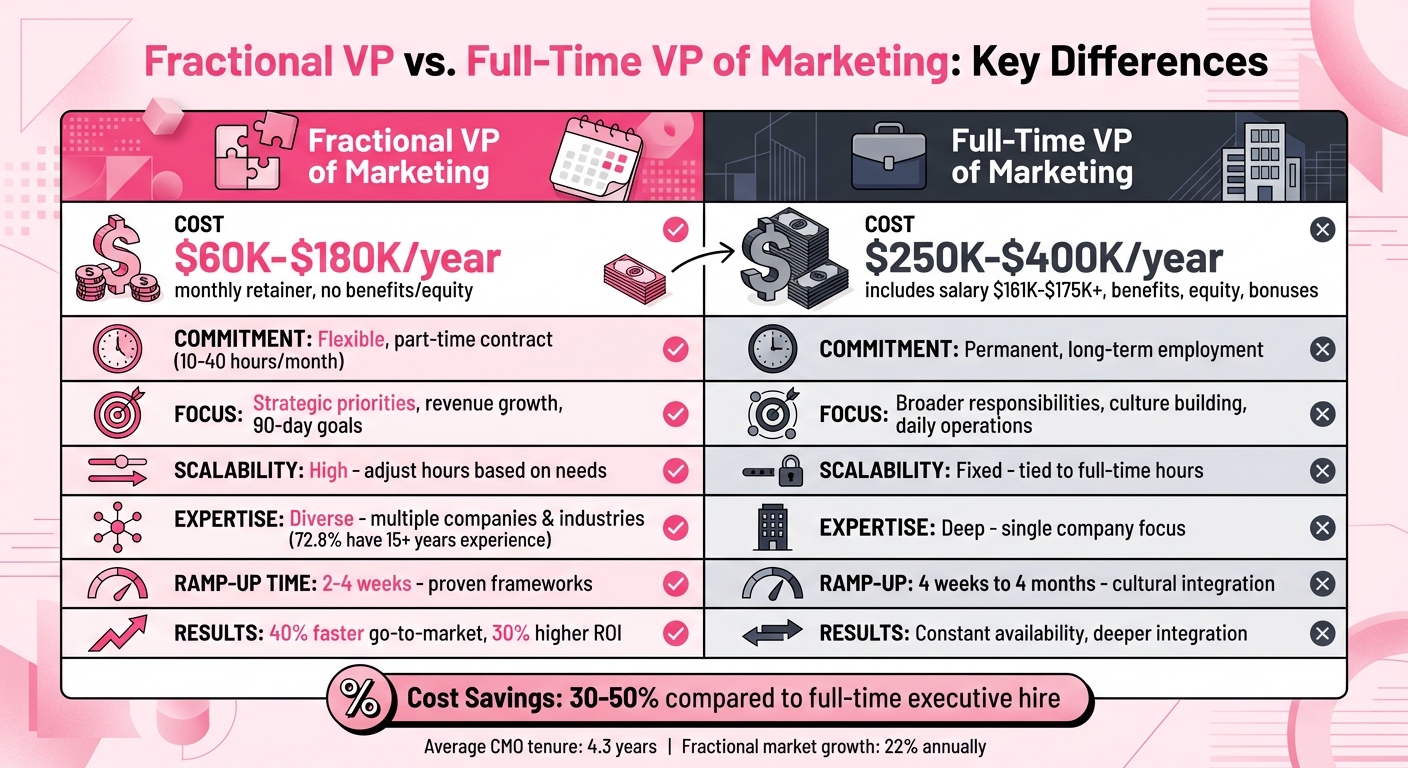
Fractional vs Full-Time VP of Marketing: Cost and Feature Comparison
A Fractional VP of Marketing is a senior executive who works with your leadership team on a part-time, contract basis to shape high-level strategies and deliver measurable results. Unlike consultants who provide advice and then step away, these leaders actively participate in executive meetings, take ownership of revenue targets, and ensure outcomes are achieved.
“Think of them as: a senior marketing executive you rent instead of buy.” – Chelsie Wyse, Founder, TACT Marketing Strategy
The role focuses on creating and aligning marketing strategies, improving collaboration between sales and marketing, and establishing an efficient operating framework – all without committing to the long-term costs of a full-time hire. Their expertise centers on strategic initiatives: defining growth plans, identifying target customer segments, and crafting value propositions that directly impact revenue. Rather than handling day-to-day tasks, Fractional VPs oversee existing teams, agencies, or vendors to execute the strategy.
How Much Does a Fractional VP of Marketing Cost?
Most companies hire a Fractional VP of Marketing on a monthly retainer or part-time contract. Typical engagements range from $5,000 to $15,000 per month, or roughly $60,000 to $180,000 per year, depending on scope, growth stage, and hours required. That is usually far less than the full cost of a full-time executive when salary, benefits, taxes, and equity are included.
The exact cost depends on how involved the leader needs to be. Some companies need strategic oversight for 10 to 20 hours per week, while others need heavier support during a launch, repositioning, or growth phase. This builds on our guide to comparing fractional CMO providers.
How Fractional Marketing Leadership Works
Fractional VPs operate with efficiency and precision, focusing on impactful decisions. Typically, they work 10 to 40 hours per month on a retainer basis, with responsibilities outlined in a statement of work. They participate in executive meetings, guide quarterly planning, set objectives and key results (OKRs), and establish reliable reporting systems for CEOs and sales leaders. Instead of being present daily, they prioritize critical decisions – like selecting marketing channels, allocating budgets, and identifying metrics that drive growth.
“Most growing companies don’t need a CMO five days a week. What they need is someone who can set the strategic direction, build the right systems, and guide their team through critical growth phases.” – Peter Geisheker, CEO, The Geisheker Group, Inc.
This approach works best when a company already has a capable team or trusted vendors to execute the strategy. Fractional VPs focus on high-level leadership, mentoring internal staff, managing external agencies, and ensuring every marketing dollar contributes to measurable revenue outcomes. Their targeted involvement often leads to quicker go-to-market results, which is a major advantage of this model. Some businesses use fractional leaders as a stepping stone to full-time executives, testing strategies before committing to a permanent hire. Others find it to be a long-term solution, especially if they don’t require full-time senior marketing oversight. By focusing on strategic goals without the burden of full-time costs, fractional leadership ensures alignment with revenue growth at a sustainable expense.
Fractional VP vs. Full-Time VP: Key Differences
The differences between fractional and full-time marketing leadership highlight the unique advantages of the fractional model.
| Feature | Fractional VP of Marketing | Full-Time VP of Marketing |
|---|---|---|
| Cost | Lower; monthly retainer without benefits, equity, or tax overhead | Higher; includes salary ($161,000–$175,000+), benefits, equity, and bonuses |
| Commitment | Flexible; part-time contractual arrangement | Permanent, long-term employment |
| Focus | Strategic priorities, revenue growth, and specific 90-day goals | Broader responsibilities, including culture building and daily operations |
| Scalability | High hours can be adjusted based on business needs | Fixed; tied to full-time hours |
| Expertise | Brings diverse experience from working with multiple companies | Deep focus on a single company’s internal operations |
| Ramp-up Time | Fast, proven frameworks allow for quick impact within weeks | Slower; requires time to integrate into company culture (4 weeks to 4 months) |
The main difference is in precision versus presence. A full-time VP offers constant availability and deeper cultural integration, while a fractional VP provides targeted leadership focused on results in the next two to three quarters. If your company needs someone to build brand culture, manage investor relations, and attend every internal meeting, a full-time hire might be the right choice. But if your main goal is to refine your strategy, align sales and marketing, and achieve measurable growth without the overhead of a permanent executive, a fractional VP could be the ideal solution.
Benefits of Hiring a Fractional VP of Marketing
Hiring a Fractional VP of Marketing gives companies access to high-level expertise without the hefty price tag of a full-time executive. This approach combines strategic insight, operational adaptability, and immediate results, helping businesses grow while keeping expenses manageable. While this article focuses on marketing, many organizations also find value in fractional sales leadership to align their entire revenue engine.
Cost Savings
Hiring a full-time VP or CMO can cost a company $350,000 to $400,000 a year when including benefits, payroll taxes, equity, retirement plans, and office space. In comparison, a Fractional VP of Marketing usually works on a retainer of $5,000–$15,000 per month, totaling $60,000 to $180,000 annually. This results in savings of 30% to 50% compared to hiring a full-time executive.
Fractional executives also eliminate hidden costs like recruitment fees, lengthy onboarding processes, and administrative overhead – expenses that full-time hires often bring.
“The most profound advantage of fractional CMOs lies not in what they do, but in what they don’t have to do. Full-time executives spend an average of 40-50% of their time in meetings, administrative tasks, and internal politics.” – Amanda Bianca Co, Growth Rocket
This efficiency translates directly into better returns. Companies that hire fractional CMOs often report a 30% boost in marketing ROI, with some B2B and e-commerce businesses seeing increases of 40% to 60%. The key is that businesses pay for impactful, strategic work – not for time spent on tasks that don’t drive revenue.
And it’s not just about saving money. Fractional leadership also provides unmatched flexibility to adjust to shifting priorities.
Flexibility and Scalability
Fractional VPs allow organizations to adjust their involvement as needed. Whether it’s a product launch, fundraising effort, or market expansion, companies can ramp up their hours during busy periods and scale down during quieter times.
The demand for fractional executives is growing fast. The industry is expanding by 22% annually, with demand for fractional CMOs rising 57% since 2020. This shift reflects a new way of thinking about leadership. As marketing budgets decreased to 7.7% of overall revenue in 2024 – a 15% drop from the previous year – companies are under pressure to make every dollar count. The fractional executive model offers a way to access senior-level expertise without the commitment of a permanent hire.
Companies that utilize fractional executives also see a 40% faster go-to-market launch, thanks to the proven frameworks these leaders bring. Unlike consultants who give advice and then leave, fractional VPs serve as embedded executives, providing ongoing guidance. This is especially important since the average tenure of a full-time CMO is only 4.3 years.
“Most companies don’t need a full-time, on-staff CMO. But they do need consistent access to the judgment, perspective, and leadership of a true executive – even if that leadership is delivered part-time.” – Jennifer Zick, Founder and CEO, Authentic Brand
Fast Access to Expertise
Another benefit of fractional VPs is how rapidly they can start delivering results. While hiring a full-time executive can take 3–6 months, a Fractional VP can be onboarded in just 2–4 weeks. Within the first 30 days, they often identify quick wins, and a complete strategy is usually in place within 60 days.
This speed results from experience. About 72.8% of fractional marketing leaders have over 15 years of professional experience. Their broad expertise enables them to apply proven tactics immediately. Working with multiple companies also provides them with cross-industry insights that full-time executives, focused on just one organization, might not have. Businesses that use fractional marketing leadership experience an average of 29% higher revenue growth compared to those that do not.
Beyond creating strategies, fractional VPs also help develop internal teams. 68% of companies report improved confidence and skill development among their marketing staff under fractional leadership. This mentorship ensures that the benefits extend beyond the engagement, leaving a lasting impact on the organization.
When to Hire a Fractional VP of Marketing
Bringing in fractional leadership makes the most sense when there’s a noticeable gap between your current marketing efforts and your revenue goals. These are the scenarios where a part-time strategic leader can make a real difference in driving growth and streamlining operations.
Fast Growth or Scaling
When companies grow quickly, founders often find themselves stretched too thin. They’re juggling campaigns, managing vendors, and trying to build a strategy – all while running the business itself. If your annual marketing budget has crossed $500,000 and the workload is overwhelming, a Fractional VP can step in to create scalable systems that produce results fast.
Take this example: In 2025, a Series B software company struggling with product-market fit hired a fractional CMO to revamp its go-to-market strategy. The result? A 240% increase in qualified pipeline and a successful $45 million Series C funding round within just six months. Similarly, between 2024 and 2025, a startup transitioning from Seed to Series A used a fractional CMO to set up an internal CRM and a drip marketing team. This led to their Monthly Recurring Revenue (MRR) growing 4x in just nine months.
The numbers speak volumes — companies lacking dedicated marketing leadership experience 23% slower revenue growth and face 34% higher customer acquisition costs. Unlike full-time hires, who might take 4–6 months to become effective, fractional executives can start delivering value within weeks by leveraging proven strategies and established vendor networks.
But fast scaling isn’t the only time fractional leadership is needed. Major market shifts, like launching a new product or rebranding, also call for experienced guidance.
Product Launches or Rebranding
Big moves, like rolling out a new product or rebranding, require well-coordinated strategies that most internal teams aren’t equipped to handle. A Fractional VP brings the expertise to oversee these high-stakes projects without committing to a full-time hire. They’ll craft go-to-market plans, align sales and marketing teams, and set up metrics to track success.
Here’s an example: An e-commerce brand generating $5 million in annual recurring revenue hired a fractional CMO to tackle stagnant website traffic. The leader focused on technical SEO improvements and site architecture. Within five months, the brand saw a 60% year-over-year increase in organic traffic. These types of engagements usually last 6 to 12 months, giving enough time to implement strategies and show measurable results.
While growth and market initiatives are clear indicators, limited internal resources can also signal the need for fractional expertise.
Limited Resources or Expertise Gaps
For startups and mid-sized companies with revenues between $2 million and $50 million, hiring a full-time executive might not make sense. These businesses often need high-level insight for only 15–20 hours per week. A common reason to bring in a fractional leader is when teams are good at executing day-to-day tasks but lack a broader, data-driven strategy or a cohesive customer journey. If your revenue is flat or declining despite steady or rising marketing spend, it’s a clear sign you need someone to identify and fix strategic gaps.
“A fractional CMO provides the ideal solution, offering the strategic horsepower to build a scalable foundation without the heavy financial and operational burden of a full-time executive.” – Sarah Little, GrowTal
Before you hire, make sure you have a stable budget for both the fractional leader’s retainer and the resources needed to execute their strategy. Don’t rush into hiring if your product isn’t validated yet – focus on achieving product-market fit and building your MVP first. Once you’re ready, set clear success metrics like lead quality, conversion rates, or revenue targets to ensure accountability from day one.
Core Responsibilities of a Fractional VP of Marketing
A Fractional VP of Marketing takes your business objectives and turns them into actionable strategies, overseeing the entire marketing function. They focus on aligning your revenue goals with clear plans, ensuring progress is measurable, and holding teams accountable for delivering results. Here’s how they make it happen.
Marketing Leadership and Planning
One of their primary tasks is bridging the gap between your vision and day-to-day execution. A Fractional VP crafts 90-day and 12-month marketing roadmaps that align with your revenue targets. This involves deciding which channels – like SEO, paid ads, or events – will deliver the most impact and setting clear milestones to define success.
They also focus on uniting sales and marketing efforts. This includes defining Marketing Qualified Leads (MQLs) and Sales Qualified Leads (SQLs) and setting up Service Level Agreements (SLAs) to ensure timely follow-ups on leads. Within the first 30 days, they conduct audits to identify quick wins and address any gaps in your revenue pipeline.
Once the plan is in place, their attention shifts to monitoring performance and ensuring every initiative contributes to revenue growth.
Performance Tracking and ROI
Fractional VPs rely on data to guide decisions. They build dashboards and reporting systems to track critical metrics like Customer Acquisition Cost (CAC) and Lifetime Value (LTV). Instead of focusing on vanity metrics like impressions or clicks, they emphasize measures that directly impact revenue, such as lead-to-customer conversion rates and pipeline velocity.
Here’s why this matters: companies using fractional CMO services often see 29% higher revenue growth compared to those without. A well-functioning marketing engine typically requires pipeline coverage that’s at least three times the sales quota. Fractional VPs also implement attribution models to connect marketing efforts to closed deals, offering clear insights into what’s driving results.
With these systems in place, they ensure teams and vendors are aligned and delivering on their objectives.
Team and Vendor Management
A Fractional VP doesn’t just design the strategy – they make sure it’s executed effectively. They set Key Performance Indicators (KPIs) for internal teams, freelancers, and agencies to ensure deadlines are met and quality standards are upheld. By creating streamlined workflows and standard operating procedures, they eliminate bottlenecks and improve efficiency.
They also mentor junior marketing staff and assess when to bring in specialists or additional agency support. From refining creative briefs to testing new ideas and holding vendors accountable with scorecards, they ensure every piece of the puzzle contributes to the bigger picture. As Peter Geisheker, a Fractional CMO at The Geisheker Group, explains:
“An agency runs campaigns. A fractional CMO runs your marketing function. The difference shows up in your pipeline.” – Peter Geisheker, Fractional CMO, The Geisheker Group
Because they are embedded within your leadership team, Fractional VPs can tackle cross-functional challenges and address underperforming vendors without being bogged down by internal politics. Most fractional engagements follow a structured timeline: diagnostic assessment (Days 1–30), strategy and quick wins (Days 31–60), and scaling/optimization (Days 61–90).
How to Engage a Fractional VP of Marketing
Bringing in a Fractional VP of Marketing is a smart way to access top-tier strategy without the cost of a full-time executive. But to get the most out of this role, you need a clear plan. Here’s a three-step process to guide you: define your needs, find the right person, and set them up for success.
Assess Your Marketing Needs and Goals
Start by identifying your biggest marketing challenges. Maybe you’re stuck in founder-led decision-making, or your sales and marketing teams aren’t aligned. Write down your top two or three pain points – like poor lead quality, unclear messaging, or preparing for a product launch.
Next, figure out whether you need someone to lead the strategy or just execute tasks. Agencies and freelancers are great for deliverables, but a Fractional VP takes ownership of outcomes, manages teams, and sets the overall direction. This role is especially valuable for companies with significant marketing budgets. Typically, businesses generating $2 million to $50 million in annual revenue benefit the most from fractional leadership.
Before hiring, ensure you have at least one marketing coordinator or an execution resource in place. A Fractional VP needs support to implement their strategies effectively. You might also consider running a 30-day diagnostic with a candidate to evaluate current campaigns, content, and performance. This can reveal any “revenue leaks” before committing to a longer-term arrangement.
Once you’ve clarified your needs, it’s time to find a candidate who can meet them.
Evaluate and Select the Right Candidate
Look for someone who has successfully scaled businesses similar to yours. For example, if you’re a B2B SaaS company moving from founder-led sales to a scalable go-to-market strategy, find a candidate with experience in that specific transition. Industry expertise is key – a Fractional VP familiar with your market can hit the ground running without needing extensive onboarding.
Assess their ability to balance long-term strategy with actionable steps. The right person should be able to craft a 3–5 year plan and break it down into achievable goals. Ask about their approach to measuring ROI and how they track metrics like Customer Acquisition Cost (CAC), Lifetime Value (LTV), and pipeline velocity. Be cautious of anyone who promises quick results or provides vague case studies without concrete data.
Instead of a traditional interview, consider paying your top candidate for a 90-minute working session. Ask them to tackle a real business challenge, like drafting B2B demand generation techniques for the next quarter. When checking references, focus on the impact they had during their tenure. Did they “own” outcomes, or were they simply offering advice?
Kamyar Shah, a Fractional COO and CMO, offers this caution:
“Fractional CMOs who lack operational discipline produce beautiful slide decks and no pipeline contribution.”
Before finalizing your decision, clarify the candidate’s authority over budgets, vendor selections, and hiring. Undefined decision rights can lead to strategic bottlenecks.
Once you’ve chosen the right person, ensure they’re fully integrated into your leadership team.
Integrate with Leadership and Track Results
Treat your Fractional VP as an integral part of the executive team, not just an external consultant. Add them to internal communication platforms like Slack or Microsoft Teams, and involve them in strategic planning and board meetings. Introduce them to the company during an all-hands meeting to establish their role as a strategic leader.
Give them access to all necessary data, analytics dashboards, and historical brand assets to avoid delays. The CEO must publicly delegate authority to the Fractional VP, empowering them to make decisions and allocate budgets without constant oversight.
Establish a structured communication rhythm, including weekly check-ins, monthly strategy reviews, and quarterly planning sessions. Define success with clear KPIs such as CAC, pipeline growth, LTV, and conversion rates. If the marketing function still feels siloed after 90 days, it might indicate a lack of CEO support or ineffective integration efforts.
Joliene van Grieken, Co-founder of The Growth Syndicate, emphasizes:
“The CEO should be the champion of the CMO you’re bringing in because they need to get power of attorney to do stuff. The CEO needs to really embed the CMO into the organization.”
Regularly review how your Fractional VP spends their time. If they’re bogged down with tasks like tweaking social posts or running email campaigns, their strategic expertise is being wasted. Protect their time by involving them only in high-level discussions and critical decisions. Companies leveraging fractional marketing leadership have been shown to achieve 29% higher revenue growth than those without it.
Example: Strategic Pete‘s Fractional CMO Services
Overview of Strategic Pete’s Services
Strategic Pete demonstrates how fractional leadership can turn marketing into a dependable source of revenue. Specializing in part-time CMO services for B2B and SaaS companies, Strategic Pete offers executive-level marketing expertise without the high cost of a full-time hire. Founded by Peter Murphy Lewis, who has over 18 years of experience and has worked with more than 200 clients, the firm aims to make marketing efforts generate predictable revenue streams.
Every engagement begins with a 90-day Marketing Blueprint. This includes a diagnostic audit, funnel analysis, competitor review, and an actionable plan tailored to the client’s needs. This process addresses common pain points like inaccurate market positioning, overly broad audience targeting, and disorganized “gut-feeling” marketing strategies. Within eight weeks, Strategic Pete establishes a “Marketing OS”, complete with KPR scorecards and real-time dashboards to streamline operations.
Strategic Pete offers three service tiers, allowing businesses to choose the level of support they need:
- Blueprint Tier: A one-time diagnostic and 90-day plan starting at $5,000.
- Blueprint + Guidance: Priced from $10,000 per month, this tier provides ongoing strategic advice.
- Execution Tier: Starting at $15,000+ per month, this option includes hands-on services like CRM setup, funnel optimization, and even brand representation at events.
For context, a full-time CMO typically costs around $360,000 annually. Strategic Pete’s flexible model provides a cost-effective alternative with a clear focus on driving revenue.
How Strategic Pete Drives Business Growth
Strategic Pete’s methods demonstrate how fractional marketing leadership can deliver measurable success. Under Peter Murphy Lewis’s direction, Tanganyika Wildlife Park saw its revenue double and its reach expand tenfold.
“Peter is a true multiplier for those around him. Since we began working together, we’ve 2X’d our revenue and 10X’d our reach with his project management and strategic guidance.” – LynnLee Schmidt, Tanganyika Wildlife Park
In another case, Strategic Pete partnered with a long-term care SaaS company in November 2024. At the time, the company held less than 2% market share. By launching the “LTC Heroes” podcast and incorporating live podcasting booths at trade shows, the company achieved a staggering 100X increase in lead generation. This effort generated 15 sales-qualified leads weekly while also cutting trade show expenses through negotiated free booth space and travel arrangements.
For WebStreet, Strategic Pete implemented a case study–driven content strategy that successfully reengaged dormant leads, turning them into paying customers.
“Peter prioritized case studies as a core content strategy… This approach reengaged leads and led to conversions.” – Mike Vranjkovic, Managing Partner and Co-Founder, WebStreet
Another success story involves a healthcare recruiting client. Through a targeted programmatic advertising strategy, the client experienced a 131% increase in monthly applications while reducing job board spending by over 6%.
These results highlight Strategic Pete’s ability to deliver tailored marketing solutions that drive growth and efficiency.
Conclusion
A Fractional VP of Marketing offers executive-level strategy at a fraction of the cost – typically saving businesses 50% to 75% compared to hiring a full-time executive. For companies navigating tight budgets, rapid growth, or major strategic shifts, this approach ties marketing efforts directly to revenue without the hefty $250,000–$500,000 annual price tag.
Businesses that adopt fractional marketing leadership often see 30% higher marketing ROI in their first year and execute go-to-market strategies 40% faster than traditional hiring methods. With marketing budgets shrinking to just 7.7% of overall company revenue in 2024 – a 15% decline from the previous year – leaders are under immense pressure to maximize every dollar. Fractional leaders meet this challenge by implementing effective systems, mentoring internal teams, and taking ownership of measurable outcomes, rather than merely offering advice.
“Marketing is no longer about big budgets – it’s about smart leadership.” – Sanjeev Arora, Fractional CMO Partners
The numbers highlight a growing trend toward leaner, smarter leadership. The fractional executive market is expanding by 22% annually, fueled by SaaS companies, private equity firms, and venture-backed startups seeking agility without compromising on strategic expertise. Whether launching a product, scaling operations, or filling skill gaps, fractional leaders provide the flexibility, speed, and results businesses need – often ramping up in just 30–60 days compared to the 4–7 months typical for full-time hires.
For companies seeking strategic marketing leadership that aligns with revenue goals and adapts to growth, the fractional model isn’t just a cost-saving measure – it’s a competitive edge. The real question isn’t whether you can afford fractional leadership, but whether you can afford to miss out. Leverage fractional leadership to fuel growth, optimize spending, and stay ahead in today’s fast-paced market.
Which Fractional Marketing Role Do You Actually Need?
Buyers arrive at this decision searching for different job titles for what they assume is the same person: a fractional VP of marketing, a fractional CMO, a fractional VP of growth, a fractional VP of brand. The titles are not interchangeable, and picking the wrong one is the most common way a good hire produces a disappointing quarter. The work each role owns is genuinely different.
| Role | What they own | Hire one when |
|---|---|---|
| Fractional VP of Marketing | The plan, the calendar and the team or agencies executing it | The direction is roughly agreed and nobody senior is running it day to day |
| Fractional CMO | Positioning, budget allocation and the revenue number marketing is accountable for | The strategy itself is unresolved, or the board wants one name against the result |
| Fractional VP of Growth | Acquisition experiments, channel mix and funnel economics | The product sells, but the way you buy customers does not scale |
| Fractional VP of Brand | Positioning, identity and message consistency | The offer is competitive but nobody can say in one sentence what you stand for |
| Fractional demand generation lead | Pipeline volume and quality handed to sales | Sales needs more qualified conversations, not a better strategy |
VP of marketing or CMO?
The cleanest test is where the unanswered question sits. If you can already describe who you sell to, why they buy and what you charge, and the problem is that none of it is being executed consistently, you need a VP of marketing. If any of those three answers changes depending on who in the company you ask, you need a CMO, because a VP will otherwise spend the engagement executing a strategy nobody has agreed.
The second test is accountability. A fractional VP of marketing is usually accountable for output: campaigns shipped, channels run, the team performing. A fractional CMO is accountable for an outcome, normally pipeline or revenue, and has the authority over budget and positioning that outcome requires. Do not hire for an outcome and grant only the authority of the first role.
The adjacent titles: growth, brand, CX and business development
Growth, brand, customer experience and business development leaders are specialists, not smaller versions of a marketing leader. Each is excellent inside a settled strategy and each is a poor substitute for one. A growth lead hired to fix a positioning problem will run clean, well-instrumented experiments on an offer the market has already declined. A brand lead hired to fix a pipeline problem will produce a sharper identity attached to the same empty calendar.
If more than one of those specialisms looks like the answer at the same time, that is itself the signal: the gap is above them, at the strategy layer, and the role you need is a CMO who can decide which of the four actually matters this year.
The one question that settles it
Ask what your marketing is meant to achieve in the next twelve months, and then ask who currently has the authority to change the budget if the answer turns out to be wrong. If someone in the business has that authority and simply lacks the time to run marketing, hire a fractional VP of marketing. If nobody has it, hiring anyone below executive level moves the problem rather than solving it.
Strategic Pete works at the executive end of that range. If the shape you need is senior ownership rather than extra output, our fractional CMO engagement is where that sits, and a 30-minute audit call is the quickest way to find out which of the roles above you are actually hiring for.
FAQs
How do I know if I need a fractional VP or a full-time VP?
When choosing between a fractional VP and a full-time VP, evaluate your business’s specific needs, growth stage, and budget. A fractional VP is effective if you require part-time marketing leadership at a lower cost, making it ideal for filling gaps without a full-time commitment. Conversely, a full-time VP is better suited for companies with more complex marketing requirements, particularly if your yearly marketing budget exceeds $500K or if you need consistent, high-level oversight for long-term strategies. Ultimately, the decision depends on the complexity of your operations and your strategic objectives.
What should I have in place before hiring a fractional VP of Marketing?
Before bringing a fractional VP of Marketing on board, it’s crucial to have a firm grasp on your marketing priorities, long-term goals, and the growth targets you aim to hit. Start by assessing whether your current team is bogged down with day-to-day tasks or struggling to establish a clear strategic direction.
Take the time to outline specific milestones and set measurable KPIs that align with your business objectives. Also, consider your company’s growth stage. For instance, if your marketing budget exceeds $500,000 annually or you’re encountering gaps in strategic leadership, these are strong indicators that fractional leadership could be a smart move.
How do I measure success in the first 90 days?
Success in the first 90 days as a fractional VP of Marketing hinges on hitting clear strategic goals that align with the company’s overall objectives. To set the stage, it’s crucial to dive into the market landscape, audit existing marketing efforts, and ensure all stakeholders are on the same page. Establishing measurable KPIs early on gives you a way to track progress effectively.
What does success look like? It’s about launching initial strategic initiatives that show promise, delivering measurable results like increased engagement or lead generation, and creating momentum that sets the foundation for long-term growth.
How much does a Fractional VP of Marketing cost?
Most engagements range from $5,000 to $15,000 per month, depending on scope, company stage, and expected involvement.
What does a Fractional VP of Marketing do?
A Fractional VP of Marketing builds strategy, aligns marketing with revenue goals, manages priorities, improves reporting, and helps teams or agencies execute against clear business outcomes.
How many hours does a Fractional VP of Marketing work?
Many work on a part-time basis, often around 10 to 20 hours per week, though hours can increase during launches, planning cycles, or major growth initiatives.
What is the difference between a Fractional VP of Marketing and a Fractional CMO?
A Fractional VP of Marketing usually focuses on building and running the marketing function, while a Fractional CMO may be broader in scope, often owning full executive-level brand, growth, and market leadership decisions. In practice, the difference depends on the company and engagement.