
Fractional marketing services give growing companies access to senior marketing strategy, channel oversight, and specialized execution without building a full in-house leadership team. Depending on your needs, this can include a fractional CMO, strategic planning, go-to-market support, performance reporting, team management, and coordination across SEO, content, paid media, and lifecycle marketing. For growth-stage companies, the appeal is simple: you get experienced marketing leadership and flexible support at a lower cost and faster ramp-up than a full-time hire. Some companies go further and hand the whole function to an outsourced marketing team.
Here’s how fractional marketing services typically compare to hiring a full-time marketing leader or relying only on an external agency:
- Cost: $8,000–$20,000/month vs. $350,000+ annually for a full-time CMO.
- Focus: Revenue-driven strategy, not vanity metrics like clicks or impressions.
- Impact: Companies see 30–60% higher marketing ROI and faster pipeline growth.
- Scalability: Hours can increase or decrease based on business needs.
- Hiring Speed: Onboard in 2–4 weeks, compared to 4–10 months for a full-time hire.
Fractional CMOs bridge the gap between disjointed marketing tactics and clear, results-focused leadership, helping companies scale smarter and faster.
What Are Fractional Marketing Services?
Fractional marketing services are part-time or flexible marketing leadership and support services designed for companies that need strategic direction without the cost or commitment of a full internal executive team. These services often include marketing strategy, positioning, demand generation oversight, analytics, channel planning, team leadership, and coordination with in-house marketers or agency partners. If you would rather hand this to a specialist, read about how fractional marketing works with us.
Core Benefits of Fractional Marketing Services
Custom Strategies Aligned with Business Goals
Fractional CMOs focus on creating strategies tailored to your business model, ensuring every marketing effort ties back to measurable results. By analyzing factors like unit economics, the customer journey, and revenue streams, they refine your Ideal Customer Profile (ICP), improving win/loss ratios while reducing customer acquisition costs (CAC) and boosting lifetime value (LTV). They also establish clear Service Level Agreements (SLAs) between sales and marketing, defining what qualifies as a Marketing Qualified Lead (MQL) versus a Sales Qualified Lead (SQL), ensuring that leads convert effectively into revenue.
Real-world examples highlight their impact. Between 2024 and 2025, a fractional CMO guided a productivity tech SaaS company from Seed to Series A. By building a CRM team and aligning content with the buyer journey, the company achieved a 4× increase in monthly recurring revenue within nine months. Similarly, in 2025, a retail ecommerce brand with $5M in ARR saw a 60% year-over-year organic traffic growth in just five months after a fractional CMO revamped their SEO roadmap and site structure.
Fractional CMOs also implement real-time dashboards – providing a “single source of truth” for validating strategies. They challenge outdated tactics by identifying high-impact growth opportunities. Many also lead “execution pods”, which consist of specialists in areas like SEO, paid media, and content, to ensure strategies are executed effectively.
These targeted approaches not only increase revenue but also ensure that resources are used efficiently – a topic explored further below.
Better Resource Allocation and Cost Efficiency
Hiring a full-time CMO can be a hefty investment. With a $200,000 base salary, the total cost – including benefits, payroll taxes, and other expenses – can reach $350,000 to $400,000 annually. Fractional CMOs, on the other hand, work on monthly retainers ranging from $8,000 to $20,000, delivering high-level strategic expertise for a fraction of the cost.
Their focus is on high-impact tasks, ensuring maximum efficiency. Fractional CMOs often audit your tech stack to eliminate redundant or underused tools, reallocating that budget to revenue-generating channels. For instance, in 2025, a fractional CMO implemented a technical SEO overhaul for a direct-to-consumer apparel brand, cutting blended CAC by 22% in just 90 days.
“Marketing leadership gaps cost mid-market companies 15% to 30% of potential revenue annually.” – Kamyar Shah, Fractional CMO
Companies leveraging fractional CMOs often see a 30% improvement in marketing ROI, with some B2B SaaS firms reporting increases as high as 40% to 60%. For smaller companies, the payback period is typically around four months, thanks to reduced CAC. Larger mid-market firms often see returns within seven to nine months, driven by improved pipeline growth and operational efficiency.
This cost-effective approach provides a scalable solution for marketing leadership, perfectly suited to companies in growth phases.
Scalability and Flexibility for Growing Companies
Growth rarely follows a predictable path – it often involves sudden shifts tied to product launches, funding rounds, or market pivots. Fractional CMOs are designed to adapt to these changes. You can start with as little as 10 hours per week and scale up to 20–30 hours during critical periods, such as a go-to-market overhaul. Once systems stabilize, their hours can scale back, keeping costs aligned with needs. Unlike full-time roles, which can take four to eight months to fill, fractional CMOs typically start within two to four weeks.
This model also lowers risk by allowing companies to test strategic leadership and cultural fit before committing to a permanent hire. Boards often use fractional CMOs as a trial phase to shape long-term roles and establish effective systems.
“A Fractional CMO steps in as a calibrated decision: bringing in senior-level ownership, scoped to your business phase, designed to build motion before you build a department.” – Yuliia Shvetsova, Author, O-CMO
With the average CMO tenure now at just 4.3 years – the lowest on record – fractional models are becoming an attractive option for succession planning. LinkedIn profiles featuring “fractional” in their titles have skyrocketed from about 2,000 in 2022 to over 110,000 by 2025. Companies are realizing that they don’t always need a full-time executive to establish a strong marketing foundation. Instead, they require fractional marketing leadership before transitioning to permanent hires.
This flexible approach ensures that marketing leadership aligns seamlessly with a company’s evolving needs, paving the way for sustained growth.
sbb-itb-8f8c601
What Fractional Marketing Services Typically Include
Go-to-Market Strategy and Positioning
Fractional CMOs act as “Launch Commanders”, orchestrating product, marketing, and sales efforts to ensure consistent messaging and clear positioning. They typically start with a quick, 1–3-week audit to evaluate market position, competition, and existing assets, aiming to identify gaps and opportunities with the highest potential impact.
One of their first steps is defining your Ideal Customer Profile (ICP). By pinpointing the most profitable customer segments and high-margin products, they create a tailored roadmap. This plan includes value propositions, distribution models, pricing strategies, and customer acquisition channels. For example, Kalungi, a fractional CMO agency, worked with CPGvision – a SaaS company specializing in trade promotion management – on a brand overhaul. This collaboration led to a 603% increase in organic traffic, a 533% boost in first-page search results, and $4.7 million added to the sales pipeline.
“It all came out of the Kalungi process. Understanding customer personas, their pain points. They have a real instinct for strategy. They quickly pick up on what’s working and what’s not and how to course correct.”
- Connie Whitehouse, VP Strategy, CPGvision
To maintain focus and alignment, fractional CMOs often create a “strategy instruction manual.” This document ensures teams stay on track and avoid veering from the plan. They emphasize input goals – like the frequency of content creation – over lagging metrics such as total sales. Their process typically unfolds in three stages: Discovery, Strategy/Roadmap, and Execution/Optimization.
Beyond crafting strategies, fractional CMOs also focus on breaking down internal silos to enable cohesive execution.
Sales and Marketing Alignment
For many growth-stage companies, sales and marketing often operate in silos, leading to inefficiencies. Fractional CMOs address this by uniting these teams around a shared Ideal Customer Profile and consistent buyer personas. This alignment ensures both teams target the same high-value segments. They also implement lead scoring systems and establish clear criteria for Marketing Qualified Leads (MQLs) and Sales Qualified Leads (SQLs), streamlining handoffs and reducing friction.
Take Xappex, a B2B SaaS company in the Salesforce ecosystem. With the help of Digital Hunch’s fractional CMO services, they implemented a three-stage sprint framework that resulted in a 28% increase in trial subscriptions by the end of Q1 2025.
Fractional CMOs centralize sales and marketing data within a single CRM, creating a unified “source of truth” for reporting. By shifting the focus from vanity metrics to revenue-driven KPIs – like pipeline velocity, win rates, and customer acquisition costs – companies often see substantial improvements. Research shows aligned teams can experience up to a 36% increase in conversion rates and achieve up to 209% higher ROI on marketing investments.
Performance Reporting, Funnel Analysis, and Optimization
Once strategic alignment is achieved, fractional CMOs focus on performance optimization through data-driven decision-making. Using advanced MarTech stacks and attribution models, they remove guesswork and ensure accountability. Funnel audits are a key tool in identifying where prospects drop off between marketing and sales, enabling targeted improvements to boost conversion rates.
Fractional CMOs often introduce practices like a weekly “Funnel Delta” huddle – a brief 15-minute meeting where teams review KPI changes, address experiment backlogs, and resolve blockers. They also streamline the tech stack by eliminating underused tools, reallocating budgets to channels that directly drive revenue. These adjustments are tightly aligned with the overarching goals of revenue growth and resource efficiency.
The results speak for themselves. Data shows that fractional CMOs can generate a marketing-sourced pipeline within just 60 days of engagement. Additionally, companies report a 48% faster time-to-market for launching new products and services. By continuously tracking key metrics like lead quality, conversion rates, and customer acquisition costs, fractional CMOs ensure every marketing dollar contributes to measurable business growth.
My First 30 Days as a Fractional CMO (The Exact Framework I Use)
Fractional Marketing Services vs. Agencies and Full-Time Marketing Hires
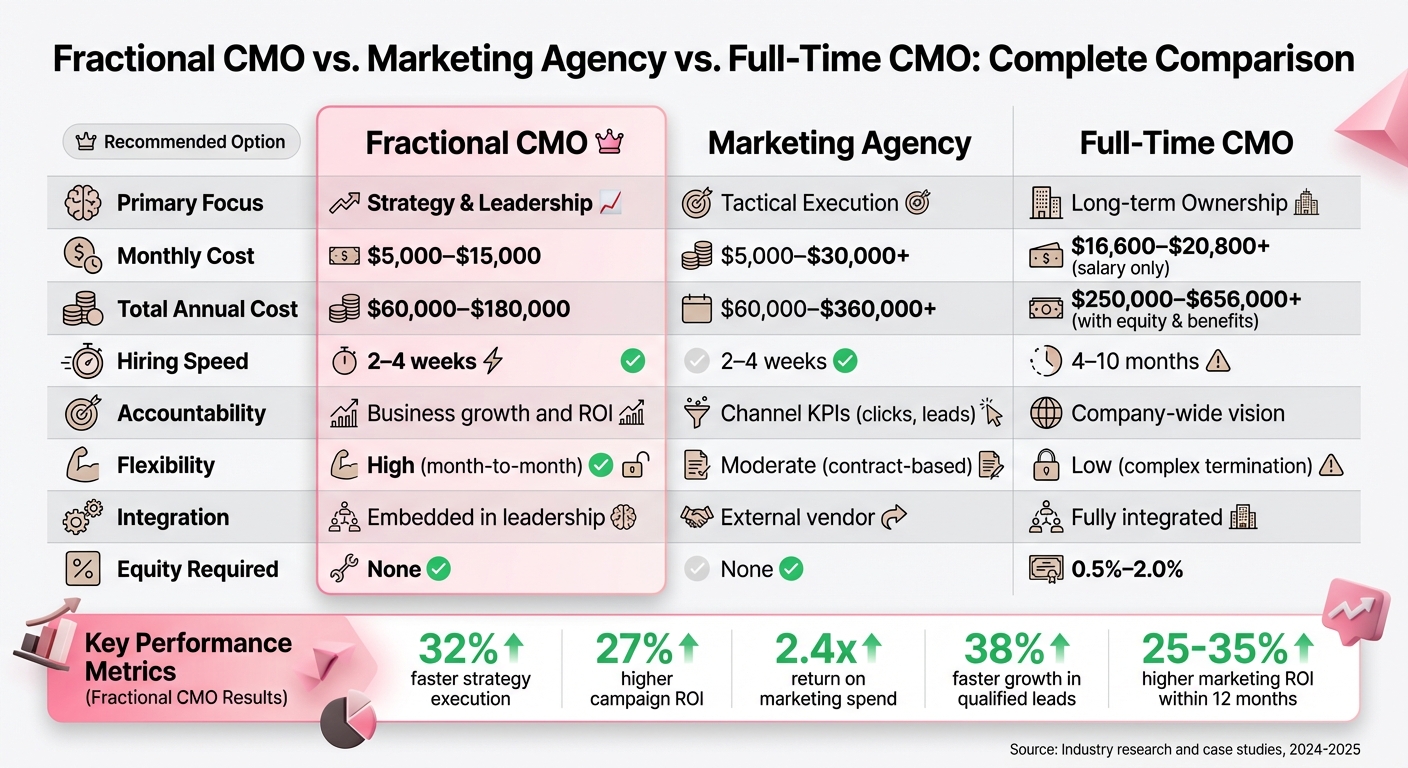
Fractional CMO vs Marketing Agency vs Full-Time CMO: Cost and Performance Comparison
Comparison Table: Strengths and Weaknesses
When growth-stage companies need to shape their marketing strategy, they typically face three options: hire a fractional CMO, partner with a marketing agency vs. a fractional CMO, or bring on a full-time CMO. Each approach offers distinct advantages, but choosing the wrong one can lead to wasted time, money, and missed opportunities.
At its core, the choice boils down to role clarity. A fractional CMO operates as your strategic leader, creating the marketing blueprint, aligning efforts with revenue goals, and mentoring your team. Marketing agencies, on the other hand, specialize in execution – handling tasks like SEO, PPC, and content production – but require guidance from someone who understands your business at a strategic level. A full-time CMO provides deep integration and oversight, making them ideal for large-scale operations.
| Factor | Fractional CMO | Marketing Agency | Full-Time CMO |
|---|---|---|---|
| Primary Focus | Strategy & Leadership | Tactical Execution | Long-term Ownership |
| Monthly Cost | $5,000–$15,000 | $5,000–$30,000+ | $16,600–$20,800+ (salary only) |
| Total Annual Cost | $60,000–$180,000 | $60,000–$360,000+ | $250,000–$656,000+ (with equity & benefits) |
| Hiring Speed | 2–4 weeks | 2–4 weeks | 4–10 months |
| Accountability | Business growth and ROI | Channel KPIs (clicks, leads) | Company-wide vision |
| Flexibility | High (month-to-month) | Moderate (contract-based) | Low (complex termination) |
| Integration | Embedded in leadership | External vendor | Fully integrated |
| Equity Required | None | None | 0.5%–2.0% |
The numbers speak for themselves. Companies working with fractional CMOs report 32% faster strategy execution and 27% higher campaign ROI compared to agencies. On average, clients see a 2.4x return on marketing spend and experience 38% faster growth in qualified leads. The demand for fractional leadership is also on the rise, with LinkedIn profiles mentioning “fractional leadership” growing from 2,000 in 2022 to over 110,000 by early 2024. Projections show these roles increasing by more than 40% between 2023 and 2025.
Why Fractional CMOs Deliver More Value
The strength of fractional CMOs lies in their ability to take ownership of strategy and results. As Michael Porter of Porter Wills puts it:
“Hiring an agency before you have a strategy is like hiring a construction crew without an architect. They will build something, but it probably will not be the right house”.
While agencies often focus on their own performance metrics – like clicks or impressions – a fractional CMO integrates into your leadership team, prioritizing revenue-focused goals that drive your business forward.
This strategic alignment makes a measurable difference. Within 12 months, fractional CMOs can deliver 25% to 35% higher marketing ROI by focusing on revenue-driving metrics instead of vanity statistics. They also help eliminate the “founder bottleneck”, where CEOs spend over 20% of their time acting as interim marketing leaders. By stepping in with senior-level expertise, fractional CMOs provide a cost-effective alternative to full-time hires, which often come with price tags exceeding $200,000 annually.
Speed is another critical factor. Fractional CMOs can be onboarded in 2–4 weeks, with a strategic framework ready in 2–3 months. In contrast, hiring a full-time CMO can take 4–10 months. For companies chasing funding milestones or rapid growth, this time savings can be a game-changer.
An emerging trend among successful businesses is the hybrid model, where a fractional CMO takes on the role of strategic overseer. Acting as a “general contractor”, they develop the overall strategy while managing agencies or in-house teams for execution. This approach highlights the fractional CMO’s role as a key driver of growth for companies navigating critical stages of development.
How to Select and Onboard the Right Fractional CMO
Defining Your Specific Marketing Needs
Before you start interviewing candidates, take a hard look at your marketing challenges. Are you spending too much time on marketing yourself? Are your leads inconsistent, or do your campaigns feel scattered? These are signs that you might need a fractional CMO to step in.
One way to prepare is by creating a one-page “Growth Brief”. This document should outline your Ideal Customer Profile, 12-month revenue goals, and the current state of your sales funnel. It’s a great alignment tool for interviews. When you present candidates with a real business challenge, pay attention to their responses. Weak candidates tend to jump straight to tactics, offering solutions like “run more ads” or “try TikTok” without addressing the deeper business dynamics.
Details matter. For instance, if you’re a Series A B2B SaaS company, you’ll want someone with specific experience scaling companies at that stage – not a generalist who’s dabbled in everything. 78% of businesses seek niche expertise to improve ROI, while hiring someone with mismatched experience can lower performance outcomes by 20-30%. During the hiring process, ask for a 30-60-90 day plan to gauge how each candidate would approach your unique business goals.
Having a clear understanding of your needs and challenges will make it easier to evaluate candidates for both their expertise and their ability to align with your team.
Evaluating Experience and Cultural Fit
While experience is critical, cultural fit can make or break the relationship. In fact, 68% of fractional CMO partnerships fail to meet expectations due to mismatched goals or poor strategic alignment. These failures can cost companies anywhere from $50,000 to $200,000 in fees, not to mention opportunity costs that often exceed $500,000.
To avoid this, conduct thorough reference checks. Speak with a former CEO, a direct report, and a vendor they worked with. Ask targeted questions about their impact on revenue and how well they integrated with leadership. Since fractional CMOs don’t have direct authority, they need to lead through influence and trust. Look for emotional intelligence and their ability to empower the existing team rather than overshadowing them.
Here are some red flags to watch for during the hiring process:
| Red Flag | Warning Sign |
|---|---|
| Guaranteed Results | Claims like “double your revenue” without first auditing your business |
| One-Size-Fits-All | Relies on generic playbooks instead of tailoring strategies to your industry or growth stage |
| Poor Listening | Interrupts during discovery calls, showing a lack of stakeholder management skills |
| Tactical Bias | Suggests specific tools or platforms before defining an overarching strategy |
| KPI Resistance | Avoids tying their performance to measurable goals or regular reviews |
To test their skills and compatibility, consider starting with a 30-to-90-day pilot engagement. Set clear deliverables to evaluate their working style and strategic depth before committing to a long-term arrangement. Some companies even opt for paid 90-minute working sessions in place of traditional interviews to see how candidates think on their feet.
Ensuring a Smooth Onboarding Process
Once you’ve chosen the right candidate, a structured onboarding process is essential for quick and effective results. While speed is important, skipping foundational steps can lead to problems later. A successful onboarding typically follows a 90-day structure: Month 1 focuses on audits and strategy, Month 2 on foundational work and “quick wins”, and Month 3 on scaling and optimization.
Before their start date, prepare by setting up digital access (CRM, analytics tools, email, Slack) and compiling a documentation package that includes strategic priorities, team structure, and brand guidelines. Conduct a CRM audit ahead of time – messy data can delay progress by weeks. During the first week, focus on high-level business discussions about challenges, revenue goals, and resource constraints, rather than jumping into tactical tasks.
Define 5-7 core metrics (like SQL volume, pipeline velocity, or CAC) upfront to measure ROI effectively. Introduce the fractional CMO to key team members in Sales, Finance, and Operations to establish alignment on lead criteria and handoff processes. Also, clarify their budget authority and decision-making scope to avoid bottlenecks in campaign approvals.
Set a 30-day “quick win” goal, such as launching a couple of low-hanging fruit campaigns (e.g., email nurture sequences or a LinkedIn strategy) in Month 2 to generate momentum. Use weekly reviews with a structured document to track progress, compare metrics to baselines, and outline upcoming priorities. Active participation from the founder – like engaging on LinkedIn or joining customer calls – can amplify results by 30-50%.
A well-planned onboarding process not only accelerates the fractional CMO’s impact but also lays a solid foundation for sustainable growth and measurable outcomes.
Conclusion
Growth-stage companies don’t need more marketing noise – they need a clear, results-driven strategy that ties every dollar to measurable outcomes. That’s where fractional CMOs step in, offering executive-level leadership to create positioning frameworks, build measurement systems, and craft playbooks for long-term success. Unlike agencies chasing clicks and impressions or full-time hires bogged down by lengthy onboarding, fractional leaders integrate directly into the C-suite and often deliver results within 30–60 days. This approach, as we’ve discussed in earlier sections on resource allocation and scalability, is essential for driving sustainable growth.
Companies that embrace fractional CMOs see real results: a 40% faster go-to-market timeline and a 30% boost in marketing ROI within the first year. In some cases, ROI can soar as high as 589–600%. With marketing budgets shrinking to 7.7% of company revenue in 2024 (down from 9.1% in 2023), every dollar spent must count.
“Fractional marketing leadership isn’t a cost-saving tactic; it’s a strategic edge. It’s how growth-stage businesses compete with enterprise players – without losing speed, flexibility, or focus.”
- Sanjeev Arora, Fractional CMO Partners
The fractional model doesn’t just cut costs by 60–70% compared to full-time executives – it also taps into cross-industry expertise to eliminate guesswork and strengthen internal capabilities.
This streamlined approach and proven effectiveness highlight why fractional leadership is reshaping marketing strategies. If your founder is spending over 20% of their time managing marketing or your campaigns lack focus despite increased spending, fractional leadership may be the game-changer that turns marketing into a revenue driver. The real question isn’t whether you can afford it – it’s whether you can afford to scale without it.
FAQs
What are fractional marketing services?
Fractional marketing services give companies flexible access to senior marketing leadership and specialist support without hiring a full-time executive team. They can include strategy, channel planning, campaign oversight, reporting, positioning, and team leadership.
What is included in fractional marketing services?
The exact scope varies, but most engagements include marketing strategy, go-to-market planning, performance analysis, team management, and oversight of channels like SEO, paid media, content, email, and lifecycle marketing.
How much do fractional marketing services cost?
Costs depend on scope, seniority, and hours, but many engagements fall well below the total cost of a full-time marketing executive. Pricing is often monthly and can scale up or down based on business needs.
How are fractional marketing services different from a marketing agency?
A marketing agency usually focuses on execution within specific channels. Fractional marketing services add strategic leadership, prioritization, and accountability across the full marketing function, often coordinating agencies or internal teams.
Who should hire fractional marketing services?
They are often a strong fit for growth-stage companies that need strategic marketing leadership, better channel alignment, or stronger reporting before committing to a full-time executive hire.
Is a fractional CMO right for my company right now?
If your company is experiencing growth but hitting obstacles like stalled progress, an unclear strategy, or disjointed marketing efforts, a fractional CMO could be the solution. This part-time, high-level role provides strategic guidance without the expense of a full-time executive. However, if your business is still in its early days or heavily focused on product development, it might be premature to bring one on board.
What results can I expect in the first 60–90 days?
In the first 60–90 days, the focus is on aligning the team and refining the marketing strategy. During this time, you’ll see key deliverables such as a well-defined plan, thorough audits, and some early successes. These initial wins help create a solid groundwork for future growth, ensuring resources are used effectively and paving the way for measurable outcomes.
How do I measure ROI from a fractional marketing leader?
To gauge ROI effectively, focus on tracking measurable metrics such as revenue growth, pipeline generated, customer acquisition cost (CAC), and marketing-influenced deals closed. Establish clear KPIs to guide your analysis, and keep an eye on metrics like cost per acquisition (CPA). Additionally, evaluate results that reflect better positioning or operational efficiency.
When calculating ROI, use this formula:
(Value Generated – Cost of Investment) / Cost of Investment × 100
This approach ensures you concentrate on the financial outcomes that are directly linked to your efforts compared to their costs.