
For SaaS companies, the choice between a fractional CMO vs paid media agencies for SaaS usually comes down to one question: do you need marketing strategy or campaign execution?
Choose a fractional CMO if your team lacks positioning, go-to-market direction, funnel strategy, or revenue accountability. Choose a paid media agency if your strategy is already clear, and you need specialists to run, test, and scale campaigns across channels like Google Ads, LinkedIn, SEO, or paid social.
- Fractional CMO: Ideal for companies that need high-level marketing leadership to define strategies, align teams, and connect marketing efforts to revenue. Costs $5,000–$15,000/month for strategy alone, or $25,000–$45,000/month with execution support. Best for SaaS businesses with an internal team that lacks direction.
- Paid Media Agency: Ideal for companies with a solid strategy that need help executing campaigns. They handle PPC, SEO, and paid ads, with fees ranging from $3,000–$25,000/month. They are good for quickly scaling efforts but may lack alignment with broader business goals without internal leadership.
Quick Comparison
| Factor | Fractional CMO | Paid Media Agency |
|---|---|---|
| Primary Role | Strategy and leadership | Campaign execution |
| Cost | $5K–$15K/month (strategy only) | $3K–$25K/month (includes execution) |
| Time to Impact | 60–90 days | 14–30 days |
| Focus | Business outcomes (ARR, ROI) | Channel KPIs (CTR, CPC, leads) |
| Best For | Companies needing direction | Companies needing execution |
Key Takeaway
If your SaaS company does not have a clear ICP, positioning, funnel strategy, or revenue-based marketing plan, start with a fractional CMO. If those pieces are already in place and your main challenge is launching or scaling campaigns, hire a paid media agency. If you need both direction and execution, use a fractional CMO to lead strategy and manage the agency.
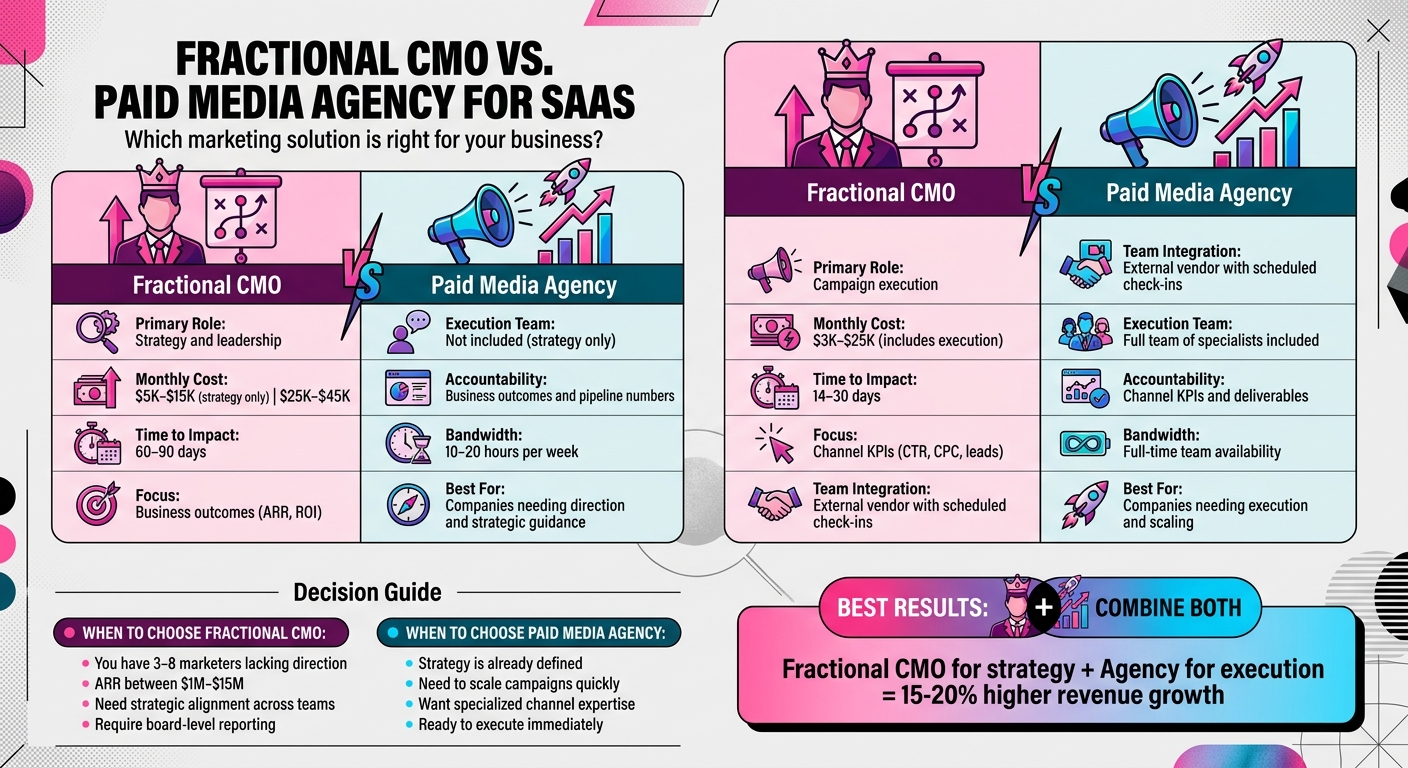
Fractional CMO vs Paid Media Agency: Complete Comparison for SaaS Companies
Fractional CMO: Senior Marketing Leadership for SaaS
What a Fractional CMO Does
A fractional CMO provides part-time executive-level leadership focused on strategy rather than day-to-day operations. Their role includes shaping your go-to-market strategy, developing positioning frameworks, and aligning marketing, sales, and product teams to drive growth effectively.
Fractional CMOs usually focus on strategy, prioritization, and team alignment, while execution is often handled by internal staff or agency partners. This strategic planning lays the groundwork for the operational execution that follows.
“Marketing spend without strategic ownership produces activity, not revenue.” – Kamyar Shah, Fractional COO & CMO
Main Responsibilities of a Fractional CMO
The primary focus of a fractional CMO is strategic leadership and aligning marketing efforts with revenue goals. They define your Ideal Customer Profile (ICP) and buyer personas, translating these insights into actionable marketing KPIs such as Annual Recurring Revenue (ARR), Customer Acquisition Cost (CAC), and Lifetime Value (LTV). They also evaluate your marketing tech stack to ensure accurate attribution and ROI tracking. Managing relationships with external vendors or agencies is another responsibility, ensuring performance aligns with agreed-upon metrics.
Fractional CMOs also handle board-level reporting, presenting marketing performance to leadership and investors to maintain transparency and oversight. They play a key role in mentoring and developing in-house marketing teams, helping to build long-term internal capabilities.
When a Fractional CMO Makes Sense
Fractional CMOs bring the most value when your company has the resources for execution but lacks strategic guidance. For instance, if you have a marketing team of 3–8 people handling tactical work without a clear overarching plan, a fractional CMO can step in to align their efforts with broader revenue objectives. This approach is particularly beneficial for SaaS companies earning between $1M and $15M in ARR, where hiring a full-time CMO may be hard to justify financially. Full-time CMO compensation varies widely by market, company size, and whether equity and bonus are included.
This model works especially well during pivotal moments, such as market repositioning, creating a new category, or scaling from $5M to $15M in ARR. However, it’s crucial to have a capable internal team ready to execute the strategies set by the fractional CMO. Their role is distinct from that of paid media agencies, focusing on strategy rather than hands-on implementation.
sbb-itb-8f8c601
Paid Media Agencies: Execution Partners for SaaS
What Paid Media Agencies Provide
Paid media agencies specialize in executing marketing strategies. Their primary responsibilities include managing PPC campaigns on platforms such as Google Search, LinkedIn, and Meta; handling SEO (both technical and on-page); running display ads; optimizing campaigns; and delivering performance reports. They focus on building and managing campaigns, including crafting ad copy, designing landing pages, managing bids, and testing creative assets.
A key offering from these agencies is the regular creative updates needed to keep demand generation campaigns effective. For platforms like LinkedIn and YouTube, this often means refreshing creative assets every two to three weeks to avoid ad fatigue. Many companies outsource at least part of their content marketing to external partners, especially when they need specialized skills or extra execution capacity.
When it comes to pricing, full-service digital agencies that handle SEO, content, and paid media typically charge between $5,000 and $15,000 or more per month. On the other hand, specialist SaaS PPC agencies have retainers ranging from $3,700 to $10,000 monthly, depending on the scope and channels involved. For businesses spending between $6,200 and $31,000 per month, these retainers often provide more execution capacity than hiring a single in-house marketer.
This execution-driven approach highlights both the benefits and challenges of working with paid media agencies.
Where Paid Media Agencies Excel
Agencies bring deep expertise in specific marketing channels, knowledge that often takes years to build internally. Their experience with SaaS companies gives them a sharp understanding of what works in B2B demand generation. This allows them to launch and scale campaigns quickly, which is especially helpful for companies looking to grow fast or expand into new markets.
For growth-stage companies with a solid product-market fit, agencies can effectively manage large, multi-market campaigns across regions like the UK and EU. They also maintain strict testing routines, which is crucial for platforms like LinkedIn, where creative assets can quickly lose their effectiveness.
“The real trade-off is: Control and context (in‑house) versus specialist depth and speed (agency) versus risk‑managed execution (hybrid)” – Todd Chambers, CEO of Upraw Media
Another advantage is the flexibility agencies offer in pricing. Unlike the fixed costs of hiring in-house staff, agencies provide a variable pricing model. For example, hiring a mid-level paid media manager with B2B SaaS experience can cost between $74,000 and $105,000 annually (including benefits and tools). In contrast, an agency retainer allows businesses to scale resources up or down as needed.
Where Paid Media Agencies Fall Short
Despite their strengths, agencies can struggle with strategic alignment, a challenge often referred to as the “strategy-execution gap.” As Peter Geisheker, B2B Fractional CMO at The Geisheker Group, explains:
“I’ve seen too many businesses spend tens of thousands of dollars on marketing agencies without a coherent B2B marketing strategy to tie it all together. The result? Fragmented campaigns, inconsistent messaging, and leadership teams who can’t explain what marketing is actually doing for revenue”
Agencies often focus on platform-specific metrics like clicks, impressions, and cost-per-lead rather than broader business outcomes unless directed by a CMO. Without strategic oversight, campaigns risk drifting away from the company’s main objectives. Additionally, because they operate externally, agencies lack the internal knowledge needed to quickly adapt to changes in the product, sales feedback, or shifting priorities.
For agencies to succeed, they need strong direction from internal leadership. Todd Chambers emphasizes this point:
“An agency without a strong internal point of contact will lose focus. Someone needs to own the relationship: brief the agency on product changes, share sales feedback, approve decisions, and hold the agency to account”
It’s also important to note that achieving meaningful results from paid media often takes 90 to 120 days. Without clear strategic guidance during this period, agencies may end up optimizing for metrics that don’t align with long-term business goals. This highlights the importance of balancing execution with strong leadership when working with paid media agencies.
Fractional CMO vs. Paid Media Agency: Side-by-Side Comparison
What to Compare
When deciding between a fractional CMO and a paid media agency, SaaS leaders should look beyond the monthly fees. The key differences lie in how each integrates with your team, their areas of accountability, and how quickly they can contribute to revenue growth.
A fractional CMO steps in as a part-time executive, steering your company’s positioning, budget allocation, and go-to-market strategies. They define your Ideal Customer Profile (ICP) and messaging framework, then oversee both internal teams and external vendors to ensure alignment with business objectives. On the other hand, a paid media agency works as an external vendor, focusing on delivering results through targeted campaigns. Their team of specialists – designers, copywriters, and PPC experts – aims to meet channel-specific metrics like CTR, CPC, and lead volume.
This distinction between strategic leadership and tactical execution is crucial. Fractional CMOs take ownership of business outcomes and revenue goals, while agencies gauge success based on campaign performance and lead generation. As Peter Geisheker from The Geisheker Group aptly states:
“The smartest path for a scaling company is often to lead with a Fractional CMO who then manages and directs the marketing agency”.
The comparison table below highlights these differences to help you make an informed choice.
Comparison Table: Fractional CMO vs. Paid Media Agency
| Factor | Fractional CMO | Paid Media Agency |
|---|---|---|
| Primary Focus | Strategy, leadership, and ROI alignment | Execution, channel expertise, and scaling campaigns |
| Team Integration | Embedded in the leadership team (often using tools like Slack) | External vendor relationship with scheduled check-ins |
| Execution Team | Not included (strategy only) | Full team of specialists included |
| Time to Impact | 60–90 days (from strategy to execution) | 14–30 days (with a ready-made team) |
| Monthly Cost | $5,000–$15,000 | $3,000–$25,000 |
| Management Role | Manages internal staff and external agencies | Manages its own internal specialists |
| Accountability | Business outcomes and pipeline numbers | Channel KPIs (CTR, CPC, lead volume) |
| Best For | Companies needing strategic direction and leadership | Companies needing immediate tactical capacity |
Cost Considerations
The cost differences highlight the distinct roles each option serves. Fractional CMOs typically charge $5,000–$15,000 per month, but that fee doesn’t include execution. Adding execution teams can push the total to $25,000–$45,000 per month. Even so, this can still cost less than hiring a full-time CMO, especially when salary, bonus, equity, and benefits are considered. Total compensation varies widely by company stage and market.
Fractional CMO vs Marketing Manager vs Agency | What’s the Difference?
Pros and Cons of Each Option
When deciding between a fractional CMO and a paid media agency, the right choice will depend on your company’s specific needs and the resources you already have in place. Here’s a closer look at the strengths and weaknesses of each option.
Fractional CMO: Advantages and Disadvantages
A fractional CMO offers strategic leadership at a fraction of the cost of hiring a full-time executive. Considering that a full-time CMO typically earns between $250,000 and $400,000 annually, a fractional CMO can save 30% to 70% of that expense. Their role often involves embedding themselves within leadership, defining your ideal customer profile (ICP), shaping go-to-market strategies, and mentoring your team to create lasting systems.
But there’s a catch: fractional CMOs focus on strategy, not execution. This means their $10,000–$15,000 monthly retainer often requires additional investment in specialists to implement the strategies they develop. Without an execution team, even the best strategy won’t yield results.
Another drawback is their limited availability. Fractional CMOs typically work 10–20 hours per week, which may be insufficient during high-pressure periods such as product launches or rebranding efforts. Additionally, the impact of their strategic work usually takes 60–90 days to materialize.
Paid Media Agencies: Advantages and Disadvantages
If your company needs immediate execution, paid media agencies can step in with a pre-assembled team ready to deliver results within 14–30 days. Their retainers, which range from $3,000 to $25,000 per month, often include both strategy and execution, making them a practical choice for businesses without an internal marketing team. These agencies also bring specialized expertise across channels like Google Ads, LinkedIn, and SEO.
However, agencies can struggle with strategic alignment. Without senior leadership steering the ship, they might focus on short-term metrics like clicks and impressions rather than long-term business goals. Shirley Paz from NeoGig sums it up well:
“Agencies execute; CMOs provide strategic direction and accountability.”
Another downside is knowledge dependency. When an agency’s contract ends, their expertise often leaves with them, unlike a fractional CMO who builds internal capabilities. Agencies may also struggle to align with your company’s broader goals, such as product roadmaps or sales strategies, resulting in messaging that doesn’t always hit the mark. This misalignment can be especially costly for SaaS companies spending over $300,000 annually on marketing without a clear return on investment.
Pros and Cons Comparison Table
The table below highlights the key differences between fractional CMOs and paid media agencies:
| Factor | Fractional CMO | Paid Media Agency |
|---|---|---|
| Primary Advantage | Strategic leadership at a lower cost | Immediate execution with a skilled team |
| Cost Structure | $10K–$15K/month (strategy only) | $3K–$25K/month (includes execution) |
| True Monthly Cost | $25K–$45K (with execution specialists) | $3K–$25K (all-inclusive) |
| Time to Impact | 60–90 days | 14–30 days |
| Knowledge Transfer | Builds internal team capabilities | Expertise departs when the contract ends |
| Main Limitation | Lacks execution capacity | May lack alignment with broader goals |
| Bandwidth | 10–20 hours per week | Full-time team availability |
| Accountability | Focus on business outcomes and ROI | Focus on channel KPIs and deliverables |
| Best For | Companies with an execution team needing strategic guidance | Companies with a solid strategy needing scalable execution |
Early-Stage SaaS: Fractional CMO for Planning and Direction
If your SaaS company is in the early stages – pre-Series A or around $1 million in ARR – you’re likely still figuring out who your ideal customers are and how to consistently reach them. At this point, a fractional CMO can make a big difference. Without clear positioning or a go-to-market strategy, your marketing efforts can feel scattered and ineffective.
A fractional CMO helps validate your market, define your ideal customer profile (ICP), create messaging that resonates, and map out a marketing strategy – all before you start pouring money into paid channels. For instance, hiring a fractional CMO for $5,000–$10,000 per month can provide this critical foundation. However, expecting them to handle both strategy and execution is a common mistake. As Ishan Manchanda from GrowthSpree points out:
“The trap: most Series A companies don’t have an execution team. They hire a fractional CMO expecting strategy AND execution, and 90 days later they have a beautiful strategy deck and zero pipeline because there’s nobody to execute it.”
Once your strategy is in place, the next step is scaling your efforts effectively.
Growth-Stage SaaS: Agencies for Scaling Paid Channels
When your SaaS company reaches the growth stage – typically between $1 million and $15 million in ARR – your focus shifts from planning to scaling. At this point, you’ve likely validated your go-to-market strategy and need a repeatable way to build your pipeline. This is where paid media agencies shine.
Agencies bring specialized expertise across platforms like Google Ads, LinkedIn, and SEO. They can deliver results quickly, often within 14–30 days, because they come with a full team ready to execute. If your strategy is solid but you need to scale faster, partnering with an agency (with retainers ranging from $5,000–$25,000 per month) can be a smart move. However, there’s a catch: without internal marketing leadership to align the agency’s work with your broader business goals, you might see plenty of activity but little impact on your pipeline.
To avoid this, many companies at this stage pair a fractional CMO with an agency. This pairing ensures strategic oversight while the agency focuses on execution.
Mid-Market SaaS: Combining Both for Better Results
For SaaS companies with $15 million or more in ARR, a blended approach often delivers the best results. At this stage, you need both senior-level strategy and strong execution. A fractional CMO provides the strategic layer – handling board-level reporting, aligning cross-functional teams, and managing agency relationships – while a paid media agency focuses on executing campaigns.
This combination bridges the gap between strategy and execution. It ensures that tactical campaigns align with revenue goals, product roadmaps, and sales strategies. As Manchanda explains:
“The typical path is: agency (Series A, prove the GTM), fractional CMO + agency (late Series A / early Series B, add strategic layer), full-time CMO (Series B+, internalize the function).”
This dual approach not only enhances current efforts but also sets the stage for transitioning to a full-time CMO when the time is right. Meanwhile, the agency continues scaling your paid channels without missing a beat.
Using a Fractional CMO and Paid Media Agencies Together
How This Combined Approach Works
Pairing a fractional CMO with a paid media agency can supercharge your marketing by blending strategic oversight with expert execution. Here’s how it works: the fractional CMO lays the groundwork by defining your Ideal Customer Profile (ICP), crafting your positioning, and setting your messaging strategy. The paid media agency then builds on this foundation to execute campaigns across platforms such as Google and LinkedIn.
This setup eliminates the risk of scattered tactics that miss the mark with your audience. The fractional CMO acts as the bridge, managing the agency relationship to ensure campaigns deliver results that align with your broader business goals – not just surface-level metrics like clicks or impressions.
To keep everything on track, this partnership follows a structured schedule: weekly check-ins for tactical updates, monthly performance reviews, and quarterly strategic adjustments. While the agency fine-tunes ad copy and creative elements, the CMO analyzes performance data to refine budgets and channel strategies.
The payoff? When strategy and execution are well aligned, companies may see stronger marketing efficiency and clearer revenue attribution, proving the value of aligning strategy with execution. And when it comes to cost, this combined approach typically runs between $8,000 and $18,000 per month, offering a more streamlined and cost-effective alternative to managing separate resources.
This collaborative model not only delivers measurable results but also lays a strong foundation for broader strategic decisions, as detailed in the next section.
Conclusion: Fractional CMO vs Paid Media Agencies for SaaS
Main Points to Remember
In this article, we’ve broken down the roles of strategic leadership and tactical execution in SaaS marketing. The choice between these two depends on whether your business needs high-level guidance or hands-on campaign management. A fractional CMO provides direction and leadership for go-to-market strategies but doesn’t typically handle execution. On the other hand, a paid media agency focuses on executing campaigns across platforms like Google Ads and LinkedIn but may lack the strategic oversight to align campaigns with your broader goals.
The key takeaway? Identify whether your primary challenge lies in strategy, execution, or both. Avoid common pitfalls, like hiring a fractional CMO without a team to execute their vision, which can stall your pipeline. Similarly, partnering with an agency without a solid strategic foundation can lead to disorganized campaigns that waste budget without delivering measurable results.
What SaaS Leaders Should Do Next
Now that you have a clearer understanding, take a step back to evaluate your team’s current needs. If you have a team of three or more marketers who are struggling with direction, a fractional CMO could provide the leadership they need. If your strategy is already in place but you’re looking to scale, a paid media agency might be the better fit. For SaaS companies under $1M ARR, a leaner approach – such as DIY strategies or advisory support – might suffice. Meanwhile, businesses nearing $15M+ ARR may be ready for a full-time CMO paired with specialized agencies.
For those seeking integrated strategy and execution, Strategic Pete (https://strategicpete.com) provides customized fractional CMO services tailored to B2B and SaaS organizations. Use the next 90 days to identify your gaps and choose the right partner to help you bridge them.
Need SaaS Marketing Strategy Before Scaling Paid Media?
Strategic Pete provides fractional CMO support for B2B SaaS companies that need clearer positioning, stronger go-to-market strategy, better agency oversight, and marketing accountability tied to pipeline and revenue.
If your paid media efforts are active yet disconnected from strategy, a fractional CMO can help define the plan, align execution partners, and ensure campaigns support business outcomes rather than isolated channel metrics.
FAQs
What should I hire first: a fractional CMO or a paid media agency?
Choosing between a fractional CMO and a paid media agency comes down to your business needs. If your focus is on strategic leadership – developing a marketing plan, refining your positioning, and managing execution – a fractional CMO is the way to go. On the other hand, if you’re looking for hands-on execution like managing ad campaigns or improving SEO, a paid media agency might be a better fit. For early-stage SaaS companies, starting with a fractional CMO often helps establish a strong strategic foundation before diving into tactical efforts.
Should SaaS companies use both a fractional CMO and a paid media agency?
Yes, if the company needs both strategic leadership and execution capacity. A fractional CMO can define the ICP, positioning, messaging, budget priorities, and performance targets, while the agency executes campaigns across paid search, paid social, SEO, or other channels. This works best when the fractional CMO owns strategy and agency accountability, and the agency owns campaign delivery.
How can I tell if my paid media is failing due to strategy or execution?
When your paid media efforts aren’t delivering, the first step is figuring out whether the issue stems from strategy or execution. Here’s how to break it down:
- Strategy Issues: If your campaigns lack clear, data-backed goals or don’t align with your business objectives, the issue is likely the overall plan. A solid strategy should guide every aspect of your campaign.
- Execution Gaps: On the flip side, if your strategy is well thought out but the results still fall short, the issue might be in how the plan is carried out. Common culprits include poor audience targeting, ineffective messaging, or lackluster optimization efforts.
The key? Regularly analyze your performance metrics. This will help you zero in on whether the root of the problem is in the “what” (strategy) or the “how” (execution).
What should a fractional CMO manage when I’m using an agency?
A fractional CMO focuses on the strategic aspects of marketing, including crafting go-to-market strategies, defining target personas, refining positioning and messaging, and developing channel strategies. They ensure marketing efforts align with overall business objectives, oversee the marketing roadmap, and maintain alignment between sales and marketing teams. Additionally, they manage relationships with agencies to ensure smooth collaboration.
However, the hands-on execution – like content creation, campaign management, or technical SEO – is typically handled by the agency. The fractional CMO’s role is to provide high-level guidance and oversight, leaving the tactical work to the execution team.