
A fractional CMO for professional services firms is a part-time senior marketing leader who helps firms like consultancies, law firms, accounting firms, advisory firms, and other expertise-led businesses build a clear growth strategy without hiring a full-time CMO. They bring executive-level marketing leadership, align marketing with revenue goals, improve positioning, and create systems for lead generation, referrals, and pipeline growth.
For firms that rely too heavily on founder-led business development or inconsistent referrals, a fractional CMO can help turn scattered marketing into a structured growth engine. This model is often the right fit when a firm needs strategic direction, stronger lead quality, and better marketing accountability, but is not ready for a full-time executive hire.
When a Professional Services Firm Should Hire a Fractional CMO
sbb-itb-8f8c601
Who This Is For:
A fractional CMO is usually a strong fit for professional services firms that:
- Have grown to the point where founder-led marketing is no longer enough
- Rely heavily on referrals but want a more predictable pipeline
- Need better positioning, messaging, and market differentiation
- Have agencies or internal marketers, but lack strategic leadership
- Want marketing tied more clearly to revenue, not just activity
This is especially relevant for firms with long sales cycles, relationship-driven buying, and high-trust offers where authority, credibility, and clear specialization matter.
What Is a Fractional CMO for Professional Services and How Do They Support Growth?
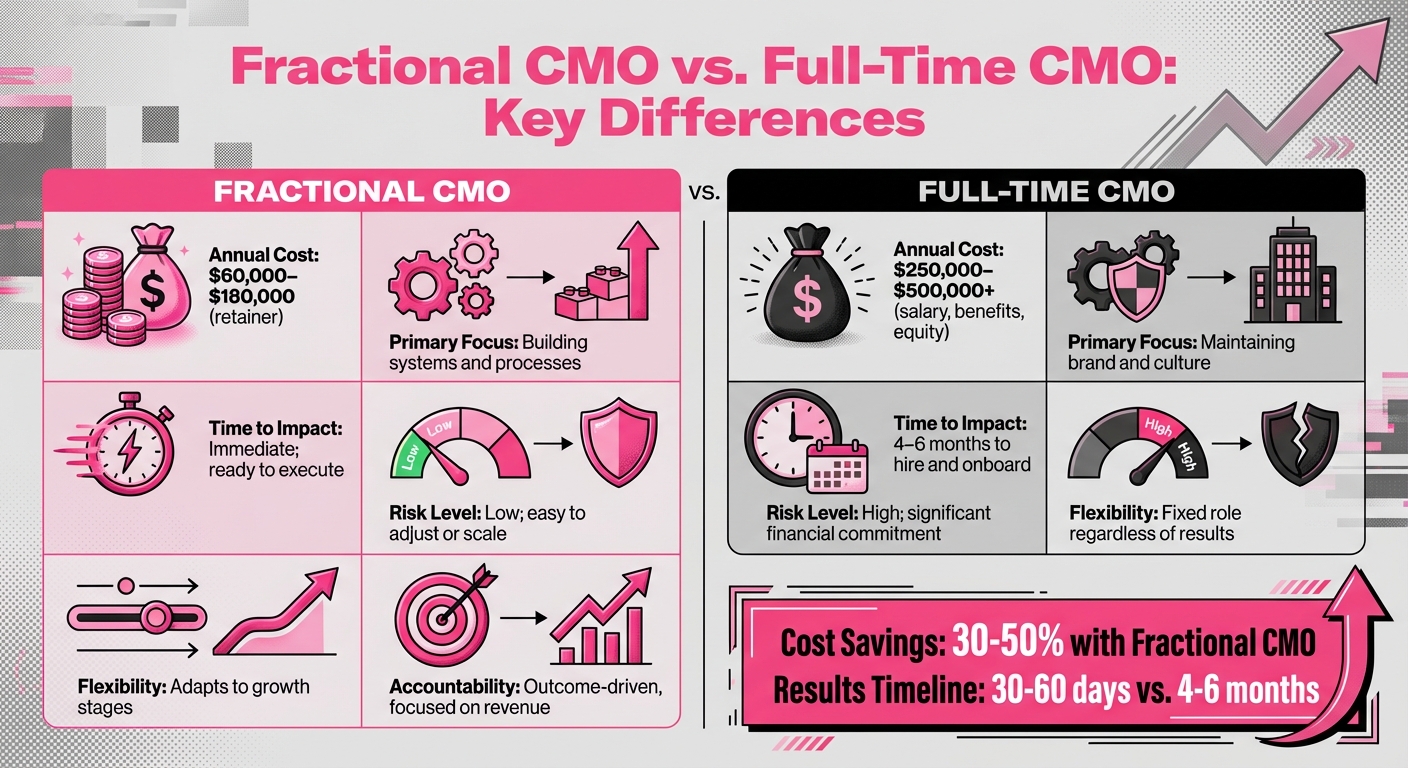
Fractional CMO vs Full-Time CMO: Cost, Impact & Flexibility Comparison
Role and Main Responsibilities
A fractional CMO is a part-time addition to your leadership team, offering senior marketing expertise without the need for a full-time hire. Unlike consultants who provide advice and then step away, a fractional CMO takes full responsibility for marketing outcomes. They lead the marketing team, implement systems, and ensure those systems continue driving results even after their tenure.
For professional services firms, this role is especially valuable. These firms often face long sales cycles and require a marketing leader who prioritizes trust and authority over high-volume tactics. In practice, a fractional CMO develops go-to-market strategies, sets up B2B marketing services, aligns marketing budgets with revenue goals, and turns technical expertise into content that attracts qualified leads.
“Marketing doesn’t need to be the deepest technical expert, but must facilitate strategic alignment… Marketing has to be the shepherd that brings everything together.”
- Clement, Co-founder, The Growth Syndicate
Fractional CMO vs. Full-Time CMO
The distinction between a fractional CMO and a full-time CMO goes beyond just time commitment. Full-time CMOs are typically focused on maintaining established marketing operations, ensuring brand consistency, and managing larger teams. On the other hand, fractional CMOs are ideal for building marketing systems from scratch, particularly in companies that are still scaling.
| Feature | Fractional CMO | Full-Time CMO |
|---|---|---|
| Annual Cost | $60,000–$180,000 (retainer) | $250,000–$500,000+ (salary, benefits, equity) |
| Primary Focus | Building systems and processes | Maintaining brand and culture |
| Time to Impact | Immediate; ready to execute | 4–6 months to hire and onboard |
| Risk Level | Low; easy to adjust or scale | High; significant financial commitment |
| Flexibility | Adapts to growth stages | Fixed role regardless of results |
| Accountability | Outcome-driven, focused on revenue | Long-term stability and team focus |
Fractional CMOs often bring insights and frameworks from working across different industries, while full-time CMOs are generally more immersed in a single company’s culture and practices.
“A full-time CMO and a Fractional CMO are not the same role at different price points. They are entirely different structural instruments designed for different stages of organizational maturity.”
- Kamyar Shah, Founder, World Consulting Group
This makes fractional CMOs especially valuable for companies navigating transitional growth phases.
Why Growing Firms Get the Most Value
Companies with revenues between $2M and $12M often find themselves in a challenging spot. They’re too large to rely solely on the founder’s personal network for growth but not yet big enough to afford a full-time executive. This “death zone” is where a fractional CMO can make a transformative impact.
Without experienced marketing leadership, firms may fall into a pattern of disconnected tactics rather than executing a unified strategy. Firms with strong marketing leadership tend to see a 25% to 35% higher return on marketing investments.
Fractional CMOs also offer a unique advantage: independence. Kamyar Shah describes this as “political immunity”, enabling them to address sensitive issues like misaligned processes, ineffective projects, or poor service positioning without the internal politics that can hinder full-time employees.
“With a fractional it’s actually easier to test because you’re not really stuck to hiring. A lot of times founders don’t know what they are looking for when they start hiring people.”
- Joliene van Grieken, Co-founder, The Growth Syndicate
This flexibility allows companies to shift strategies – whether pivoting from enterprise sales to a product-led approach or changing focus from content marketing to partner channels – without the disruptions and costs that come with replacing a full-time executive.
What a Fractional CMO Helps Professional Services Firms Improve
Lower Costs and Better Efficiency
Hiring a fractional CMO gives companies access to top-tier marketing leadership at a fraction of the cost of a full-time executive. Instead of paying $200,000–$300,000+ annually for a full-time CMO, businesses can expect to spend between $60,000 and $120,000 per year for a fractional CMO, saving 30–50% on expenses. Additionally, these professionals can deliver strategic results within 30–60 days, avoiding the lengthy 4–6 month hiring and onboarding process typical of a traditional CMO.
“Trust signals are real, and they can make or break your business and your budget. You can spend money on ads, SEO, and content all day long, but if your brand and message aren’t aligned, you won’t see true ROI.”
- Julie Fisher, Founder, Fisher Marketing Services
Fractional CMOs excel at aligning every marketing dollar with revenue goals, ensuring no resources are wasted. They also work closely with external agencies to ensure vendor efforts support the company’s core priorities. This streamlined approach allows for faster execution and smoother entry into new markets, enabling firms to launch campaigns without delay.
Faster Market Entry and Campaign Launches
What might take months with traditional leadership can be condensed into weeks with a fractional CMO. Leveraging their cross-industry expertise, they conduct comprehensive marketing audits within the first 2–4 weeks, identifying ineffective strategies and securing quick wins. This speed is especially valuable for firms expanding into new markets or launching new services.
Fractional CMOs also implement essential tools – like CRM systems, automation platforms, and analytics dashboards – early in their tenure to prevent operational hiccups during growth phases. Beyond technology, they refine messaging and sales collateral, helping sales teams close deals faster and drive revenue growth.
The flexibility of the fractional model means firms can scale their marketing leadership as needed. Whether it’s a short-term push for a new service launch or testing a fresh market position, fractional CMOs deliver measurable results within 60–90 days. This adaptability creates momentum, aligning marketing efforts directly with revenue goals.
Revenue Growth Through Marketing Alignment
Fractional CMOs are laser-focused on aligning marketing efforts with revenue goals, turning marketing into a growth engine rather than a collection of disconnected activities. Instead of chasing vanity metrics like website traffic or social media likes, they prioritize meaningful indicators such as lead quality, pipeline velocity, and client acquisition costs.
For professional services firms—where over 60% of new clients often come from referrals—fractional CMOs help turn unpredictable referral streams into consistent revenue. They implement KPI dashboards that give leaders real-time insights into how marketing efforts are impacting business results.
A compelling example comes from Amata Law Office Suites, which partnered with a fractional CMO from Smart Yeti between 2024 and 2025. By redefining their client profile, repositioning their brand, and tying campaigns directly to their sales pipeline, Amata saw a 24% increase in services revenue within just one year.
“Any small to midsized company would benefit from hiring Smart Yeti as their CMO, versus hiring this position in-house.”
- Ron Bockstahler, CEO, Amata Law Office Suites
This transition from activity-based marketing to a results-oriented approach addresses growth challenges faced by companies with revenues between $2M and $12M, ensuring all marketing efforts lead to measurable business success.
Marketing Strategies Fractional CMOs Use for Scaling Firms
Fractional CMOs are recognized for their ability to blend cost savings with quick campaign execution, employing customized strategies to boost business growth.
Inbound Marketing Systems
Fractional CMOs concentrate on converting expertise into a reliable stream of qualified leads. They achieve this by developing structured content such as webinars, white papers, and industry articles that target specific client needs. This strategy not only boosts organic search traffic but also fosters long-term brand recognition.
To amplify this, they optimize LinkedIn profiles and develop content calendars that establish firm partners as thought leaders. Account-Based Marketing (ABM) campaigns are another tool they use to target high-value prospects. Additionally, they design referral and partnership programs, complemented by automated emails and content funnels, to keep potential clients engaged throughout lengthy B2B sales cycles.
Once the leads are in, fractional CMOs shift their focus to fine-tuning the sales pipeline to convert these opportunities into revenue.
Sales Pipeline Improvements
Fractional CMOs dig into existing sales processes, identifying bottlenecks by mapping workflows and interviewing leadership. They segment leads into categories – cold, active, or churned – so teams can focus their efforts on the most promising opportunities.
They also enhance sales enablement by aligning messaging, updating sales materials, and establishing clear service-level agreements (SLAs). This transforms lead metrics from superficial numbers into tangible revenue outcomes.
A great example is Xappex, a B2B SaaS company in the Salesforce ecosystem. By partnering with Digital Hunch Agency in late 2024, they revamped lead segmentation and onboarding emails, resulting in a 28% boost in trial subscriptions by Q1 2025. Similarly, Moser Roofing adopted a “7 Fundamentals” framework under guidance from The Marketing Blender, achieving 15% growth in 2021 and accelerating to 50% growth in 2022.
But sales optimization is just one piece of the puzzle. Fractional CMOs also rely on data-driven performance marketing to ensure ongoing success.
Performance Marketing and Data Analysis
Fractional CMOs connect marketing efforts directly to core business metrics like Customer Acquisition Cost (CAC), Lifetime Value (LTV), and payback periods. They analyze the entire sales funnel to identify areas where performance is lagging.
To track progress, they create dashboards that break down revenue goals into actionable weekly metrics, such as Marketing Qualified Leads (MQLs), funnel velocity, and conversion rates. This allows for quick, ROI-focused adjustments.
They also hold external agencies accountable by auditing tech stacks – covering CRMs, email systems, and analytics tools – to eliminate inefficiencies and improve visibility into the funnel. Companies with fractional CMOs report average revenue growth of 29%, compared to 19% for firms without this level of strategic marketing leadership.
“Marketing must be a commercial function – accountable to outcomes, not just activity.”
- Jose Escalera, CEO, The Idea Farm
What Results Can a Professional Services Firm Expect From a Fractional CMO?
Building Authority and Market Position
Take Amalfi, a private community built for elite athletes and investors. In 2024, they hired fractional CMO Ryan Hunt to completely overhaul their brand and introduce a paid membership model. Hunt redefined their value proposition, implemented advanced member segmentation, and developed a personalized journey mapping system supported by an integrated marketing technology stack. The results? Membership increased by 121% in just 90 days, and by day 120, it grew by 203%. Additionally, web traffic soared by 320%, with a 26% conversion rate from paid channels. Co-founder John Beauprez couldn’t have been happier:
“Ryan has been 10 out of 10. Best hire ever. We love him. Such a crusher”.
Meanwhile, the Electrical Association of Minnesota took a different approach to build authority. Starting in late 2023, fractional CMO Kari Switala of Wild Fig Marketing led a market relaunch for their annual summit and apprenticeship programs. Switala rebranded the event with a new name and logo, improved SEO by using ungated blog content, and implemented a monthly email marketing schedule to keep engagement consistent. The result? A 15% increase in apprenticeship sign-ups and record-breaking attendance at the newly branded summit.
Improving ROI Through Better Marketing Operations
For IPRO, a legal technology firm backed by private equity, challenges emerged after acquiring international companies. Their marketing operations were fragmented, causing inefficiencies. Fractional CMO Steph Hermanson from Atomic Revenue stepped in to streamline processes. She conducted a comprehensive review of their technology stack, removed redundancies, and implemented a data-driven lead-generation system. The efforts unified marketing teams across the U.S. and Europe and introduced a revenue operations dashboard to monitor key performance indicators (KPIs) that previously went untracked. John Korba, Revenue Operations Director, described the transformation:
“We were all aligned to the same goals: great processes, great data, and great ROI”.
Fractional CMOs often deliver quick wins by identifying inefficiencies. On average, strategic marketing leadership uncovers 15-25% of wasted budget within the first 30 days. They also have a proven track record of reducing Customer Acquisition Costs (CAC) by 15-30% in just 60-90 days, while boosting marketing-sourced pipeline contributions by 25-50% within six months.
Successful Market Launches
For SuiteHop, an events and ticketing platform, the pandemic left them struggling to regain their footing. In early 2025, CEO Todd Lindenbaum brought in a fractional CMO to develop a comprehensive growth strategy over 8–12 months. The CMO started by analyzing data and conducting a SWOT assessment, which led to the launch of a targeted “win-back” campaign aimed at re-engaging inactive customers. Additionally, they helped recruit a new head of sales to rebuild the company’s growth engine. This collaboration laid the groundwork for leveraging SuiteHop’s technology platform to expand its distribution channels. Lindenbaum summed up the experience:
Leveraging part-time CMO expertise proved most effective.
Across these examples, a key takeaway emerges: fractional CMOs focus on creating scalable marketing systems rather than executing one-off campaigns. They tackle issues like data attribution, align sales and marketing teams through Service Level Agreements (SLAs), and set up repeatable processes that can later be handed over to in-house teams. This approach positions companies to decide if fractional leadership is the right path for long-term growth.
Conclusion: Should Your Firm Hire a Fractional CMO?
If your firm has hit a plateau, your CEO is stretched thin with positioning decisions, or your marketing feels disjointed and disconnected from revenue goals, a fractional CMO could be the answer. This approach is especially effective for companies generating between $2 million and $50 million annually that need fractional CMO leadership. Typically, fractional CMOs cost about 30% to 50% of a full-time CMO’s salary, offering senior-level expertise without the added overhead.
Firms going through major changes—such as launching new services, expanding into new markets, or preparing for funding rounds—often see the biggest benefits. These tend to be businesses where referrals make up over 60% of new clients but lack a structured system to grow that channel. If your marketing efforts aren’t clearly linked to measurable results like pipeline growth or client acquisition costs, it’s a clear sign that you might need strategic help. Tackling these issues begins with conducting a marketing audit and testing a short-term pilot project, as described below.
A marketing audit helps identify strategic gaps, establish clear KPIs (such as qualified lead volume and conversion rates), and set the stage for a 90-day pilot to assess alignment and results. As Joliene van Grieken from The Growth Syndicate explains:
“With a fractional it’s actually easier to test because you’re not really stuck to hiring”.
As discussed earlier, fractional CMOs replace scattered tactics with sustainable, repeatable systems that drive growth. This model empowers your team to eventually take ownership of scalable marketing strategies. If you’re ready to bring in a leader who can build systems that last, fractional CMO services could be the key to accelerating your growth.
FAQs
Is a fractional CMO a good fit for a professional services firm?
A fractional CMO is often a strong fit for professional services firms that need senior marketing leadership but are not ready to hire a full-time CMO. This is especially true for firms that want to improve positioning, build a more predictable pipeline, strengthen referral marketing, or align marketing more closely with revenue goals.
How is a fractional CMO different from a marketing agency for a professional services firm?
A marketing agency usually executes specific channels or campaigns. A fractional CMO sets the strategy, prioritizes the right growth opportunities, aligns internal teams, manages outside vendors, and makes sure marketing supports business goals. Many professional services firms need both, but the fractional CMO typically provides the leadership layer.
What types of professional services firms benefit most from a fractional CMO?
Firms with complex sales cycles, expertise-led services, and relationship-based buying often benefit most. This can include law firms, accounting firms, consulting firms, architecture firms, engineering firms, advisory firms, and other businesses where trust, authority, and specialization drive new business.
When should a professional services firm hire a fractional CMO?
The right time is usually when growth has stalled, referrals are inconsistent, the founder is still leading too much of the marketing, or marketing activity is happening without a clear strategy or measurable return.
How many hours per week does a fractional CMO work?
A fractional CMO usually dedicates 10 to 30 hours per week to their role, with many experts estimating an average of 10 to 20 hours weekly. The exact number of hours mainly depends on the business’s needs and the scope of work agreed upon.
What should I expect in the first 30–60 days?
In the first 30–60 days, the focus is on establishing a strong foundation, aligning goals, and achieving early wins. During the initial 30 days, the goal is to set benchmarks, develop a clear strategy, and identify areas for quick improvements. By the 60-day point, progress is evident through scalable systems, the launch of initial marketing efforts, and a 90-day plan to guide upcoming actions. This stage is vital for creating clarity and setting the stage for long-term success.
How can I tell if a fractional CMO is effective?
To evaluate how effectively a fractional CMO is performing, focus on tracking key metrics. These include lead generation, sales cycle duration, average deal size, and revenue growth. Besides the numbers, success can also be reflected in better strategic alignment, more streamlined operations, and stronger demand generation efforts. Make it a routine to compare these outcomes against your set goals and benchmarks to ensure you’re making tangible progress.