
Private equity firms are increasingly turning to fractional CMOs to drive revenue growth in portfolio companies while keeping costs low. These part-time marketing leaders deliver results faster and at a fraction of the cost of full-time hires. Here’s why:
- Cost Savings: Fractional CMOs cost 50–70% less than full-time CMOs, with monthly fees ranging from $5,000 to $15,000.
- Quick Impact: They can deliver measurable results in 30–90 days, compared to the 9–12 month ramp-up for full-time hires.
- Expertise: They bring experience across multiple companies, identifying bottlenecks and implementing proven solutions.
- Focus on Metrics: Fractional CMOs prioritize revenue growth, pipeline acceleration, and preparing companies for higher exit valuations.
Private equity firms benefit from their ability to create scalable marketing systems, align sales and marketing teams, and optimize technology stacks. This approach not only improves EBITDA but also boosts exit multiples, making fractional CMOs a smart choice for mid-market B2B and SaaS companies.
How to Break Into Private Equity as a Fractional or Interim CMO
How Fractional CMOs Improve Growth and Efficiency
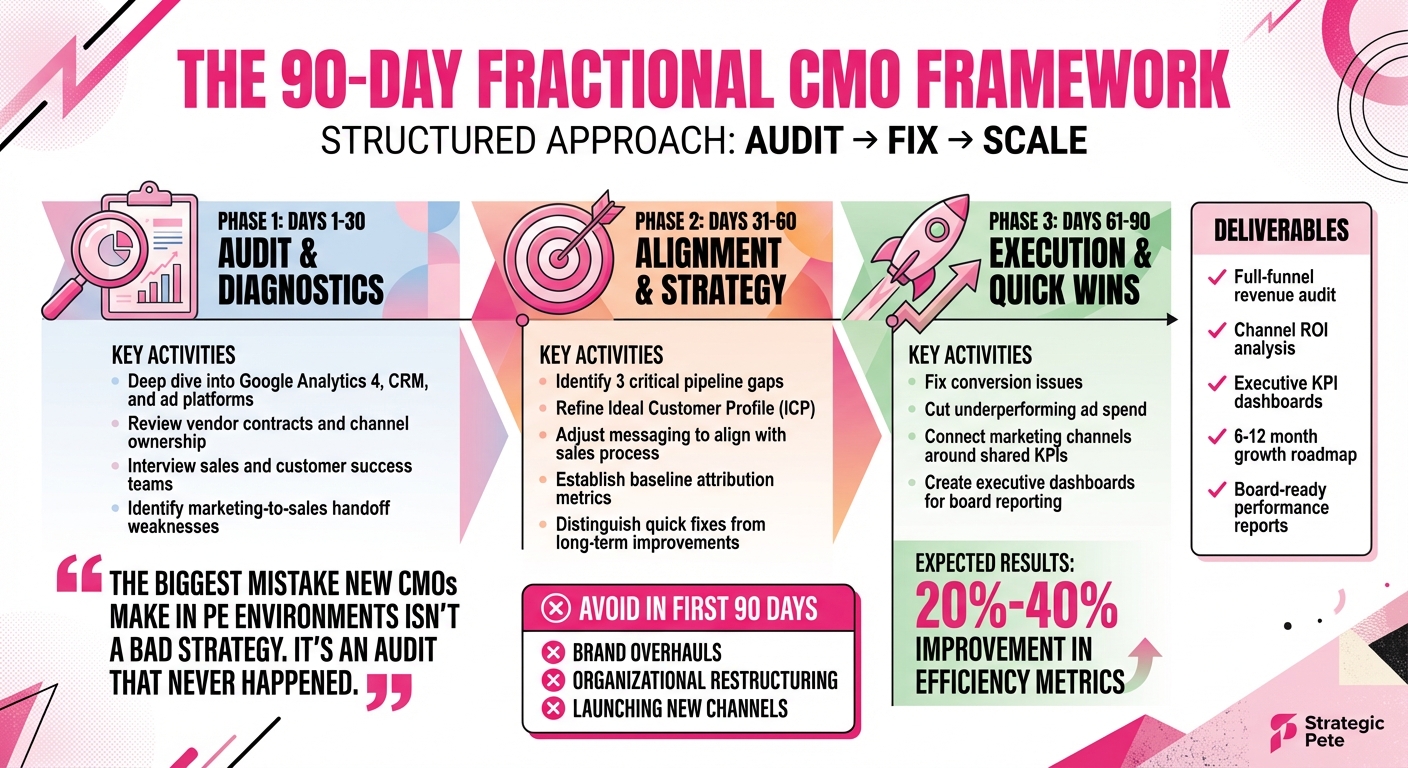
90-Day Fractional CMO Implementation Framework for Private Equity Portfolio Companies
Fractional CMOs use a structured approach – audit, fix, and scale – to deliver noticeable results within the first quarter. This framework aligns perfectly with private equity goals, where every quarter is critical for boosting EBITDA and preparing for a successful exit. It’s a straightforward process that transitions into a detailed 30/60/90-day plan, ensuring early wins and measurable progress.
Running 30/60/90-Day Marketing Audits
The initial 30 days focus entirely on diagnostics. Fractional CMOs dive into tools like Google Analytics 4, CRM systems, and advertising platforms to uncover system issues. They review vendor contracts, analyze ownership of channels like SEO and paid ads, and conduct interviews with sales and customer success teams to identify weak points in the marketing-to-sales handoff.
"The biggest mistake new CMOs make in PE environments isn’t a bad strategy. It’s an audit that never happened."
- Adam McLane, Growth Marketing Consultancy
From Days 31 to 60, the focus shifts to alignment. At this stage, fractional CMOs prioritize identifying three critical pipeline gaps, distinguishing between immediate actionable fixes and longer-term improvements. They refine the Ideal Customer Profile (ICP), adjust messaging to align with the sales process, and establish a baseline for attribution to ensure all stakeholders agree on success metrics.
Execution kicks in from Days 61 to 90. During this phase, fractional CMOs focus on quick wins to build credibility – such as fixing conversion issues or cutting underperforming ad spend – while laying the groundwork for long-term improvements. This includes connecting marketing channels around shared KPIs and creating executive dashboards for board-level reporting.
Importantly, seasoned fractional CMOs avoid large-scale changes like brand overhauls, organizational restructuring, or launching new channels in the first 90 days. These efforts can drain resources without delivering immediate revenue gains. When quick wins are executed effectively, efficiency metrics typically improve by 20% to 40% within the first quarter.
Building Go-to-Market Plans That Match Investment Goals
Fractional CMOs ensure every marketing initiative aligns with the firm’s investment thesis and value creation plan. This means translating marketing efforts into metrics that resonate with boards, such as Annual Recurring Revenue (ARR), EBITDA growth, Customer Acquisition Cost (CAC) payback periods, and pipeline velocity.
The go-to-market strategy focuses on creating a repeatable acquisition engine. This not only reduces dependency on founders but also demonstrates long-term scalability to potential buyers, helping to secure higher valuation multiples at exit. A common pitfall is that 60% of companies fail to target their value proposition effectively at high-priority accounts. Fractional CMOs solve this by refining ICPs and directing marketing budgets toward high-margin accounts instead of wasting resources on broad, unfocused segments.
"Fractional CMOs in PE environments must be bilingual: fluent in brand and growth and in board expectations – metrics, timelines, risks, and ROI."
This approach shifts the perception of marketing from a cost center to a growth driver. Companies that leverage commercial acceleration programs often achieve a median ROI that’s 20% to 30% higher than those focused solely on cost-cutting. With a clear plan in place, the next step involves integrating systems to ensure ongoing success.
Fixing Marketing Systems and Improving Performance
Many portfolio companies inherit disconnected technology stacks, where tools like CRMs, email platforms, and analytics systems fail to work together. Fractional CMOs step in to integrate these systems, eliminate outdated expenses, and standardize KPIs so sales and marketing teams have a shared understanding of what qualifies as a lead. This reduces friction during the marketing-to-sales transition.
They also rebuild demand generation processes around attribution systems that clearly track ROI and pipeline velocity. This gives private equity firms reliable, auditable data on which marketing efforts contribute to revenue growth. Performance dashboards are then created to provide updates at multiple levels: weekly internal reviews, monthly CEO updates, and quarterly board presentations.
The results are striking. Companies that use fractional CMOs save 67% compared to the cost of hiring a full-time CMO. Beyond cost savings, these structured systems reduce revenue volatility and lower the perceived risk for potential buyers, which can lead to higher valuation multiples during the exit process. By optimizing systems, fractional CMOs directly support EBITDA growth and set the stage for a stronger exit valuation.
Measuring Results: What Fractional CMOs Deliver
Once systems are optimized, fractional CMOs shift their focus to delivering measurable outcomes that directly influence EBITDA and exit value.
Performance Metrics Fractional CMOs Track
Private equity firms demand clear, data-driven insights that demonstrate growth and profitability. Fractional CMOs zero in on metrics like Customer Acquisition Cost (CAC), Lifetime Value (LTV), and the LTV/CAC ratio, as these directly impact enterprise value and signal sustainable growth. They also keep tabs on pipeline velocity, sales cycle length, and Marketing Qualified Lead (MQL) growth, all of which contribute to improved cash flow and flexibility during the hold period.
Revenue attribution is another key area. Fractional CMOs track marketing-sourced revenue and channel ROI, turning marketing into a measurable, auditable system rather than just an expense. For SaaS and subscription-based companies, monitoring metrics like churn rate and net revenue retention (NRR) provides insight into long-term stability. On average, these efforts lead to a 25%–35% reduction in CAC and a 45% boost in lead quality scores within the first few months of engagement.
"The number one complaint we hear from CEOs is some version of ‘I’m spending money on marketing but I can’t tell you what it’s producing.’ That’s not a marketing problem. It’s a leadership vacuum."
- Lou Hughes, CEO, Moving Minds
Typically, fractional CMOs deliver a measurable, marketing-sourced pipeline within 60 days of starting their engagement. Companies leveraging commercial acceleration programs often see 20%–30% higher ROI compared to those relying solely on cost-cutting strategies. These metrics come to life through real-world case studies.
Case Study: How a Fractional CMO Drove Growth and ROI
Consider a B2B software company backed by private equity, which was spending $35,000 monthly on paid media with no clear attribution. Moving Minds stepped in with fractional CMO leadership and, within three weeks, rebuilt the company’s tracking system. The result? They discovered that 40% of the budget was generating no pipeline. By reallocating funds to better-performing channels, the company doubled its marketing-sourced pipeline within 60 days – all without increasing the total spend.
Businesses working with fractional CMOs often achieve an ROI of 3× to 5× their initial investment within the first year. Additionally, trust-building content strategies implemented by fractional leaders can shorten sales cycles by 20%–40%. These improvements in operational metrics and marketing pipelines set the stage for higher-value exits.
Preparing Portfolio Companies for Better Exits
Fractional CMOs don’t just improve day-to-day metrics – they also prepare companies for more lucrative exits. By creating predictable and scalable revenue systems, they make businesses more attractive to buyers. Buyers value companies with documented, repeatable acquisition engines because these systems show that growth isn’t dependent on a single founder or key relationship. Fractional CMOs achieve this by ensuring clean attribution, maintaining CRM hygiene, and setting up performance dashboards that demonstrate a reliable "growth engine."
"Buyers pay premiums for companies where the growth engine is a system, not a person."
- Peter Geisheker, Fractional CMO
The financial impact of fractional CMOs can be substantial. For example, saving $100,000 annually in SG&A costs by using a fractional CMO instead of a full-time one can add $1 million to $1.5 million to the exit value, assuming a 10×–15× multiple. Diversifying acquisition channels also reduces the risks associated with over-reliance on a single lead source. Before an exit, fractional CMOs conduct attribution audits, evaluate CAC versus LTV, and analyze funnel velocity to ensure the company’s revenue story is both compelling and defensible.
sbb-itb-8f8c601
How Strategic Pete Serves Private Equity Firms
Strategic Pete works closely with private equity firms and their portfolio companies to transform marketing into a measurable driver of revenue rather than just an expense. The firm focuses on B2B and SaaS businesses with revenues ranging from $5 million to $100 million – companies where the complexity of marketing has outgrown internal resources. Instead of offering generic advice, Strategic Pete provides fractional CMO services, delivering full-time impact at 50%–70% of the typical cost.
Custom Marketing Audits and Growth Plans
Strategic Pete uses a 90-Day Portfolio Revenue Acceleration Framework designed to align with the typical private equity hold period. Here’s how it works:
- Days 1–30: A deep dive into the company’s marketing systems, including a full-funnel revenue audit, channel ROI analysis, evaluation of customer acquisition cost (CAC) and lifetime value (LTV), and identification of bottlenecks in the lead-to-sale process.
- Days 31–60: Focus shifts to system optimization. This includes refining the Ideal Customer Profile (ICP), aligning messaging, restructuring paid channels, and setting shared KPIs for sales and marketing.
- Days 61–90: Portfolio companies receive executive-level KPI dashboards, validated plans for scaling marketing channels, and a 6–12 month growth roadmap complete with board-ready performance reports.
"Marketing systems in recently acquired companies are often underdeveloped, misaligned, or dependent on founder intuition."
- Peter Geisheker, Founder, The Geisheker Group
Strategic Pete also supports private equity firms during acquisitions by conducting marketing due diligence. This includes auditing attribution systems, assessing channel dependency risks, analyzing funnel velocity, and ensuring clarity in ICP before deals close. With these insights, the firm creates a clear roadmap for growth, setting the stage for consistent inbound demand generation.
Inbound Marketing and Demand Generation
To complement its audits, Strategic Pete develops targeted inbound marketing strategies aimed at driving consistent lead generation. By building repeatable systems, the firm reduces reliance on founder relationships and outdated methods, directly boosting EBITDA and improving exit valuations. Their expertise includes inbound marketing strategies, optimizing sales pipelines, automating the customer journey, and tracking performance in real time.
For B2B and SaaS companies, this means creating content strategies that shorten sales cycles, focusing SEO and PPC efforts on commercial intent, and ensuring cross-functional teams are aligned on revenue goals. The result? Marketing shifts from being a speculative effort to becoming a structured, repeatable system for driving growth.
"Marketing, when engineered correctly, becomes part of the asset rather than simply an expense category."
- Peter Geisheker, Founder, The Geisheker Group
Data-Driven Performance Tracking
Strategic Pete takes performance tracking seriously, ensuring every marketing effort is tied to measurable results. The firm sets up executive dashboards that deliver real-time, financial-grade reporting. These dashboards track key metrics like pipeline velocity, marketing-sourced revenue, channel ROI, and CAC trends, providing clear insights into the impact of marketing strategies. This builds on our guide to choosing between fractional CMO firms.
Conclusion
Private equity firms increasingly find themselves under pressure to generate returns through operational improvements rather than relying solely on financial restructuring. In this environment, fractional CMOs have become powerful allies – offering senior marketing expertise at a fraction of the cost (50–70% less) and delivering measurable results within just 30–60 days. Unlike traditional marketing executives, fractional CMOs take on the role of revenue strategists, focusing on expanding EBITDA, accelerating pipeline growth, and preparing companies for successful exits.
The numbers back this up. PE firms that balance cost-saving measures with revenue growth strategies report 15% EBITDA growth, compared to just 5% for those focused only on cutting expenses. Additionally, companies leveraging commercial acceleration programs achieve 20–30% higher median ROI than those relying solely on cost reductions. With leadership in portfolio companies playing a critical role in overall fund performance, the caliber of marketing leadership directly influences outcomes. Fractional CMOs excel at creating scalable revenue systems, which in turn boost exit valuations.
By shifting marketing from a cost center to a growth engine, fractional CMOs deliver tangible results. They implement repeatable, documented revenue processes that reduce buyer risk and drive higher valuation multiples at exit. Their approach minimizes dependency on specific channels, aligns sales and marketing teams with shared goals, and provides financial-grade reporting. With average hold periods now stretching to 6.7 years, these systematic growth strategies are no longer a luxury – they are essential.
For mid-market B2B and SaaS companies ($5M–$100M), fractional CMOs offer immediate impact, portfolio-wide expertise, and scalable solutions. The question isn’t whether fractional CMOs can deliver results – the evidence clearly shows they do. The real question is: Can your portfolio companies afford to miss out on this level of strategic marketing leadership during critical phases of growth and exit planning?
FAQs
When should we hire a fractional CMO instead of a full-time CMO?
Hiring a fractional CMO can be a smart move when your business requires high-level marketing expertise but isn’t ready to commit to the expense or permanence of a full-time executive. These professionals bring the advantage of quick execution, adaptability, and a focus on delivering measurable results – perfect for businesses aiming for rapid growth.
Fractional CMOs are especially useful for private equity firms managing several portfolio companies. They provide strategic oversight and implementation without the added costs and risks associated with a full-time hire, offering a practical solution for scaling efficiently.
What should we expect a fractional CMO to deliver in the first 90 days?
In the first 90 days, a fractional CMO usually concentrates on getting up to speed, reviewing your current marketing strategies, and defining clear goals that align with your investment priorities. Their main tasks often involve creating a strategic plan, assessing operational effectiveness, and implementing early changes to improve marketing performance. These initial efforts help establish a solid foundation for measurable progress and ensure alignment with your business objectives.
How do we measure a fractional CMO’s ROI and impact on exit value?
A fractional CMO’s return on investment (ROI) and influence on a company’s exit value come down to their ability to boost revenue, streamline marketing efforts, and close execution gaps. By aligning marketing strategies with the company’s investment objectives and delivering clear, measurable results, they help drive up the business’s valuation at the time of exit.