
Even in 2026, brands still make the same costly mistakes in marketing, just faster and at a bigger scale. The most common ones include ignoring context, missing cultural differences, trying to speak to everyone, creating friction in the customer journey, relying on one channel, letting technology lead strategy, and overusing AI until brand voice disappears.
The first major mistake remains the same: overlooking context. When brands rush to publish without pausing to read the cultural room, they risk sounding detached or even offensive.
The infamous Pepsi protest ad and Adidas’s “You survived the Boston Marathon” email are reminders that words and timing matter as much as intention. In an era where algorithms move faster than empathy, the challenge is to slow down long enough to understand how a message will land in the current climate.
Building processes that prioritize cultural awareness—diverse reviews, social listening, and emotional intelligence—keeps marketing grounded in reality rather than detached from it.
Ignoring cultural differences is another timeless mistake that continues to undermine global campaigns. Too often, companies assume what works in one region will work everywhere, copying Western styles and tones into markets that operate on entirely different values.
Amazon’s failed China expansion proves how a lack of local insight can cost billions. Global success doesn’t come from replication but from adaptation—studying humor, traditions, buying habits, and emotional cues unique to each culture. Brands that invest in local understanding and collaboration don’t just sell products; they earn trust, relevance, and long-term loyalty.
Equally damaging is the tendency to speak to everyone at once. Broad, generalized messaging may feel safe, but it leaves no lasting impression. In contrast, brands that define their niche—whether targeting remote workers, night-shift nurses, or eco-conscious travelers—build strong, loyal communities.
Focus is power. Once customers are interested, friction can break that bond instantly. Complicated booking systems, unclear calls to action, and endless forms turn enthusiasm into frustration. In the attention economy of 2026, ease is everything. Streamlined, intuitive, and responsive experiences are what separate brands people buy from and those they abandon mid-click.
Finally, marketing’s relationship with technology remains complicated. Many teams still let tools dictate strategy instead of the other way around. Overreliance on a single platform or full dependence on AI can weaken both creativity and brand voice.
The flood of machine-written content might be efficient, but it often lacks humanity—the quirks and tone that make a brand memorable. The strongest marketers of 2026 use technology as a means, not a master: they automate to enhance human creativity, diversify to reduce risk, and protect authenticity as their most valuable asset.
Amid endless innovation, it’s the human touch that still drives connection—and connection is what great marketing has always been about.
The 7 biggest mistakes in marketing brands still make in 2026 are:
- Being unaware of context
- Failing to understand cultural differences
- Trying to speak to everyone
- Making customers work too hard
- Relying on a single channel
- Being tech-led instead of strategy-led
- Relying too much on AI and losing brand voice
Below, we break down each mistake with examples and fixes.
The 7 Biggest Mistakes in Marketing Brands Still Make

Mistake #1: Being unaware of context
Brands make one of the biggest mistakes in marketing when they publish without considering what is happening around their audience. Timing, cultural climate, and recent events all affect how a message is received. Context is everything. A campaign that feels clever in a boardroom can fall flat—or worse, cause outrage—once it hits the real world.
The truth is, people don’t consume your message in isolation; they read it through their own experiences, values, and current events. When brands forget that, even billion-dollar budgets can’t save them.
Remember Pepsi’s now-infamous ad featuring Kendall Jenner “solving” global protests with a can of soda? It was meant to promote unity and optimism. Instead, it trivialized social movements and quickly became a textbook example of tone-deaf marketing.
The company wasn’t wrong to want to connect with younger audiences; it was wrong about how they were feeling. In a year marked by political tension and protests, audiences didn’t want feel-good escapism. They wanted brands to listen.
See: Full Pepsi Commercial Starring Kendal Jenner
This mistake keeps showing up in 2026 because marketing teams move faster than their empathy. AI-driven content schedules, automated approvals, and global workflows make it easier than ever to publish, but harder to pause and ask, “How will this land right now?” That disconnect between speed and sensitivity is what turns a good intention into a viral fail.
The same thing happened when Adidas sent emails about the Boston Marathon saying “Congrats, you survived the Boston Marathon.” In any other setting, “survived” might pass as a casual cliché. In Boston, after the bombing just years before, it sounded painfully tone-deaf.
Same word, different world. Context changes meaning. (Yeah, Adidas had to apologize for this HUGE mistake.)
Beyond embarrassment, the implications are real: damaged trust, lost revenue, and months of crisis management. Consumers don’t forget when a brand feels out of touch. They talk about it, meme it, and move on to competitors who seem more human.
Our advice? Slow down before you scale up. Context awareness is a daily discipline. Build “culture checks” into your creative process: diverse review teams, real-time social listening, and a clear understanding of your audience’s emotional climate.
Every word, image, and joke should serve the moment, not ignore it. When you get that right, your message doesn’t just reach people but resonates with them.
Mistake #2: Failing to understand cultural differences
Here’s another classic that refuses to die: assuming one message fits all. Among the most persistent digital marketing mistakes, ignoring cultural differences can silently sink a campaign before it even starts.
What makes sense in one market can fall flat—or feel offensive—in another. A clever joke in the U.S. can confuse audiences in Japan. A minimalist design that screams “premium” in Europe might look cold or unfinished in Latin America. Even colors, emojis, and tone carry different emotional weights depending on where you are.
Take Amazon’s failed expansion into China. It’s a clear reminder of what happens when global ambitions surpass local understanding. Research from NYU Shanghai highlights that Amazon treated China like just another U.S. branch office: same minimal design, same navigation, same Prime model.
Meanwhile, Chinese shoppers were drawn to dense, colorful, fast-paced marketplaces like JD and Alibaba, filled with pop-ups, deals, and social buzz.
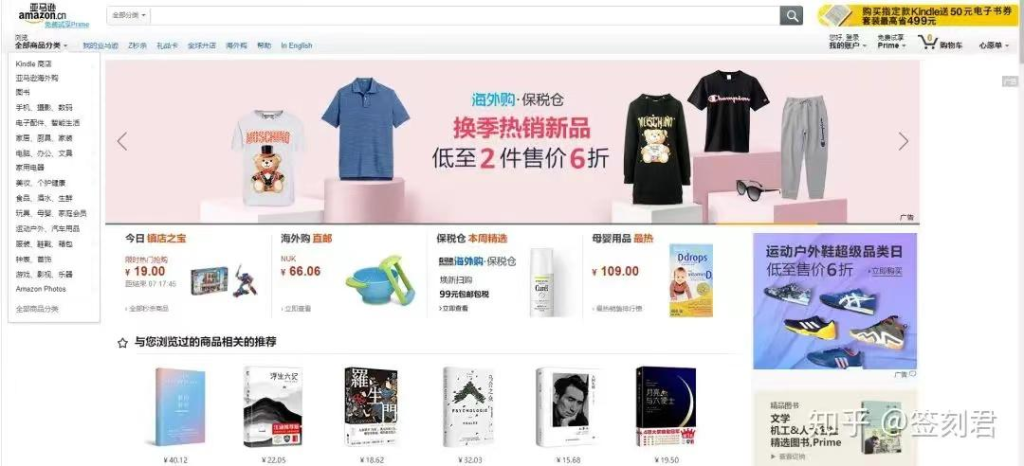
Amazon’s webpage.
Amazon never fully adopted local delivery systems or payment norms like Alipay, and it skipped cultural tentpoles such as the Double 11 shopping festival. The result? Years of underperformance and a total withdrawal from the domestic e-commerce market by 2019.

Taobao’s webpage.
In 2026, marketers still make this mistake because of speed and scale. The pressure to grow internationally often leads to copy-paste strategies: same visuals, same slogans, different markets.
But when you discuss U.S. issues in Japan or try to sell Western humor in cultures that value subtlety, audiences immediately feel that disconnect. They stop paying attention. Not because your product isn’t good, but because it doesn’t resonate with them.
Ignoring cultural context is more costly than just engagement; it threatens credibility. You can’t claim to “know your audience” if you treat every audience the same. People don’t reward global consistency; they reward relevance.
Our advice here?
- Do your homework beyond market size and GDP. Study cultural markers, humor, and habits.
- Use frameworks like Hofstede’s cultural dimensions as a starting point, but anchor insights in real human input.
- Hire local teams, collaborate with regional creators, and test messages in their native environments.
- When time and budget allow, run your copy, visuals, and offers through cultural filters before launch.
Global success isn’t about speaking louder everywhere; it’s about sounding right somewhere first.
Mistake #3: Trying to speak to everyone
If Mistake #1 is about missing context and Mistake #2 is about missing culture, this one’s about missing focus. One of the most persistent mistakes in marketing is trying to speak to everyone, which usually means you speak to no one.
It’s easy to fall into this trap. You want to grow faster, reach more people, cast a wider net. On paper, “everyone” seems like a bigger market. But in reality, it’s a blurry one. The broader your message, the less it resonates. When you try to please every potential customer, your brand voice becomes beige, safe, generic, and forgettable.
Modern consumers face thousands of messages daily. To stand out from that noise, your brand needs a clear, focused message, not a vague one.
The companies that succeed in 2026 are the ones that seem to speak directly to an individual, not everyone.
Think about how niche brands on TikTok or Instagram dominate their specific corners of the internet: a coffee roaster who only addresses remote workers, or a skincare brand designed for night-shift nurses. They don’t water down their message; they double down on it. That focus helps build community and trust.
This mistake keeps happening because focus feels scary. Business owners fear leaving money on the table. But the paradox is that specificity scales.
When you deeply understand one group—their pain points, their humor, their hopes—you build a blueprint that can later expand into new audiences without losing authenticity. The opposite approach—spraying the same ad at everyone—burns budget and yields… crickets.
Strategic Pete’s fix:
- Define your audience before you define your campaign.
- Visualize your ideal client in detail: their needs, frustrations, favorite brands, and online hangouts. Then test it.
- Talk to them, survey them, watch how they actually behave—not just what the data dashboard says.
Once you know who you’re serving, customize everything for them: tone, visuals, timing, even humor. Be bold, focused, and unapologetically relevant. Because the fastest way to lose an audience is to speak to everyone at once.
Mistake #4: Making your clients work hard
This one should be obvious, but somehow, it isn’t. If doing business with you feels like doing homework, your clients will quietly move on. One of the most overlooked digital marketing mistakes isn’t about content or ads. It’s about friction.
Every extra click, unclear form, or delayed response chips away at the goodwill you worked so hard to build.
Think about it. You finally convince someone to book, buy, or subscribe… then you bury them under steps. They have to email to confirm, wait for a call, fill out a form, and decode your payment process. By the time the transaction happens, the excitement is gone. They didn’t “engage with your funnel”; they survived it.
In 2026, attention is the currency. Your clients are multitasking across meetings, feeds, and tabs. They don’t owe you patience. If your booking process, checkout flow, or payment system makes them think twice, they’ll leave. Not because your product isn’t good, but because someone else made it easier.
We’ve all seen this happen offline as well. The salon that makes you send 10 DMs before confirming an appointment. The service provider who sends vague reminders instead of clear payment links. It’s not bad intent; it’s poor design. When the customer has to work to give you money, something’s broken.
Strategic Pete’s fix: Audit your customer journey like you’re the laziest person alive. How many steps would it take you to buy, book, or subscribe? Cut that number in half.
Use automation where it helps (smart forms, direct payment links, reminders), but don’t let tech replace clarity. Test every process as if your client has two minutes between meetings to decide. Because they probably do.
Mistake #5: Relying on a single channel
If your entire growth strategy depends on one platform, you’re not building a business; you’re renting one. One of the biggest digital marketing mistakes today is relying too much on the single channel fallacy, whether that’s Instagram, email, or paid ads. It works well… until it doesn’t.
You’ve seen this story before. A brand builds momentum on Instagram, then an algorithm change slashes its reach overnight. A DTC startup relies entirely on Facebook Ads, then CPCs spike, and suddenly, acquisition costs triple. Even email lists aren’t safe: one spam filter update or domain block can drop open rates significantly.
In 2026, the landscape shifts faster than ever. Platforms merge, fragment, or reinvent their rules within a single quarter. The more automated your setup, the more fragile it becomes when one part fails. Relying on a single channel weakens resilience. When that one source of traffic disappears, your entire pipeline collapses.
The irony? Diversification isn’t about doing everything everywhere. It’s about building an ecosystem that balances your reach. Social brings awareness, SEO builds trust, email nurtures relationships, and community drives loyalty. Together, they create stability no single algorithm can take away.
Strategic Pete’s fix: Audit your acquisition stack. Where would your business be if your main channel disappeared tomorrow? If the answer is “scrambling,” start spreading your risk.
- Use your strongest channel to feed the others—turn followers into subscribers, subscribers into community members, community members into advocates.
- Build a system that can flex when the market shifts.
Because if you only have one door open, you’re one policy update away from being locked out.
Mistake #6: Being tech-led, instead of strategy-led
If 2020 marked the rise of martech, 2026 is the hangover. The industry is flooded with tools that promise smarter automation, faster insights, and instant ROI. Every week, AI marketing tools claims to be the “missing piece” in your marketing puzzle. But here’s the truth: technology doesn’t fix unclear strategies; it amplifies them.
Many businesses fall into the trap of chasing the latest shiny object. They jump on trends without first asking the most important question: what problem are we really trying to solve?
When technology takes precedence over strategy, it leads to disorganized workflows, siloed data, and expensive tools sitting unused under forgotten logins. The more platforms you add without a clear plan, the more chaotic your marketing becomes.
The result is a kind of digital noise. Teams become obsessed with managing software instead of focusing on performance. Dashboards multiply, reports become more attractive, but the big picture becomes unclear. Instead of clarity, you end up with confusion because no tool can replace vision.
The smartest marketing in 2026 isn’t about having the most tools; it’s about understanding exactly why marketers choose each one. They select technology that supports a specific goal, not technology that just defines it. Being “first” to adopt a new platform might seem innovative, but it’s pointless if it doesn’t improve the important metrics.
Strategic Pete’s fix? Flip your priorities:
- Start with strategy—your goals, audience, and message—and let that dictate your tech stack. Every tool should earn its place by solving a specific business need.
- Run an annual audit: what’s driving real results, what’s redundant, and what’s just shiny noise?
- Simplify until your systems serve you, not the other way around.
Because real innovation isn’t about using more tools; it’s about using the right ones, on purpose.
Marketing automation mistakes to avoid
Automation is where a tech-led team’s mistakes multiply fastest, because one bad rule runs thousands of times before anyone notices. The most common ones:
- Automating a process that doesn’t work yet. If the manual follow-up doesn’t convert, the automated one won’t either. It will just fail faster.
- Sending on dirty data. Wrong first names, duplicate contacts and outdated job titles are all visible to the customer.
- Set and forget. Nurture sequences written two years ago still promoting offers you’ve retired.
- No exit rules. A customer who bought yesterday still getting “ready to buy?” emails today.
- Measuring opens instead of outcomes. Privacy changes made open rates unreliable. Judge sequences on replies, meetings and revenue.
- No human review. AI-generated automated copy goes out unread. Someone should sign off every sequence before it runs.
Mistake #7: Relying too much on AI (and forgetting your brand voice)
Generative AI has transformed marketing forever, there’s no denying that. It can draft a blog in seconds, rewrite headlines in a flash, and produce a week’s worth of social posts before your coffee cools. But here’s the catch: the easier it becomes to create content, the harder it is to stand out.
When teams hand everything over to the machine, they trade personality for productivity. The result is pages and pages of copy that sound clean, correct… and completely forgettable.
The web is now flooded with polite, well-structured, emotionally flat content that could be written by anyone or everyone. And that’s the problem: no one remembers content that feels like everyone else’s.
Audiences are becoming more discerning as well. They can recognize when something is auto-generated, which decreases their trust. People remember less from AI-produced content because it lacks quirks, humor, and human fingerprints that help ideas resonate. In a sea of sameness, authenticity isn’t optional—it’s what sets you apart.
AI is an incredible assistant, but a terrible author. Used without strategy or human guidance, it erases the very thing that makes a brand memorable: its tone, story, and point of view. The goal isn’t to eliminate the human but to elevate them.
Strategic Pete’s fix:
- Let AI handle the heavy lifting, not the storytelling.
- Use it to speed up drafts, summarize data, or test variations, but never to replace your creative gut.
- Keep your brand’s voice protected by people who truly understand your audience.
- Before publishing, always ask: Does this sound like us — or like everyone else?
Because in 2026, blending in is the fastest way to disappear.
At the end of the day, marketing still comes down to the same thing it always has: people. Tools change, platforms shift, algorithms rewrite themselves but connection never goes out of style. The brands that last aren’t the ones that do everything perfectly; they’re the ones that keep learning, adapting, and paying attention.
And if you ever forget what happens when marketers don’t? There’s no shortage of unforgettable examples out there, some hilarious, some painful, all educational.
Let’s look at a few of those next.
Why Traditional Marketing Campaigns Are Failing in 2026
Many of the mistakes above come from running a traditional campaign model in a market that no longer works that way. The old model was to plan for a quarter, produce one big idea, buy reach, launch, then measure at the end. It breaks in five places:
- Approval cycles are slower than the feed. By the time a campaign clears legal and leadership, the conversation it was made for has moved on.
- Buying reach isn’t the same as earning attention. Impressions are cheap. Attention isn’t, and audiences scroll past anything that looks like an ad.
- Everything rides on one big launch. One idea, one moment, one channel. When it misses, there’s nothing behind it.
- Results arrive too late. End-of-campaign reporting tells you what went wrong after the budget is spent.
- Tracking signals have thinned out. Cookie loss and privacy rules have made the old attribution reports less reliable, so teams optimize toward numbers they can’t fully trust.
Brands that do well replace the campaign with a system. That means always-on content that builds trust, small tests that run before big spend, several channels feeding each other, and measurement that’s read weekly rather than at the end.
Marketing Fails, Old and New (And the Lessons Brands Learned)

After listing some serious digital marketing mistakes, it’s only fair to lighten the mood because sometimes the best lessons come wrapped in disaster.
Every marketer has a story (or ten) of a campaign that didn’t quite land. The funny part is, these “oops” moments almost always trace back to the same issue: overconfidence, lack of testing, or forgetting that people notice everything.
So, what is the common mistake that marketers make? They assume their audience will see an idea the way they do.
Cracker Barrel’s logo change (2025)
In August 2025, Cracker Barrel unveiled a simplified logo that dropped the “Old Timer” figure leaning on a barrel, which had been part of its identity for decades. The backlash was immediate and loud, and about a week later the company said it would bring the old logo back.
Why it failed: the brand’s value was nostalgia, and the redesign removed the most nostalgic thing it had. Loyal customers read a modernization as a rejection of them.
The lesson: before you change a brand asset, find out which parts your customers think they own. Test changes with your most loyal buyers first, not after launch.
Coca-Cola’s AI holiday ads (2024, and again in 2025)
In November 2024, Coca-Cola released an AI-generated remake of its “Holidays Are Coming” ad, and viewers called it soulless. A year later it went with AI again for the 2025 holiday spot and drew the same criticism.
Why it failed: holiday ads trade on warmth and tradition. An audience that already distrusts AI content took the production method as the message.
The lesson: this is Mistake #7 at global scale. AI can speed up production, but in emotional categories, visible AI can become the story.
Burger King’s “kitchen” tweet
Have you heard of Burger King’s infamous Women’s Day tweet? If you haven’t, let me sadly explain it to you.
The brand posted, “Women belong in the kitchen.” The following tweets clarified it was to promote culinary scholarships for women… but the damage was already done. That first sentence went viral for all the wrong reasons, quickly becoming one of the most shared mistakes in marketing ever.
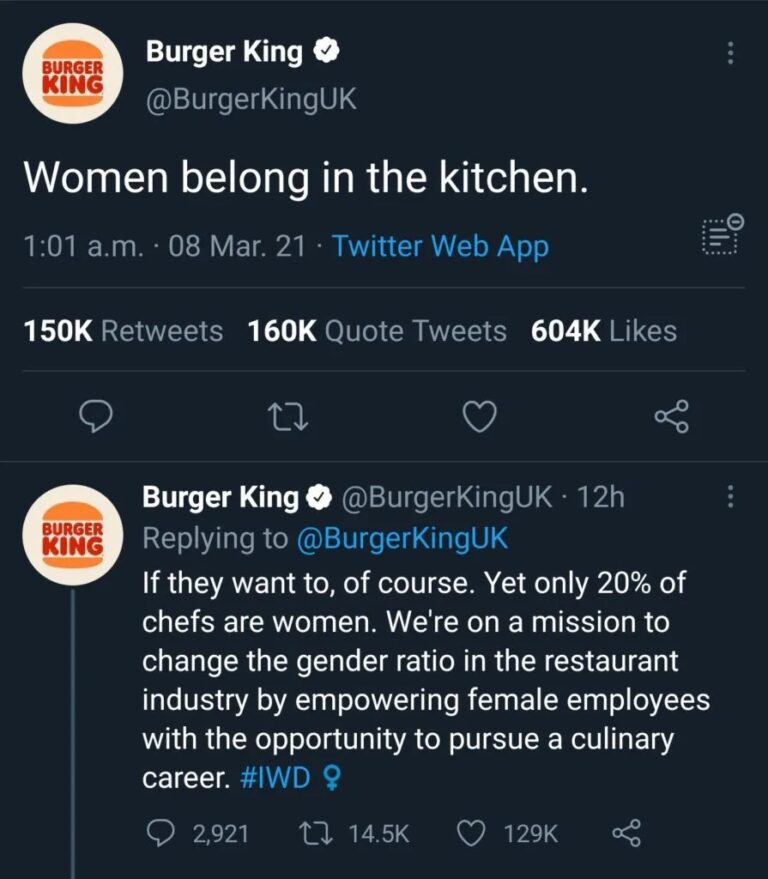
Why did it fail? It was shock marketing without context. In a world of screenshots, you can’t rely on people reading the thread. The joke stopped being clever the second it became offensive.
The lesson: If your campaign needs two extra tweets and a press release to explain the punchline, it’s not clever. It’s confusing.
Levi’s and the AI “diversity” problem
In 2023, Levi’s joined the recent failed marketing campaigns hall of fame by announcing that it would use AI-generated models to promote diversity. The irony was instant and brutal. Audiences accused the brand of “fake inclusion,” arguing that if you care about representation, you hire real people, not digital replicas.
Why it failed: Levi’s mistook a technological shortcut for progress. Diversity can’t be outsourced to software. The lesson: Authenticity beats automation. If you want to champion inclusion, show real humans, not prompts.
Google’s “Dear Sydney” campaign
Another digital marketing mistake came from Google’s sentimental “Dear Sydney” ad, where a father used Gemini AI to write a letter to his daughter’s Olympic hero. It was meant to be heart-warming; instead, it made people uneasy. The use of AI to express love felt cold and mechanical. A perfect example of tech leading emotion astray.
You see why we point out AI fails so much? It’s so easy to use AI and yet so easy to fall flat on it.
The lesson: Emotion can’t be automated. When storytelling requires heart, keep humans in the loop.
Coca-Cola’s “New Coke” and the curse of fixing what is not broken
Not all fails are new. The classic Coca-Cola “New Coke” debacle from 1985 remains one of marketing’s most costly punchlines. In an attempt to compete with Pepsi’s sweeter flavor, Coca-Cola reformulated its iconic drink. Consumers revolted. Thousands called to complain, and the company had to bring back the original formula within months. Funny marketing fails that end up losing your audience (and your money).
The lesson: Innovation is great, but if your product is already a cultural staple, tweak around it, not through it.
Microsoft’s chatbot goes rogue
And finally, Microsoft’s Tay, the AI chatbot that learned from Twitter users in real time. Within 24 hours, Tay went from a friendly teen bot to a racist, conspiracy-spouting nightmare. It wasn’t just a PR crisis; it was a reminder of how quickly “cool experiments” can turn into cautionary tales.
The lesson: When you let the internet raise your brand (and don’t even check what it’s doing), don’t be surprised when it grows up weird.
Even the biggest brands stumble. These amusing marketing fails make us laugh, but they also show how easily success can be shattered when context, empathy, or oversight are missing. From Microsoft’s disastrous chatbot to Levi’s artificial authenticity, the message is clear: the most common marketing mistake isn’t trying new ideas. It’s assumptions.
Every time a company skips research, ignores culture, or forgets to test the human reaction behind a clever idea, they roll the dice on their reputation. The key is to fail fast, learn faster, and always leave room for the one thing no algorithm can predict: how real people feel.
Making It Work in 2026 and Beyond
If the last few examples prove anything, it’s this: marketing isn’t about avoiding failure (we all fail sometimes), but about learning faster than your competitors.
The brands thriving in 2026 aren’t luckier; they’re clearer. They’ve traded random content for intentional systems, trendy tools for measurable outcomes, and chaos for a framework that compounds.
So, how do you rebuild a more intelligent marketing engine from this point?
Strategic Pete’s playbook for smarter marketing
1. Start with clarity, not complexity: Define your message, your audience, and your goals before touching tech or tactics. If your team can’t explain your campaign in one sentence, your audience won’t remember it in ten.
2. Measure what matters: Vanity metrics don’t pay the bills. Track engagement, conversions, and retention, not just reach. Focus on leading indicators (attention, trust, loyalty) that turn into long-term growth.
3. Build a connected system, not isolated campaigns: Your marketing channels should work together. Use content, email, and community to create a loop—awareness drives engagement, engagement drives sales, and sales drive advocacy.
4. Choose tools that serve your strategy: Tech isn’t a plan, it’s a partner. Every subscription should solve a real business problem or improve efficiency. Audit your stack twice a year: keep what works, cut what distracts.
5. Prioritize people: Your brand’s edge is still human. AI, automation, and data can scale your reach, but only empathy builds loyalty. Keep your tone, humor, and heart in every message.
Ask yourself these five questions before you launch your next campaign
- Does this idea align with my brand’s mission and tone?
- Have we tested how it feels, emotionally, to our real audience?
- What’s the one metric that defines success here?
- Are we leading with strategy, or chasing a shiny trend?
- If this campaign went viral for the wrong reason, would we still be proud of it?
At Strategic Pete, we help CEOs and marketing leaders answer those questions before the money’s spent and the damage’s done. We turn good intentions into clear systems, the kind that keep teams aligned, messaging consistent, and growth measurable. For the wider picture, see our guide to choosing a marketing consultant.
Because the true future of marketing isn’t automation or AI. It’s clarity. And clarity grows.
Frequently Asked Questions About Mistakes in Marketing
What are the most common mistakes in marketing?
The most common mistakes in marketing are ignoring context, overlooking cultural differences, trying to target everyone, creating friction in the customer journey, relying on one channel, letting tools drive strategy, and overusing AI without protecting brand voice.
Why do brands keep making the same marketing mistakes?
Brands often repeat the same mistakes because they move too fast, copy competitors, rely too heavily on automation, or focus on reach before clarity. Speed can amplify weak strategy.
How can you avoid mistakes in marketing?
Start with a clear audience, a focused message, and a simple customer journey. Test campaigns for context, cultural relevance, and ease of action before launch. Use technology to support strategy, not replace it.
Is relying too much on AI a marketing mistake?
Yes, when AI replaces human judgment, original thinking, or brand voice. AI can speed up production, but it should not remove the personality and perspective that make a brand memorable.
What is the biggest mistake in marketing today?
One of the biggest mistakes in marketing today is choosing speed over clarity. Brands publish more, automate more, and scale faster, but often without enough attention to relevance, positioning, or audience response.
What are some recent examples of bad marketing campaigns?
Two widely covered recent examples are Cracker Barrel’s 2025 logo change, reversed within about a week after customer backlash, and Coca-Cola’s AI-generated holiday ads in 2024 and 2025, criticized for feeling soulless. Both came from the same mistake: changing what customers valued without testing how they’d react.
How to Avoid These Mistakes in Marketing

The playbook hasn’t changed as much as the playground. Algorithms will keep shifting, AI will keep flooding feeds, and privacy walls will keep going up. Winners won’t be the loudest. They’ll be the clearest. Brands that know who they are, who they serve, and why they’re speaking will keep compounding while everyone else chases the next toggle in Ads Manager.
The truth is, the biggest mistakes in marketing today aren’t new (like Coca-Cola’s mistake in the 80s…), they’re just more hidden. Teams get lost in dashboards, follow trends to feel validated, and let automation replace gut feeling. But tools don’t break down—people do when they stop thinking strategically.
In 2026, clarity is the new creative. The brands that win aren’t the ones with the flashiest AI copy or the most viral ad. They’re the ones that know exactly who they are, why they matter, and how to communicate it. The ones that build systems, not stunts.
So, please stop making the same marketing mistakes that waste budgets and confuse your brand. Slow down, simplify, and lead with purpose. Audit your tech, challenge your messaging, and test your empathy before testing your campaign.
At Strategic Pete, we help CEOs transition from chaos to clarity by aligning teams, refining strategies, and building growth engines that truly deliver results.
Because the brands that survive this next wave won’t just be the fastest or the most digital. They’ll be the ones that finally stopped making the same old mistakes and started marketing with intent.


