

How do you market a book successfully?
- Start before launch,
- Build an audience around your book’s core idea,
- Grow an email list,
- Create pre-launch momentum, and
- Make the launch feel like an event.
This guide breaks down how to market a book like Alex Hormozi marketed his and shows how authors can apply the same principles on a smaller scale.
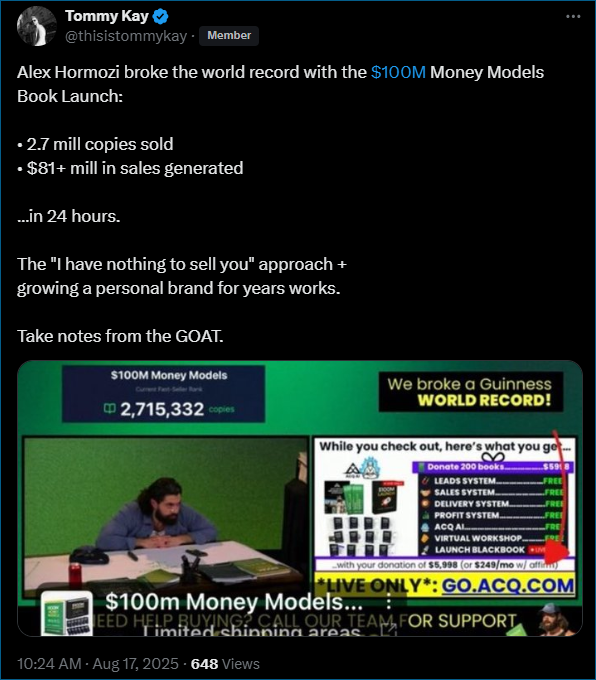
Source
Here’s the short version: book marketing works best when you build demand before publication, give readers a reason to join early, and use launch week to convert attention into sales, reviews, and word of mouth.

1. How To Promote Your Book: Build Before You Sell

The most potent weapon an author wields is an audience cultivated long before the manuscript hits the presses. Traditional publishing lore often romanticizes the solitary writer, toiling in isolation until a finished book magically attracts readers through sheer merit.
Yet, industry data paints a starkly different picture: Books without a pre-existing platform rarely break through, with 90% of titles selling fewer than 2,000 copies in their lifetime, according to a book research report.
This grim statistic underscores a fundamental truth: when it comes to how to promote your book, promotion begins not at launch but years earlier, through deliberate brand-building that transforms an unknown scribe into a trusted voice.
For authors interested in learning how to market a book, this means shifting from creator to communicator, investing in content that fosters loyalty and positions the book as an inevitable extension of an ongoing conversation rather than a cold solicitation.
Alex Hormozi exemplifies this principle, having amassed an audience of over 9 million across platforms by August 2025—3.55 million subscribers on YouTube, 4 million followers on Instagram, 918,000 on X (formerly Twitter), and 714,000 on LinkedIn—without spending a dime on ads for his record-breaking launch of $100M Money Models.
His ascent began not with sales pitches but with a “nothing to sell” ethos, a strategy he detailed in videos like his 2022 YouTube upload “How I Built a 1.2M Follower Audience in 6 Months,” which has garnered over 1 million views and emphasizes giving away high-value business insights for free to build trust and reciprocity.
Drawing from his own entrepreneurial struggles—growing Gym Launch from nearly going bankrupt to a $46 million exit in 2021—Hormozi shared practical advice on customer acquisition, offers, and leads, presenting it as philanthropy rather than a prelude to commerce.
This approach, as he explained in a 2024 podcast appearance on “The Game,” created a “cult-like following” where audiences felt indebted, priming them for future offers like his books.
By consistently delivering content that solved real problems—such as breakdowns of revenue models or scaling frameworks—without immediate upsells, Hormozi eroded skepticism in an era where most consumers distrust branded content.
The result? A loyal base that propelled his book to $2.9 million sales in 24 hours, driven by organic shares and word-of-mouth rather than paid campaigns.
Central to Hormozi’s playbook is prioritizing platforms that amplify long-form expertise and foster community, with YouTube, podcasts, and X standing out as high-impact channels for authors seeking similar traction. YouTube, where Hormozi’s channel boasts 781 million total views as of August 2025, serves as his cornerstone, hosting over 3,600 videos on business growth that average 200,000 views each.
He attributes this to a “quantity over perfection” mantra, outlined in his March 2025 LinkedIn article, where he advocates posting daily or near-daily content to outpace algorithms and build momentum, a tactic that caused his subscribers to surge by 10,000 in a single day in early August.
Podcasts, like his “The Game” series with over 500 episodes by mid-2025, allow for deeper dives—interviews with entrepreneurs yielding insights on failure and scaling—that convert listeners into subscribers at a higher rate than short-form content.
X, meanwhile, functions as his rapid-fire engagement hub, with threads on topics like “money models” garnering 50,000 impressions per post, enabling real-time interaction that humanizes the brand and drives traffic to longer content.
For authors, the lesson is selective focus: Choose 2-3 platforms aligned with your genre—YouTube for nonfiction explainers, podcasts for narrative-driven genres like memoir, X for timely debates—rather than spreading thin across TikTok or Facebook, where Hormozi ranks them lower in his 2024 “Social Media Tier List” for sustained audience growth.
The key to earning attention lies in giving away content that provides immediate, tangible value, a Hormozi hallmark that authors can replicate by teasing book themes without spoiling the core product.
In his 55-minute YouTube masterclass on social media strategy, viewed 1.5 million times since 2022, Hormozi stresses “leading with value”—sharing frameworks, case studies, and proverbs from his books for free to demonstrate expertise and hook viewers.
For instance, pre-launch clips from $100M Money Models dissected cash flow pitfalls, solving entrepreneurs’ pain points and building anticipation.
Authors should mirror this by creating “gateway content”: Blog posts or videos unpacking one chapter’s key idea, infographics summarizing research, or X threads posing questions your book answers.
Crucially, make it audience-centric—Hormozi shifted in 2023 from broad appeals to targeting business owners specifically, boosting engagement by 40%, as he revealed in a 2025 YouTube update.
Avoid self-promotion; instead, aim for 80% education and 20% subtle calls-to-action, like email sign-ups for more tips, fostering a sense of community where followers become advocates.
This pre-built audience amounts to free distribution, as shown by Hormozi’s zero-ad-spend launch that depended on his nine million-strong network for virality, with affiliates and shares expanding reach to generate $81 million in sales.
For those starting from scratch, a structured 90-day organic game plan can lay the foundation, drawing from proven frameworks:
- Days 1–30: Focus on Clarity
- Define your ideal reader (e.g., aspiring entrepreneurs for business books)
- Set up profiles on YouTube and X
- Post daily value-driven content (five videos or threads per week)
- Engage with similar creators to build reciprocity
- Days 31–60: Emphasize Consistency
- Launch a weekly podcast or newsletter
- Collaborate on guest posts
- Track metrics like engagement rates
- Aim for 1,000 followers through organic SEO tactics (e.g., keyword-optimized titles)
- Days 61–90: Scale with Momentum
- Host live Q&As
- Incentivize shares with free resources
- Refine strategy based on analytics
- Work toward 5,000 engaged followers—enough for a modest launch, as seen in indie authors who grew audiences from zero to book deals via similar plans
Hormozi’s journey proves that building before selling isn’t optional—it’s the difference between obscurity and a blockbuster.
Promoting a book or a launch?
Our free scorecard template helps you track the key metrics behind a launch, align your team and make smarter decisions.
2. Pre-Launch Book Promotion Ideas: Building Hype

The weeks leading up to a book launch are a crucial turning point in publishing, where anticipation can either fade into indifference or explode into a frenzy that drives sales to new heights, thanks to excellent execution of book promotion ideas.
Hormozi’s pre-launch blueprint, initiated precisely six weeks prior on July 2, 2025, began with a purposeful announcement that framed the book not as a product but as a communal crusade against entrepreneurial pitfalls like cash flow shortages.
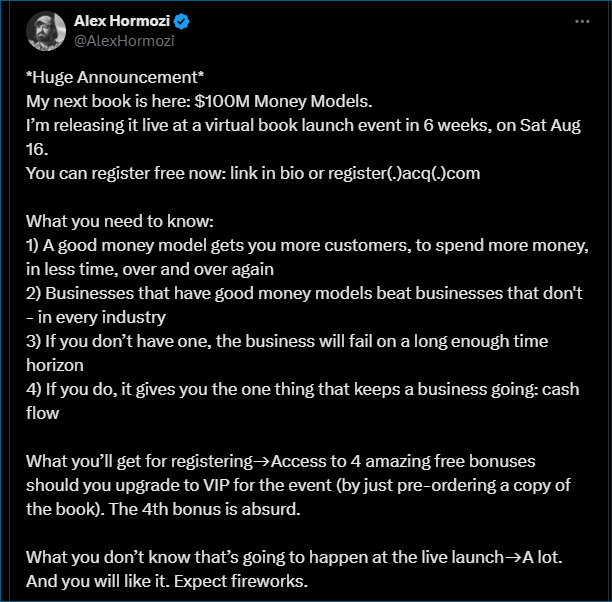
This wasn’t casual hype; it was narrative engineering, echoing his earlier successes with $100M Offers and $100M Leads, where similar framing helped scale his audience to 9 million followers.
By invoking a “movement” to equip 32.5 million U.S. entrepreneurs with tools for unbreakable business models, Hormozi tapped into aspirational psychology, making participation feel altruistic and urgent.
Want to know how to market a book by using similar hype? You can replicate this by crafting announcements that solve a singular, acute pain point—such as “overcoming writer’s block for good” in a creativity guide—and broadcasting them via email blasts or social media, ideally with a video.
Start four to six months out if possible, but compress to six weeks by leveraging existing networks, as Hormozi did, teasing “fireworks” and a secret two-year project exclusive to live attendees to stoke curiosity.
Central to building momentum for your book is constructing an email list, the lifeblood of any launch, which Hormozi supercharged through a free registration funnel.
Visitors signed up for the virtual event at no cost, but a $30 pre-order upgraded them to VIP status, unlocking four “amazing free bonuses”—including an undisclosed “absurd” fourth one—designed to reward early action and inflate perceived value.
This tiered approach, reminiscent of his prior launches that netted 500,000 sign-ups for $100M Leads, generated an estimated 250,000 registrants by leveraging opt-in landing pages optimized for conversions.
For authors, the mechanics are straightforward yet powerful when it comes to how to promote your book :
- Use tools like Mailchimp or ConvertKit to create a dedicated landing page with:
- A compelling headline (e.g., “Join the Movement: Unlock Your Book’s Secrets Early”).
- A simple signup form.
- Lead magnets (e.g., free chapter PDF, webinar invite).
- Promote via:
- Social bios and pinned posts.
- Cross-platform links.
- Goal: 1,000 subscribers in the first week via organic shares.
- Example: Hormozi’s July 2 post drove thousands by promising exclusivity.
Nurture the list with automated sequences: A welcome email recapping the announcement, followed by bi-weekly updates building suspense, which can boost open rates to 30-40%, according to Prefinery’s pre-launch best practices.
If starting small, offer incentives like discounted pre-orders or bonus content to convert free sign-ups into paid commitments, mirroring Hormozi’s VIP model that funneled users toward bulk bundles later.
Content creation during this window serves as the hype’s fuel, with Hormozi deploying a steady stream of teasers to educate and entice. From July 2 through mid-August, he shared short clips on X and Instagram reviewing chapter proverbs, highlighting pain points like failing business models, and previewing the book’s four-part framework for cash flow mastery.
A July 13 video, viewed over 198,000 times, humorously tied gym memes to money models, while a July 17 post reiterated the launch date and registration, amassing 286,000 impressions.
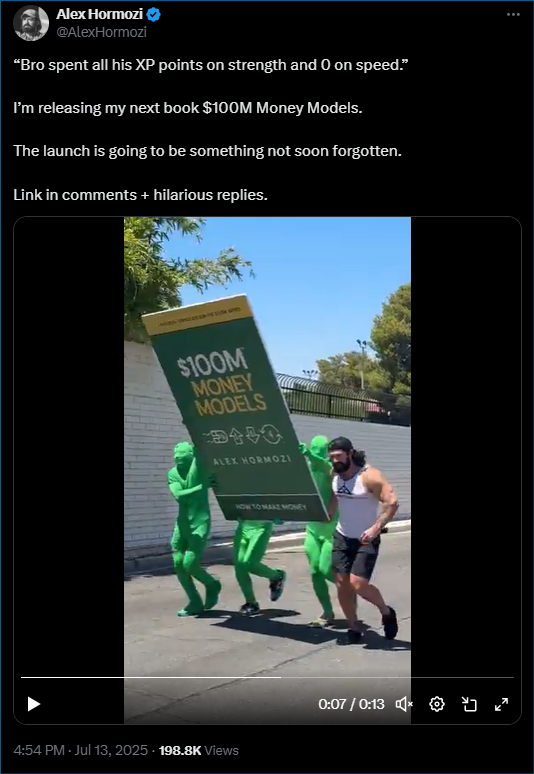
Behind-the-scenes glimpses, such as his July 9 update on “two years of planning,” humanized the process and built emotional investment.
This drip-feed strategy aligns with Kindlepreneur’s launch guide, which recommends positioning the book as a targeted solution—e.g., “the antidote to cash-strapped scaling”—through mixed media: Blog posts unpacking one idea, social reels for visuals, and podcasts for depth.
Authors should plan 2-3 posts weekly, using tools like Canva for graphics or Loom for videos, making sure each one ends with a call-to-action like “Register now to claim your bonuses.”
Monitor engagement with analytics to improve—Hormozi’s posts averaged over 100,000 views, confirming his strategy of sharing value-first content that subtly promotes the book’s promise.
Finally, strategic partnerships amplify reach exponentially, a tactic Hormozi mastered by recruiting affiliates and influencers who promoted the launch to their audiences. Building on his $100M Leads affiliate program, which enlisted 12,600 partners, he incentivized shoutouts with commissions on bundle sales, leading to top affiliates like those announced post-launch who drove hundreds of copies each.
He prepped them via emails and a dedicated guide, encouraging shares without high-pressure tactics—some affiliates even waived earnings to build goodwill. Influencers in business niches, tapped through warm intros from his network, amplified via podcasts and posts, while cold outreach involved personalized DMs highlighting mutual benefits.
For authors, start by listing 10-20 contacts—friends, fellow writers, podcasters—and pitch collaboratively: “Share this teaser with your audience for a free copy and affiliate link.”
Use platforms like HARO for media mentions or Reddit for niche communities, avoiding annoyance by offering value first, such as guest posts.
Hormozi’s zero-ad model relied on this organic amplification, proving that six weeks of alliances can yield viral scale, turning hype into a self-perpetuating force.
3. How To Market a Book With Bonuses, Bundles, and Pre-Order Incentives
The secret to explosive success lies not in the pages themselves but in the packaging that surrounds them—a meticulously crafted offer that transcends the mere exchange of cash for content.
Readers don’t buy ink and paper; they invest in transformation, be it knowledge, status, or tangible results.
Alex Hormozi shattered this paradigm with his August 16, 2025, launch of $100M Money Models, engineering an offer so laden with value that it compelled buyers to purchase in bulk, donating excess copies to entrepreneurs while unlocking escalating perks—ultimately driving 2.9 million sales and $81 million in revenue within 24 hours.
His core philosophy, echoed in prior works like $100M Offers, posits the book as merely the “tip of the value iceberg,” a low-barrier entry point to a cascade of bonuses that amplify perceived worth, making refusal feel irrational.
This strategy, rooted in value equation principles—maximizing dream outcomes while minimizing effort and sacrifice—turned a $30 book into a gateway for high-ticket commitments, proving that irresistible offers are built on ethical stacking, tiered structures, and psychological pricing.
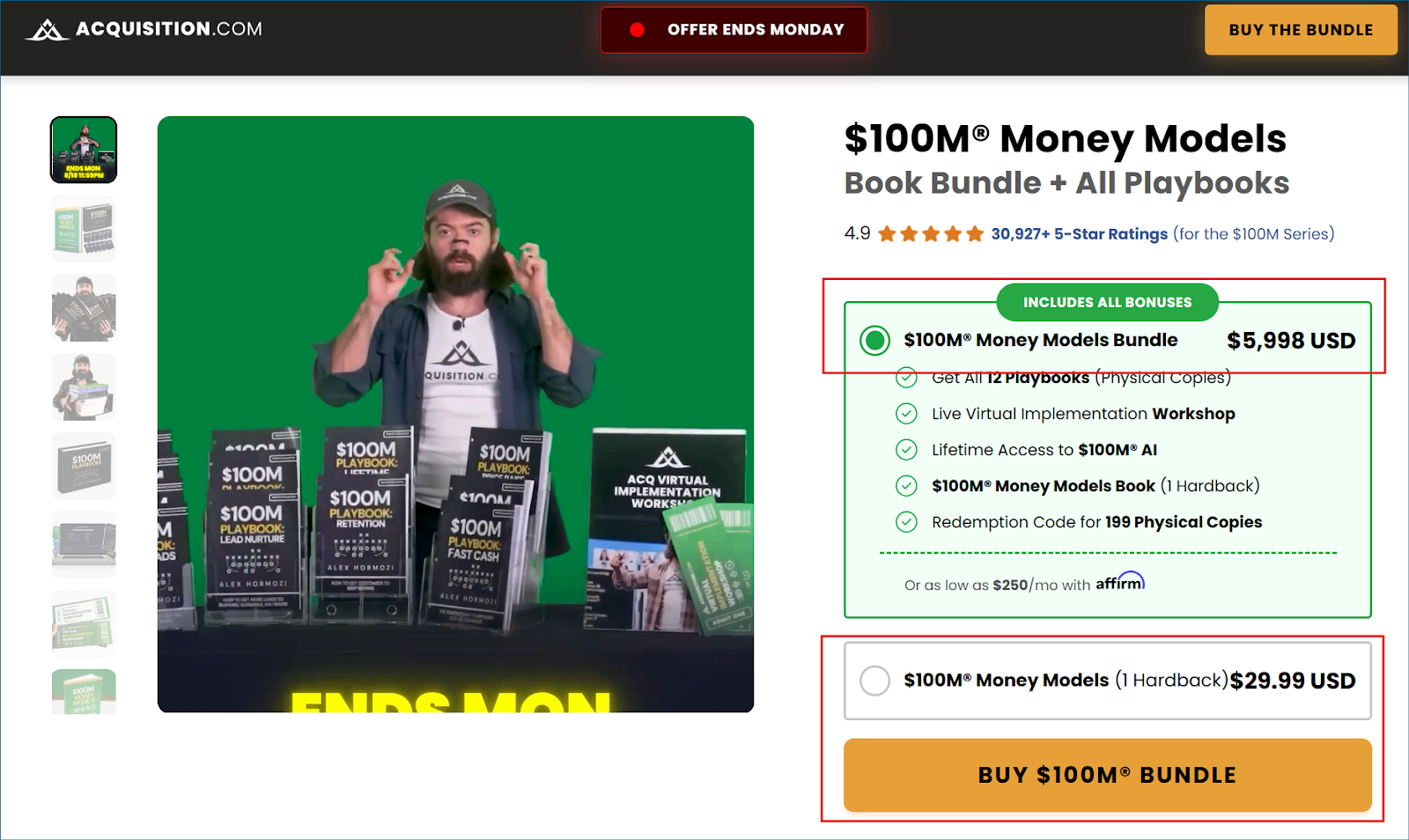
Hormozi’s approach hinges on reframing the sale: Don’t peddle a book; deliver an ecosystem of outcomes that address the buyer’s deepest needs, such as scalable cash flow for entrepreneurs.
In his July 2, 2025, announcement video, which has been viewed over 302,000 times, he hinted at the book’s focus on “getting more customers to spend more money, in less time, over and over again,” but the real hook was the promise of four “amazing free bonuses” for VIP upgraders who pre-ordered a single copy.
This stacking ethic—layering complementary assets like courses, templates, communities, and tools—ethically inflates value without deception, as each element ties directly to the book’s themes of business longevity and profitability.
Authors can adapt this by brainstorming bonuses that extend their expertise:
- For a self-help writer, offer downloadable worksheets or a private webinar;
- For a novelist, include character backstories or a reader community forum.
The key is alignment—bonuses must solve adjacent problems, boosting conversion rates when perceived as “must-haves.”
Ethical stacking requires transparency: Disclose values carefully (for example, Hormozi estimated his at $35,000–$200,000 based on previous consulting fees) and make sure deliverables are realistic, avoiding overpromising that could damage trust.
For authors without Hormozi’s scale, creating tiers remains accessible—starting with digital assets that require no large audience or team:
- Pricing Tiers
- Base book: $15–$30
- Mid-tier bundle: $50, including digital add-ons like e-templates or audio extras
- Premium tier: $100+, offering personalized coaching calls or community access (e.g., via Discord)
- Tools & Platforms
- Gumroad or Teachable makes setup simple and manageable.
- Case studies from indie authors show 2x–5x revenue uplifts through bundling.
- Value Stacking 101
- Quantify each bonus’s worth (e.g., “a $97 course for free”).
- Ensure the total perceived value is 5–10x higher than the price, a principle championed by pricing strategist Ramit Sethi.
Underpinning it all is pricing psychology, where Hormozi anchored high to make mid-tiers irresistible. By contrasting bundles against $135,000 consulting fees, a $6,000 package felt like a steal—classic anchoring bias, where initial high numbers skew perception, boosting conversions by 20–30%, according to behavioral economics research from Dan Ariely.
Authors can employ similar tactics:
- Anchor against comparable high-value services (e.g., “worth a $500 seminar”),
- Offer flexible payments via Stripe and
- Limit availability to drive FOMO.
Hormozi’s $81 million haul validates this: In a saturated market, the irresistible offer isn’t about the book—it’s about the empire it unlocks.
4. How To Launch and Promote Your Book Without Sounding Overly Salesy
The climax of any book launch—the event itself—often determines whether a title fades into obscurity or surges to bestseller status, yet many authors approach it as a mere reading or Q&A, missing the opportunity to create an immersive experience that subtly drives conversions.
The key lies in a counterintuitive strategy: selling without overt pressure, by prioritizing education and value delivery that builds trust and reciprocity.
This “teach-to-sell” model, popularized in digital marketing circles, leverages psychological principles like the rule of reciprocity—where free insights compel recipients to reciprocate with purchases—resulting in higher close rates without the hard sell.
Webinar analytics shows that events blending 70% content with 30% offers achieve 40% better retention and 25% more upsells than pitch-heavy formats.
Alex Hormozi mastered this during his August 16, 2025, launch of $100M Money Models, hosting a marathon YouTube live stream that blended exhaustive teaching with seamless pitches, attracting over 100,000 viewers and generating $81 million in revenue while shattering the Guinness World Record for nonfiction book sales in 24 hours at 2.9 million copies.
His method, executed across two extended sessions (a primary 7- to 10-hour stream and a 6-hour encore), emphasized “selling without selling” by front-loading value, interspersing testimonials, and framing buys as altruistic donations, turning the event into a movement rather than a transaction.
Hormozi’s live launch strategy was a masterclass in endurance and engagement, eschewing short webinars for extended formats that allowed deep immersion, mirroring the intensive workshops he charges $35,000 for privately.
The main event, starting at 9 a.m. PT on August 16, spanned approximately 7 to 10 hours on YouTube—no Zoom required—drawing from a pre-registered list of over 250,000 via his acquisition.com funnel.
He structured it as a hybrid of seminar and infotainment, kicking off with high-energy teasers and festivities to hook viewers, then diving into the book’s core content: a four-part framework for building resilient money models that ensure cash flow by acquiring more customers who spend more, faster, repeatedly.
With over 1,500 slides guiding the presentation, Hormozi taught breakdowns of leads, conversions, lifetime value (LTV), and retention strategies, using real-world examples from his $200 million annual portfolio at Acquisition.com.
Interspersed were Q&A sessions via live chat, case studies—like 19-year-old Ava’s journey from zero to $48,000 monthly revenue—and guest appearances from successful entrepreneurs sharing how they applied his models, illustrating the book’s principles in action.
Breaks were built in to combat fatigue, maintaining viewer retention at peak levels, with real-time demos of tools like his custom AI advisor, trained on $31 million in consulting data from 1,026 businesses.
This format not only educated but positioned the book as indispensable, with Hormozi emphasizing, “A good money model gets you more customers, to spend more money, in less time, over and over again,” tying every segment back to the thesis.
What elevated the event was Hormozi’s ability to sell subtly, teaching first and pitching second, a tactic that fostered genuine buy-in.
Visual aids, such as physical playbooks and binders, were used to make value more tangible, while the AI advisor was demonstrated in real-time, answering questions based on his proprietary data.
For authors replicating this—even solo on Zoom or YouTube—the blueprint is clear:
- Host a 1- to 3-hour virtual event (scalable from Hormozi’s epic length), outlining your book’s core ideas as actionable sessions.
- Use free tools like StreamYard for overlays, Canva for slides, and live chat for interaction, ensuring 60-70% of the time is pure teaching to build authority before any ask.
Urgency and scarcity were woven masterfully, converting education into action without aggression. Pitches used donation framing—buy 200 books for $5,998, keep one, “donate” 199 to entrepreneurs—making purchases feel philanthropic while qualifying for bonuses worth $135,000+.
Real-time updates built FOMO: “Page goes down when stream ends,” with limited playbooks and expiring bonuses like six virtual intensives over six months, led by Hormozi, Leila, and Sharran Srivatsaa on marketing, sales, and wealth. Chat hype, leaderboards for affiliates (12,600 from prior launches), and live feedback loops amplified momentum, with phrases like “Decline this one-time offer forever” reinforcing scarcity.
Authors can adapt by setting time-bound offers (e.g., “Bonuses expire in 48 hours”), using chat polls for engagement, and displaying counters to create viral urgency, even in smaller events.
Hormozi’s encore stream on August 17, lasting about 6 hours in the afternoon, reinforced the formula for stragglers, recapping teachings, pitching bonuses, and extending the 24-hour record window via global time zones.
This two-pronged approach maximized reach, proving that launches thrive on persistence.
For indie authors, an encore webinar the next day can capture missed traffic, using recordings to sustain momentum.
How To Market a Book: Lessons From the $81M Playbook (Even if You’re Not Hormozi)

Alex Hormozi’s orchestration of the $100M Money Models launch on August 16, 2025, wasn’t just a commercial triumph—it was a masterclass in entrepreneurial alchemy, converting years of free content into $81 million in revenue from over 2.9 million book sales within 24 hours, all while shattering the Guinness World Record for nonfiction titles.
This feat, achieved with zero advertising spend and a pre-built audience of 9 million followers, underscores a pivotal truth in publishing: scale isn’t reserved for titans with vast resources; it’s replicable for independent authors willing to adapt core principles to their level.
For anyone wondering how to market a book effectively, Hormozi’s playbook offers a blueprint that goes beyond hype to proven strategy.
Industry data reinforces this—self-published books now command 50% of the e-book market, per a 2025 Bowker report, yet success hinges on strategic execution rather than sheer size, with top indie earners averaging $100,000 annually by focusing on high-value offers and engaged niches, according to a Reedsy survey of 2,000 authors.
Hormozi’s approach, distilled from his journey scaling Acquisition.com to $200 million in annual revenue, delivers timeless lessons that democratize blockbuster launches.
By emphasizing value over volume, leveraging accessible tools, and hacking creativity with AI, even solo creators can engineer launches that punch above their weight, turning modest followings into sustainable income streams.
The first scalable lesson is prioritizing value over sheer volume, a shift that empowers indie authors to compete without Hormozi’s multimillion-follower base. At its core, his campaign succeeded by stacking “insane” bonuses—such as AI advisors and exclusive workshops valued at $135,000—onto book bundles, making each purchase feel like an investment in transformation rather than a transaction.
This value-first mindset, where the book serves as a low-entry gateway to deeper outcomes like business scaling frameworks, mirrors tactics used by successful indies like James Clear, whose Atomic Habits sold 20 million copies by bundling free habit trackers and newsletters that extended the book’s utility.
For smaller authors, this means focusing on quality deliverables over quantity: Instead of chasing viral hits, create bonuses like downloadable templates or mini-courses that directly solve reader pain points, such as plot outlining tools for fiction writers or SEO guides for nonfiction.
A 2025 study by the Alliance of Independent Authors (ALLi) found that indies incorporating value stacks see 2.5 times higher conversion rates, with 62% reporting sustained sales from repeat buyers drawn to the ecosystem rather than the book alone.
Hormozi’s donation framing—buyers “gifting” extra copies to entrepreneurs—added an altruistic layer, boosting perceived impact; indies can adapt this by encouraging bulk buys for book clubs or charities, fostering community and word-of-mouth without massive audiences.
Crucially, Hormozi’s success proves you don’t need millions of followers—just a focused, engaged audience cultivated through consistent, niche-specific content. His 4 million Instagram and 3.55 million YouTube subscribers were built over years with “nothing to sell” videos on business models, yielding organic reach that drove 100,000 live viewers to his stream.
For indies, this translates to targeting micro-niches: A romance author might nurture 5,000 email subscribers via Wattpad serials, while a tech writer builds 2,000 on Substack with code tutorials.
The key is depth over breadth—Hormozi’s followers felt part of a “movement,” as evidenced by 286,000 impressions on pre-launch posts; indies achieve this by hosting free webinars or AMAs, converting lurkers into advocates and amplifying reach organically.
To execute these lessons, indie authors can harness affordable tools and tech that mirror Hormozi’s infrastructure, democratizing high-impact launches without enterprise budgets.
Email platforms form the backbone: Hormozi used his list for reminders and upsells, but indies thrive with free tiers of Mailchimp (up to 500 subscribers) or ConvertKit (up to 1,000), which automate sequences like teaser drips and bonus deliveries, boosting open rates to 35-45% with segmentation features.
Community tools extend engagement—Hormozi’s exclusive Skool group for high-ticket buyers fostered networking; alternatives like Circle ($49/month) or free Discord servers enable indie authors to create VIP spaces for Q&A and beta reads, with ALLi reporting 40% higher retention among community-engaged readers.
For live events, YouTube Live (free) replicates his streams, while StreamYard ($20/month) adds professional overlays. Payment processors like Gumroad or Stripe handle bundles seamlessly, with no upfront costs beyond transaction fees.
Hormozi-style AI hacks further level the playing field, giving indie authors pro-level leverage without huge teams or budgets:
- Content & Reader Engagement
- Use ChatGPT (free tier) for FAQs:
- Prompt: “Generate 10 reader questions and answers based on my book summary.”
- Benefits: Streamlines customer support and creates content for blogs, socials, or newsletters.
- Use ChatGPT (free tier) for FAQs:
- Video & Script Creation
- Tools like Jasper or Grok AI (~$20/month) can draft launch teasers.
- Prompt: “Write a 60-second script teasing chapter insights on [topic].”
- Impact: Indie authors report 50% faster content creation (2025 Kindlepreneur survey).
- Tools like Jasper or Grok AI (~$20/month) can draft launch teasers.
- Bonus & Value Stack Creation
- Midjourney or DALL·E (~$10/month) for custom visuals.
- Sudowrite for generating worksheets, guides, or prompts.
- Enables add-ons like AI-edited companion guides to enhance bundles.
- Community & Automation
- Hormozi demoed AI’s real-time utility during his launch stream.
- Indies can replicate with Zapier integrations, embedding bots into Discord/Slack to:
- Automate responses.
- Maintain engagement.
- Foster loyalty.
- Best Practices
- Always disclose AI use and human-edit outputs for quality.
- Case study: Hugh Howey, who leveraged similar tech to self-publish Wool into a multimillion-dollar series.
The key lesson from Hormozi’s $81 million playbook is to promote as if your book is a $100 million business, even if it’s your first—ambition and offer design, not audience size, determine results.
By framing launches as movements, stacking value, and leveraging tools, indies can achieve outsized results:
A focused 1,000-person list with a compelling bundle can yield $10,000-$20,000, per PublishDrive data, scaling to six figures with iteration.
Hormozi’s record-breaking event, with its encore stream and post-launch momentum, reminds us that publishing success is engineered, not accidental. The difference lies in viewing your work not as a hobby but a high-stakes enterprise, where bold offers and relentless value delivery turn modest beginnings into enduring empires. For the wider picture, see our guide to marketing an online business. To see how we handle this for clients, read about consumer marketing with Strategic Pete.
FAQ: How To Market a Book
When should you start marketing a book?
Start marketing before the book launches. The earlier you build an audience, email list, and content around the book’s topic, the easier it is to generate pre-orders and reviews.
What is the best way to market a self-published book?
The best approach is usually a mix of email marketing, content marketing, partnerships, launch week promotion, and ongoing audience-building on one or two core channels.
Do you need a big audience to market a book successfully?
No. A smaller but relevant audience can outperform a large general audience if the readers are closely matched to the book’s topic or genre.
How do you promote a book after launch?
Keep promoting it through podcasts, guest posts, social proof, reviews, reader communities, paid retargeting, and content that reintroduces the book to new readers over time.”
Measure your launch like a business
Download the free scorecard template to track the metrics that drive real growth and keep your team accountable.


